

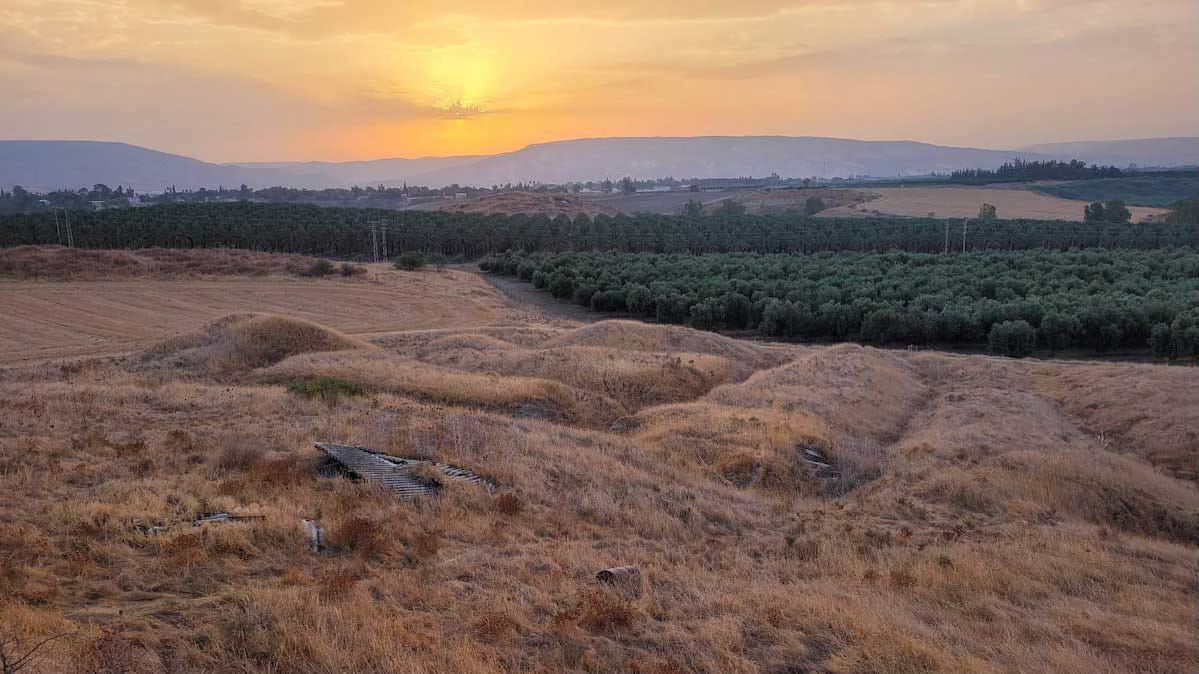
‘Ubeidiya is a prehistoric archaeological site in the Jordan valley near the southern end of the Sea of Galilee. The site preserves some of the oldest hominin fossils and archaeological finds in Eurasia, from a sequence of lakeshore and delta deposits where a stream once emptied into a great freshwater lake. Hominins lived along the lakeshore, making their tools from basalt, flint, and limestone from nearby hills and streambeds.
I visited the site around a decade ago. It was only a brief stop, just a quick pull off the road to see the rounded layout of the trenches dug years earlier.
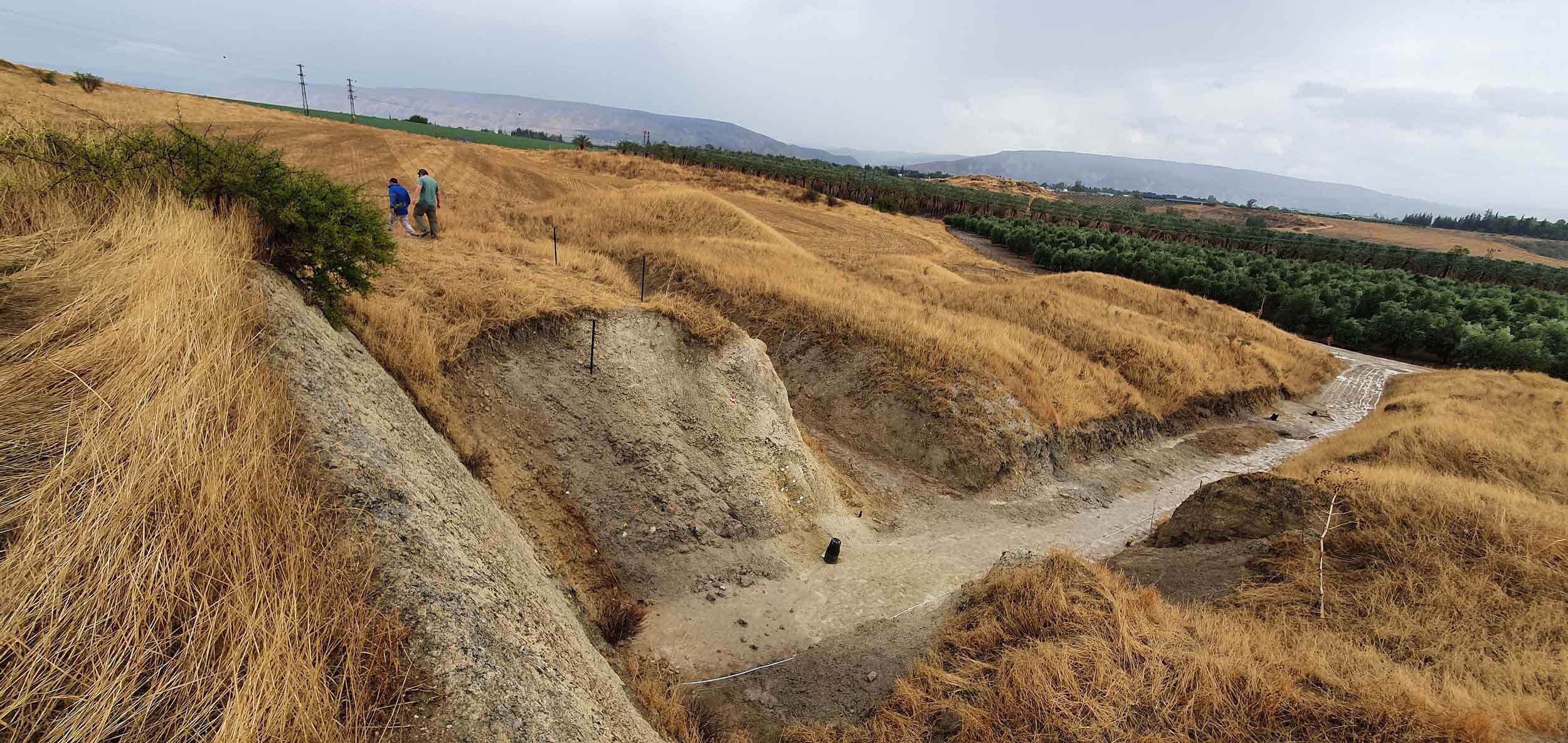
‘Ubeidiya makes an impression. Few archaeological sites have undergone such geological contortions. Its sediments may have formed in even, flat layers, but in a million-plus years the falling center of the Jordan Rift upended them, so that some tilt upwards almost vertically. You wouldn’t guess it from the gently rolling valley around.
Since the 1980s, most archaeologists have accepted that the ‘Ubeidiya site is between around 1.6 million and 1.2 million years old. But recent excavations begun in 2021 by Omry Barzilai and Miriam Belmaker have led to a re-evaluation of the site’s geological age. Their work, described in a paper published this year by Ari Matmon, suggests that the hominin fossils and artifacts from ‘Ubeidiya are around a half million years older, around 1.9 million years.
That makes the site’s large bifacial tools once again comparable in age to the oldest Acheulean in Africa. It also may put the site’s few hominin remains—among the earliest known in Eurasia—in a new light.
Years of discovery
The discovery of the ‘Ubeidiya Paleolithic site was in a field meant for tomatoes. Izy Merimsky, who was a member of Kibbutz Afikim nearby, was plowing the field when he saw stone tools and fossilized bones. He sent some of the finds to Hebrew University in Jerusalem, where the archaeologist Moshe Stekelis and paleontologist Georg Haas recognized their possible importance and made plans to excavate. Teaming with the geologist Leo Picard, they began work in 1960.
Omry Barzilai and coworkers last year published a remembrance of Merimsky’s contributions to the work after his death in 2025. Discovering the site spurred his interest in the prehistoric record. He regularly visited the ‘Ubeidiya excavations to assist the archaeologists, learning from their work. Merimsky dedicated himself to educating people about archaeology, biology, and other sciences. He gathered a collection of animal fossils and artifacts that helped in this educational work.
The Paleolithic site is a few hundred meters from a Biblical-era archaeological site known as Tell ‘Ubeidiya. A high mound directly on the bank of the Jordan River, it stands above the surrounding valley. The sites sit just two miles south of the outlet of the Sea of Galilee.
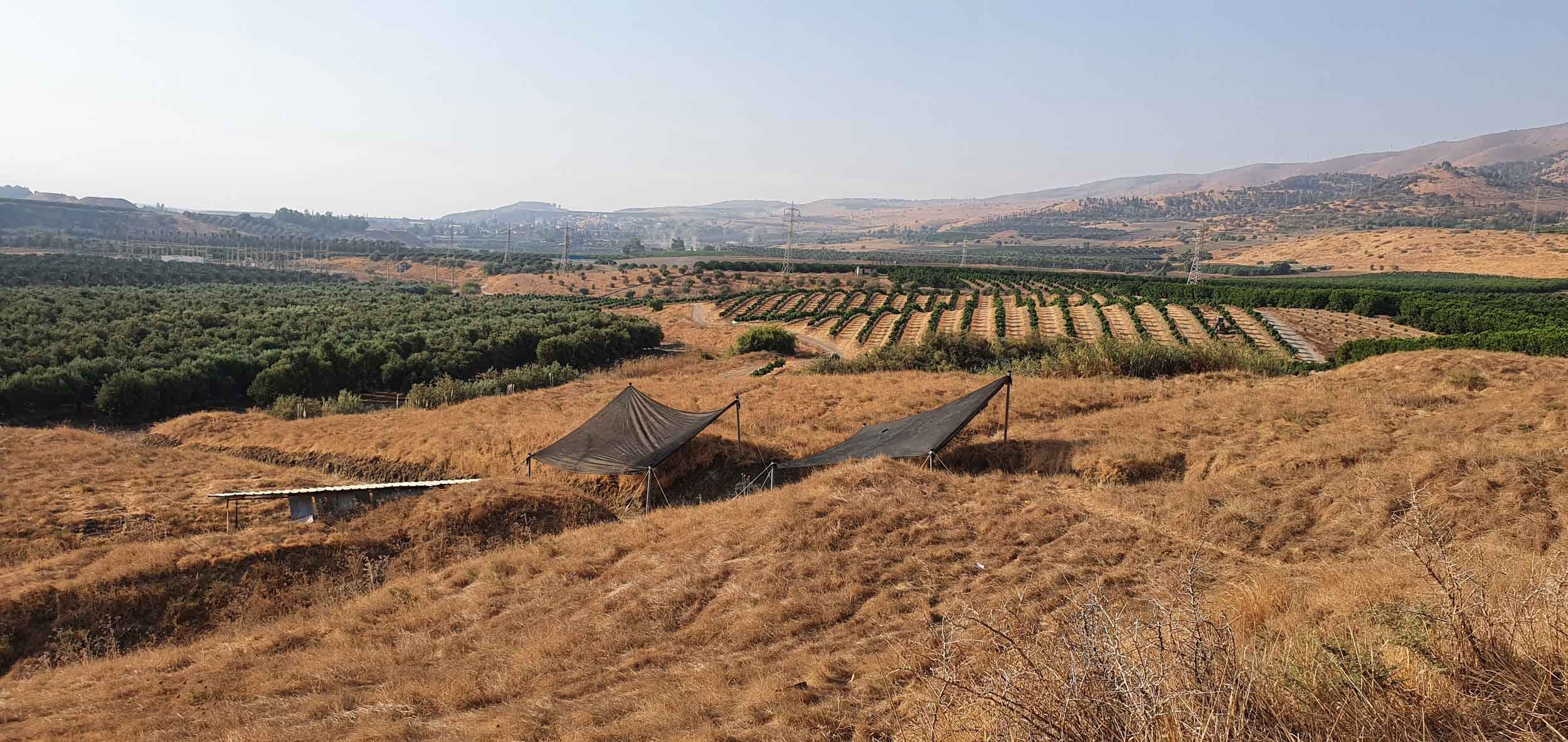
Stekelis set out to understand the age of the site and how it formed. When his crew began work in 1960, they had to bring in heavy equipment to open deep trenches, following the ancient layers downward at their naturally steep angles. Stekelis died in 1967, and his former students Ofer Bar-Yosef and Eitan Tchernov continued the ‘Ubeidiya work. Over time they exposed more than 60 layers with ancient bones and stone artifacts. Some artifact-bearing layers they initially understood as “living floors” analogous to Mary Leakey’s finds at Olduvai Gorge.
Hominin remains and artifacts
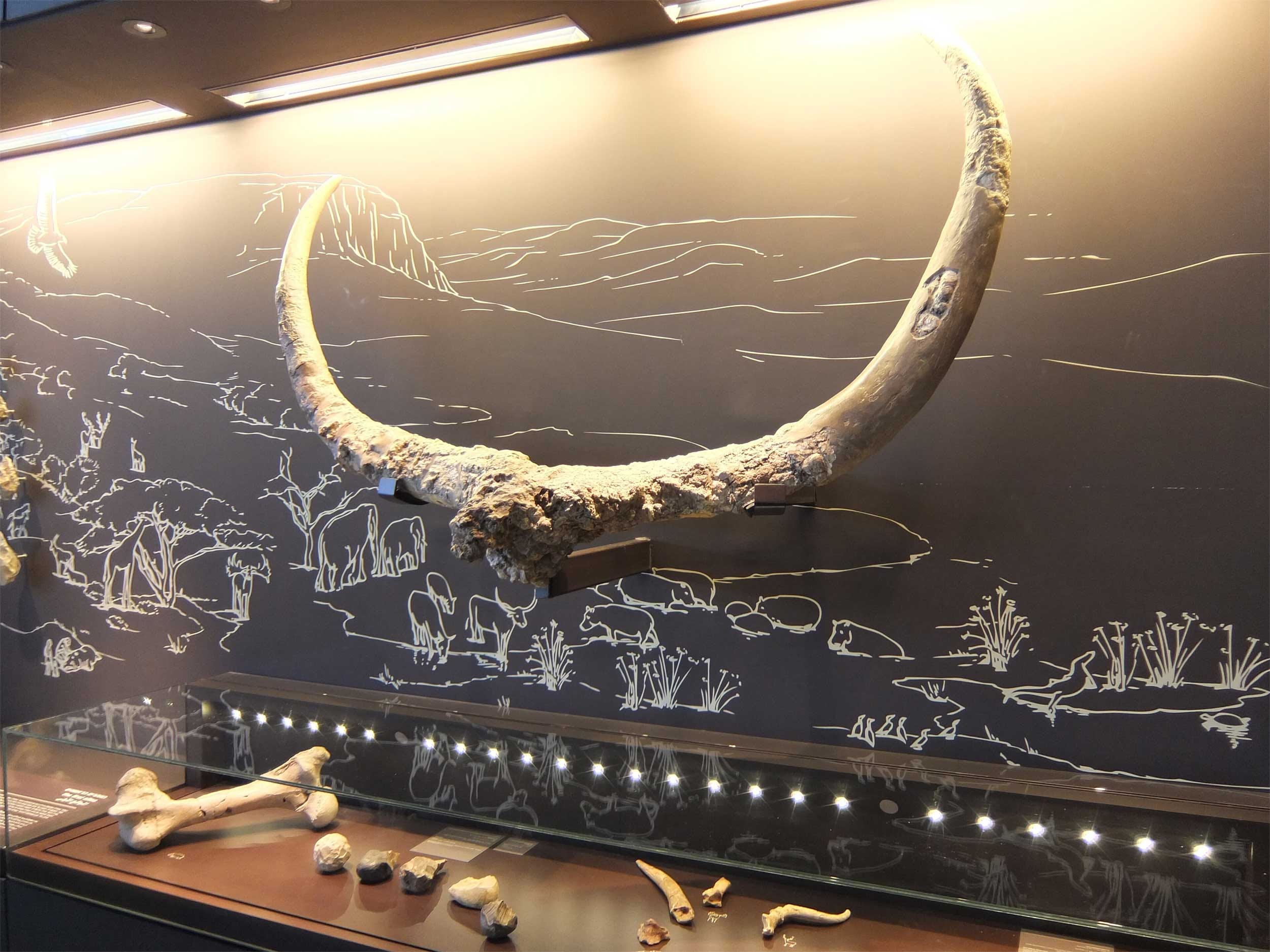
Over the years more than 150,000 stone artifacts have been excavated from ‘Ubeidiya. Bar-Yosef worked with Naama Goren-Inbar to describe the stone tools in a 1993 report. Similarities with Olduvai Gorge again surfaced in their description of the ‘Ubeidiya artifacts. With many handaxes and other large bifaces made simply from basalt, the site had many parallels with early African Acheulean sites. At the same time there were many flake tools, these often made from flint or limestone, evidence for a degree of selectivity and planning of raw material use that archaeologists had begun to recognize in these early stone traditions. Later work led by Gadi Herzlinger has explored the ways that the ‘Ubeidiya bifaces reflect the knappers’ planning of their shapes.
Despite the abundance of artifacts, the fossil bones of animals at ‘Ubeidiya show few traces of hominin butchery. Only a small proportion have cutmarks, and hardly any were broken by percussion for marrow consumption. Miriam Belmaker and Bar-Yosef noted that many bones show evidence that carnivores ate the animals, raising the possibility that hominin activity here often focused on scavenging pieces from carnivore kills. Another possibility is that the hominin activity here wasn’t especially focused on meat. Processing plant foods or making other artifacts from wood may have been more important in this area.
‘Ubeidiya is not predominantly a hominin fossil-bearing site. To date, only two have been recovered in controlled excavations there.
Still, there was excitement early in the site’s history. Initial clearing of the field by bulldozer turned up many fossils, and as these were examined in the laboratory some fragments of hominin parietal bone and two teeth were recognized. Recognizing the archaeological similarities of ‘Ubeidiya with Olduvai Gorge, Stekelis invited Phillip Tobias to examine these fossils. Tobias had embarked on a long description of the Homo habilis and Zinjanthropus boisei fossils from Olduvai, and was grateful to study the ‘Ubeidiya hominins.
These fossils posed a conundrum. A lower incisor, an upper third molar, and pieces of parietal bone are among the least informative parts to find if the aim is identifying what species of hominin fossils represent. Tobias showed that they were all different from Australopithecus, but also that they seemed as consistent with samples of modern humans as with Homo erectus or other fossil Homo.
Theya Molleson and Kenneth Oakley of the Natural History Museum in London had already done chemical testing of ‘Ubeidiya animal fossil bones, and Stekelis gave permission for them to sample the hominin material also. The fluorine content of the hominin remains turned out to be different from animal bones from the Early Pleistocene layers, suggesting they were younger. How much younger no one can say. While fluorine testing is famous in the history of archaeological work, today the method is no longer seen as a sure test of the antiquity of bones. Even so, these pieces lack the context that would place them into a specific time.
Even as this was unfolding, another hominin incisor was excavated from the site in context with other Early Pleistocene fossils. But this tooth was only recognized more than thirty years later, when Miriam Belmaker was working with unidentified fossils and picked it out. This tooth, UB 335, is strongly worn and in the size range of most species of Homo.
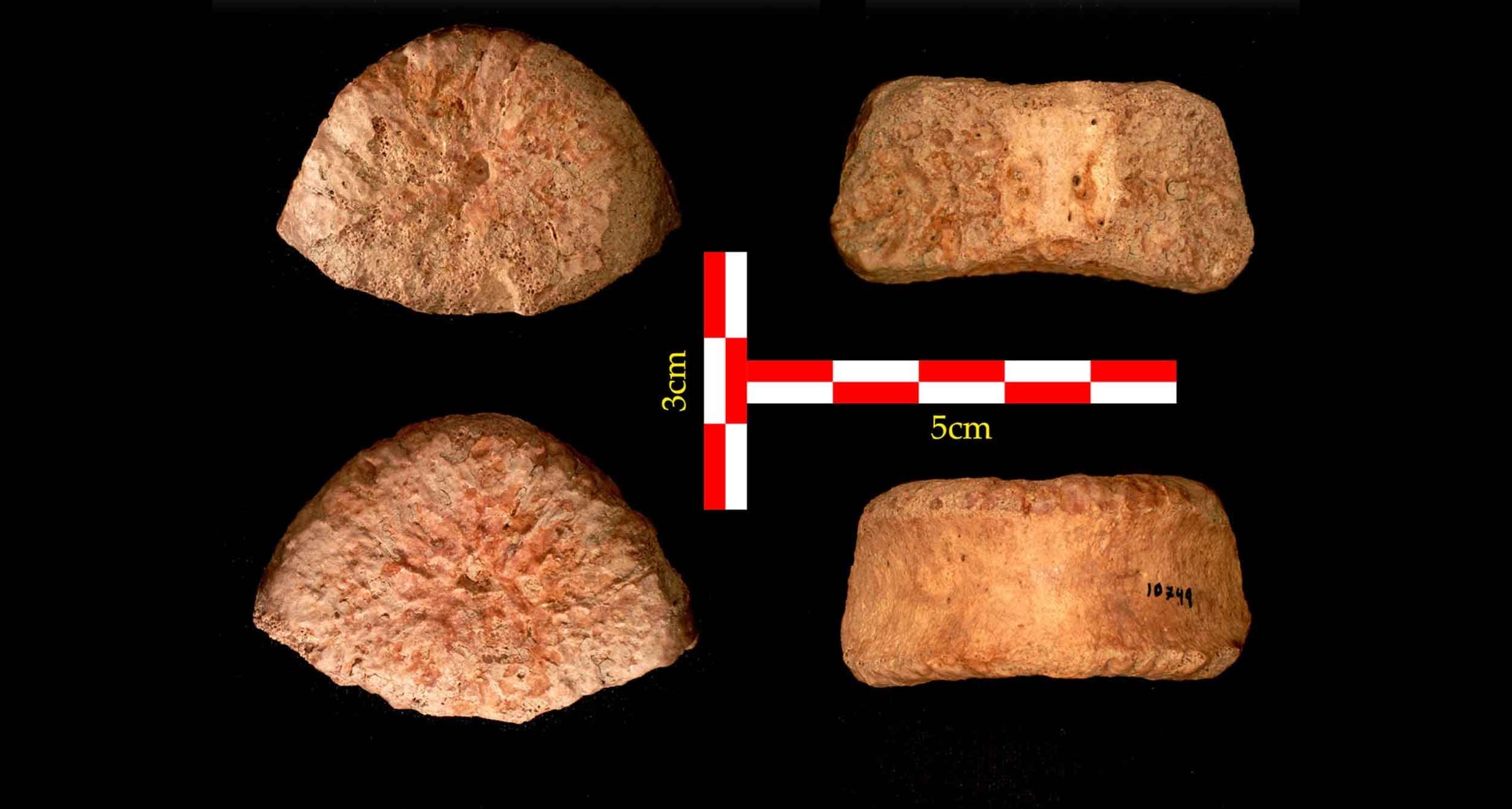
Alon Barash and collaborators in a 2022 study described a hominin vertebra from the site, UB 10749. This unfused vertebral body comes from a juvenile individual and Barash and coworkers show that its size and relative height are unlike Australopithecus, making this consistent with a larger-bodied species of Homo. Comparing this vertebra with the smaller body sizes of hominins from Dmanisi, Republic of Georgia, they speculated that the first emergence of hominins from Africa may have included multiple hominin species with different body sizes.
Personally, I agree these are reasonable interpretations of the fossils, but there are other possibilities. We know that there were larger-bodied individuals of Paranthropus, for example, but we know little about how their vertebral morphology may differ from the small ones. The lower incisor is an enigma, since several species of hominins hardly differ from each other. ‘Ubeidiya may someday tell us more, but so far it’s only the presence of hominins and not much about their diversity or relationships.
A new date
Until recently, the age of the ‘Ubeidiya site relied almost entirely on the comparisons of fossil animals from the site with other sites in Europe and in Africa. Picard’s work established the relation between ‘Ubeidiya and the earlier Erq el-Ahmar Formation exposed nearby, which has lakeshore deposits dating to a Late Pliocene age. Haas, and later Tchernov, recognized some key species in the ‘Ubeidiya fauna that suggested connections with European sites in the range between 1.6 million and 1.0 million years ago. The reversed paleomagnetic orientation of the layers is consistent with that time range.
But to triangulate the geological age of a site from animal fossils requires a clear understanding of the ages of other sites where the same animals lived. Over the years, better dates for some of the European sites of the period have emerged. For ‘Ubeidiya, one of the most relevant is the site of Blassac-La Girondie, France, which has a similar set of animals and is now dated to around 1.95 million years ago.
The renewed work on the age of the site by Ari Matmon and coworkers brings to bear several geochemical techniques. They looked at the decay of uranium to lead in mollusc shells, which provides a minimum age of 1.1 million years for the site’s formation. Shells and other organic materials can absorb uranium from groundwater at any time after their burial, and age estimates from this method relate to the uptake of the uranium, not the death of the organism.
At the higher end, they looked at cosmogenic isotopes in samples of ‘Ubeidiya sediment, focusing on small pieces of chert that formed within Eocene limestone and chalk marine sediments, and were much later eroded from these rocks and carried by the ancient Yarmuk River into the Jordan valley, then buried at ‘Ubeidiya.
These chert fragments allow an estimation of a site’s age because of their burial history. The Earth’s atmosphere is bombarded constantly by high-energy particles from space. When these particles strike atoms, they cause showers of neutrons and muons that can interact with rock and other material. These are nearly all absorbed within a few meters of the surface, so they have little effect on buried rock. Quartz crystals, including those within chert, are composed of silicon and oxygen and are highly durable. At the surface, the high-energy neutrons and muons strike a tiny fraction of silicon atoms, generating the radioactive isotope aluminum-26, and a tiny fraction of oxygen atoms, generating the radioactive beryllium-10. When a quartz crystal is buried, the production of these radioactive isotopes ends, and the aluminum-26 decays faster than the beryllium-10. So the ratio of these radioactive isotopes can estimate the time of burial: lower aluminum-26 means older burial.
Matmon and coworkers got an estimate of around 3 million years for the ‘Ubeidiya chert samples. Every other aspect of the site suggests that is far too old.
So they set out to understand why the chert has an anomalously low ratio of aluminum-26 to beryllium-10. They concluded that many of the chert fragments did not reach ‘Ubeidiya directly, but instead were recycled from earlier sedimentary deposits including the Erq el-Ahmar Formation. These earlier exposures and burials built up a longer-term signature of cosmogenic isotopes in the samples. The burial history, in other words, was complex.
Complex burial histories can be a challenge for cosmogenic dating at many sites, including cave sites in South Africa where I work. In the case of ‘Ubeidiya, Matmon and collaborators were able to develop a model for the burial and recycling of chert that helped bring down the estimated age from this method. But even considering the recycling, they found that the ratio of the two isotopes is hard to reconcile with a burial at ‘Ubeidiya after around 1.9 million years ago. Ages any older than 2 million years are very hard to reconcile with the faunal evidence. So they concluded that an age closer to around 1.9 million years is the best compromise among the different lines of evidence.
Should we believe it? I’ve had a lot of conversations with specialists in different areas of paleontology about cosmogenic dating. Some experts on fossils just don’t believe cosmogenic ages unless they are confirmed with argon-argon or other methods—unlikely at most sites since they apply to different materials generated in different ways. There are sites where different kinds of dating align well and these are uncontroversial. It’s the sites where they seem to conflict with each other that generate, well, conflict.
In the case of ‘Ubeidiya there is very little evidence pointing specifically to a lower age. Putting large bifaces at 1.9 million years here is more or less consistent with the earliest Acheulean in Ethiopia and the East African Rift Valley. That’s fundamentally the same relative situation as the 1980s, just with both regions transferred a half million years earlier in time.
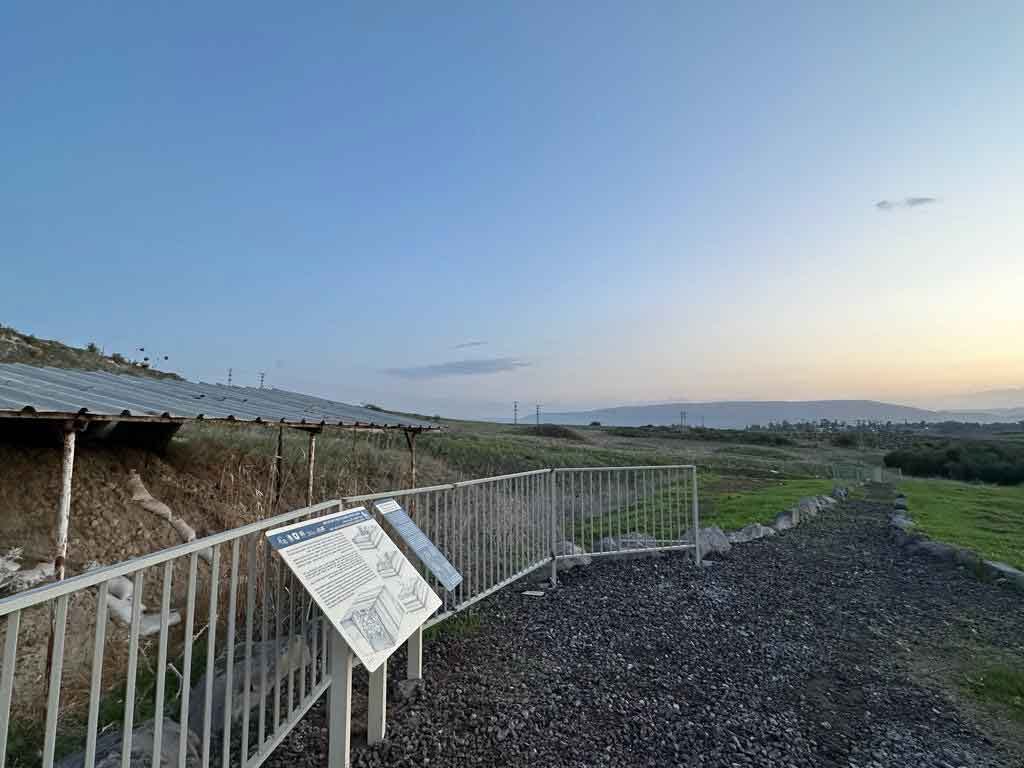
In 2022, ‘Ubeidiya was designated as a National Park by the Israel Nature and Parks Authority. New signage at the site and development of paved access roads and walkways have made it much more accessible to tourists. The plan includes interpretive signs that explain the geological layers and the types of fossil animals found at the site.
‘Ubeidiya is far from the oldest archaeological site in Eurasia. Earlier artifacts come from Shangchen, China, from the Dawqara Formation in Jordan, and cutmarked bone from Grăunceanu, Romania. Other sites in China, Pakistan, and India may reinforce the occurrence of hominins at or before 2 million years ago, although skeptics of early dates have been vocal in many cases. Still, none of these sites have the same breadth of evidence as ‘Ubeidiya. It remains a keystone in understanding the dispersal of hominins from Africa.
References
Bar-Yosef, O., & Belmaker, M. (2017). ‘Ubeidiya. In Y. Enzel & O. Bar-Yosef (Eds.), Quaternary of the Levant: Environments, Climate Change, and Humans (pp. 179–186). Cambridge University Press.
Barash, A., Belmaker, M., Bastir, M., Soudack, M., O’Brien, H. D., Woodward, H., Prendergast, A., Barzilai, O., & Been, E. (2022). The earliest Pleistocene record of a large-bodied hominin from the Levant supports two out-of-Africa dispersal events. Scientific Reports, 12(1), 1721. https://doi.org/10.1038/s41598-022-05712-y
Barzilai, O., Sharon, G., Gubenko, N., & Belmaker, M. (2025). Izy Merimsky and his collection from the site of ‘Ubeidiya. Mitekufat Haeven – Journal of the Israel Prehistoric Society, 55, 259–266.
Belmaker, M., Tchernov, E., Condemi, S., & Bar-Yosef, O. (2002). New evidence for hominid presence in the Lower Pleistocene of the Southern Levant. Journal of Human Evolution, 43(1), 43–56. https://doi.org/10.1006/jhev.2002.0556
Herzlinger, G., Brenet, M., Varanda, A., Deschamps, M., & Goren-Inbar, N. (2021). Revisiting the Acheulian Large Cutting Tools of ‘Ubeidiya, Israel. Journal of Paleolithic Archaeology, 4(4), 31. https://doi.org/10.1007/s41982-021-00108-2
Matmon, A., Kuzmenko, A., Shaar, R., Nuriel, P., Hidy, A., Guillong, M., Blevis, R., Wieler, N., Vainer, S., Asscher, Y., Belmaker, M., & Barzilai, O. (2026). Complex exposure-burial history and Pleistocene sediment recycling in the dead sea rift with implications for the age of the Acheulean site of ‘Ubeidiya. Quaternary Science Reviews, 378, 109871. https://doi.org/10.1016/j.quascirev.2026.109871
Molleson, T. I., & Oakley, K. P. (1966). Relative Antiquity of the Ubeidiya Hominid. Nature, 209(5029), 1268–1268. https://doi.org/10.1038/2091268a0
Muller, A., Barsky, D., Sala-Ramos, R., Sharon, G., Titton, S., Vergès, J.-M., & Grosman, L. (2023). The limestone spheroids of ‘Ubeidiya: Intentional imposition of symmetric geometry by early hominins? Royal Society Open Science, 10(9), 230671. https://doi.org/10.1098/rsos.230671
Tobias, P. V. (1966). Fossil Hominid Remains from Ubeidiya, Israel. Nature, 211(5045), 130–133. https://doi.org/10.1038/211130a0