

A new preprint from the geneticist David Reich focuses on the interactions of Neanderthal and African ancestral humans some 250,000 years ago. The research connects with several ideas about Neanderthal DNA that I’ve discussed here and elsewhere, including the matrilineal population dynamics I outlined recently. Reich adds a hypothesis that hasn’t been discussed much by geneticists: Maybe the range expansion that delivered African genes also brought cultural innovations to early Neanderthals.
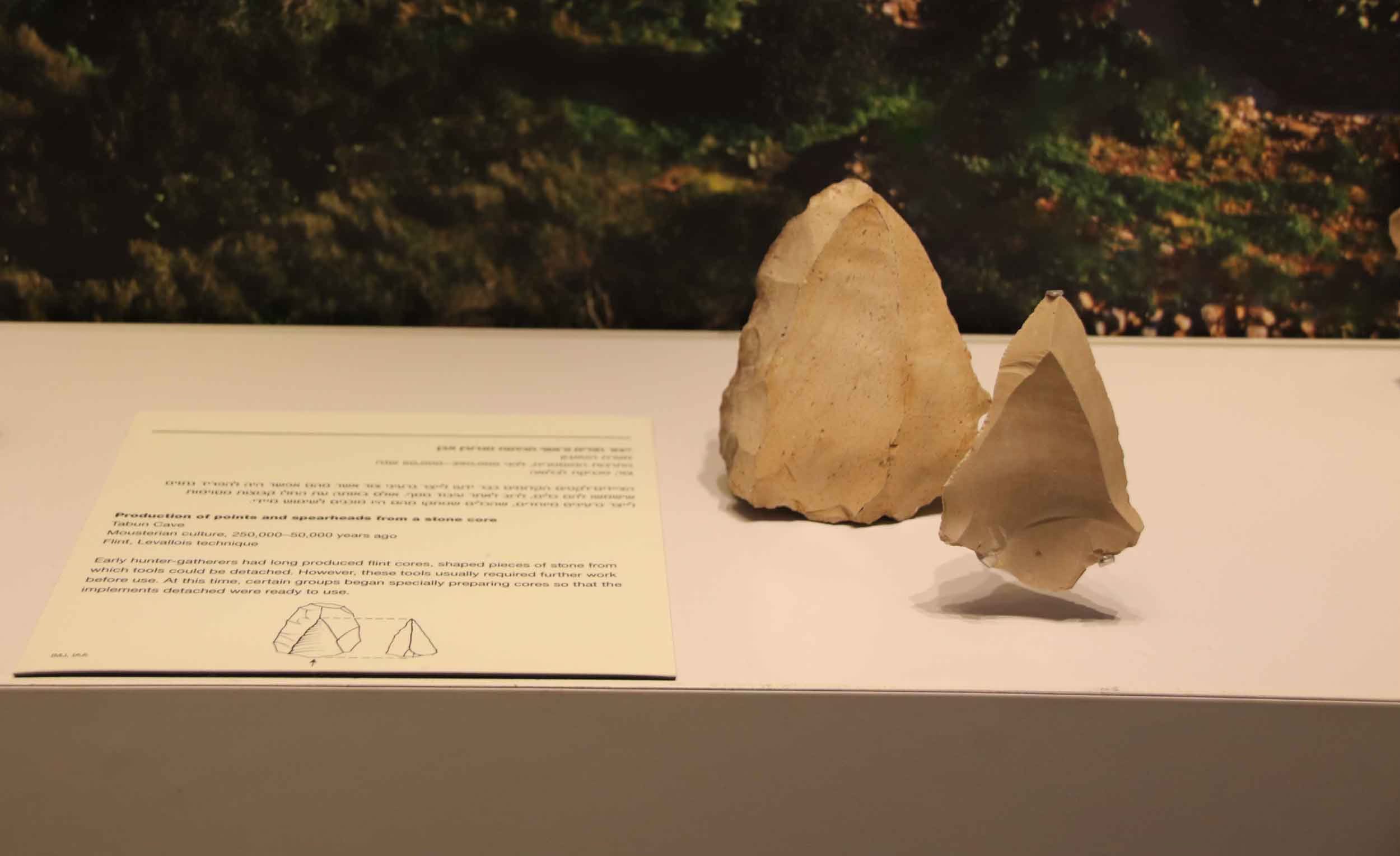
Archaeologists have long noted technical commonalities between stone tool industries associated with Neanderthals and Middle Stone Age (MSA) tools made around the same time in Africa. Reich discusses the Levallois flaking strategies that underlay Mousterian toolkits, greater use of fire, and improved hafting technology. I would add the use of ochre and other pigments, greater resharpening and recycling of artifacts, and more organized structuring of campsites. Could such similarities in material culture have followed one or more waves of migration from Africa into the Neanderthal range?
Ancient peoples who could trade genes could surely also trade ideas. Understanding such multiregional connections has long been important to my own work. Episodes of gene flow, idea exchanges, and coevolution of genes and cultural adaptations are a generalized version of this model that I share.
Still, Reich’s specific idea that an African range expansion may have “formed” the Neanderthal population and its cultural repertoire is quite a bold statement. In it, I see something very much like the “Mode 3 hypothesis” proposed by Rob Foley and Marta Lahr in 1997. In this strong form, Reich’s idea is disproved by the archaeological record of Asia, where Denisovans shared the Levallois and other cultural innovations of Neanderthals and MSA Africans.
This broader pattern of cultural exchanges is not surprising or unexpected. It may be consistent with a role for African genes in the evolution of Neanderthal behavior.
Sex and dispersal
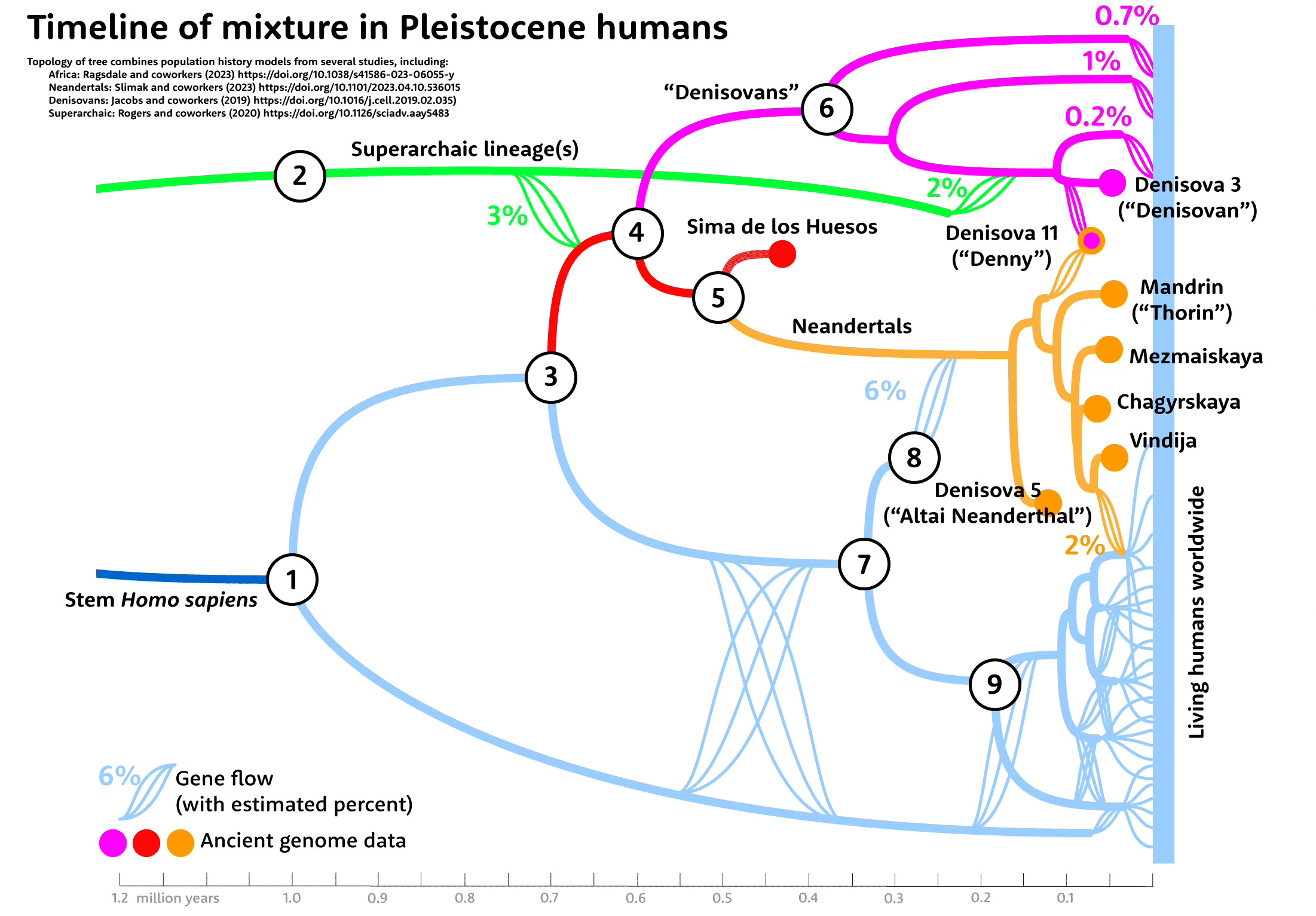
In the article, Reich examines the African gene flow into Neanderthal groups sometime around 250,000 years ago. (In my diagram of genetic mixture among ancient genomes above, this episode is designated with the number 8.) The most profound effect of this gene flow was the complete replacement of earlier Neanderthal mitochondrial DNA (mtDNA) and Y chromosome branches by African lineages. In addition to these two uniparental genetic systems, the African gene flow makes up around 6% of the whole genomes of later Neanderthals. Reich notes that this combination of mtDNA and Y chromosome replacement seems unusual when coupled with more modest nuclear gene flow.
A couple of weeks ago, I recounted new research by Alexander Platt and coworkers, who were the first to characterize the X chromosome bias of that African gene flow into Neanderthals. One possible explanation for their findings is a matrilineal social organization in an expanding African population as they encountered and mixed with Neanderthals.
Reich shows that sex-biased dispersal might also explain the mitochondrial and Y chromosome results. The article’s main innovation, established in simulations, is that sex bias in either a paternal or maternal direction would increase genetic drift with disproportionate effects on both uniparental systems. Reich notes the results from Platt and coworkers that suggest a maternal bias, but suggests that the X chromosome results are much weaker than either uniparental system and suffer from the general challenge of accurately identifying introgressed segments. So he leaves open the possibility of an excess of gene flow from men rather than from women.
The article further suggests that a similar process may have unfolded within Africa. The evidence that suggests today’s Africans derive a fraction of their ancestry from an “archaic ghost population” might be explained if a single early modern group began to grow in numbers and geographic range within Africa, mixing with other long-diverged groups.
The current idea of the timing of these events within Africa is that ancestors of today’s Khoesan, central African hunter-gatherers, and other groups started to differentiate after 300,000 years ago. These early ancestors may have absorbed genes from archaic African groups. One or more groups may have pushed into Eurasia at this time, spreading similar genes to the Neanderthals.
My take on the genetics
There is a lot in Reich’s article that I agree with. The core of the hypothesis is that the gene flow brought African genes to Neanderthal populations and may have transformed them in functionally important ways. I’ve been saying this for a long time. Indeed, a central theme in one of my earliest scientific papers, now twenty-five years old, is that Africa-to-Europe gene flow played a role in the transition from early Neanderthals at Sima de los Huesos and other sites to later Neanderthals.
Further, I see great potential in connecting the Middle Pleistocene dynamics within Africa with the dynamics outside of Africa. Over the last decade, the paleoanthropological trend has been to promote the early evolution of Homo sapiens as a “Pan-African” phenomenon, an idea that has been called “African multiregional evolution”. This idea, in my view, may be both too little and too much.
Too little: The Pan-African model ignores the genetic interactions of early African groups with Neanderthals and possibly other Eurasian peoples. We know the human network included these populations, but the Pan-African label leaves them out.
Too much: If early modern humans were networked across the entire continent of Africa, what room was there for archaic forms of humans and Homo naledi? These groups make up the majority of the later Middle Pleistocene fossil record, and their degree of niche overlap with ancestral modern humans is unclear.
In reality the patterns of movements, fissions, and mixtures of groups must have been heterogeneous and sporadic enough to enable persistence of many divergent groups, even while some became more and more tightly connected. By 40,000 years ago the dispersal and networking of modern human groups was certainly dominated by their strengths, but during their early evolution 250,000 years ago their limitations were still very evident. One reason I like Reich’s model is that it can unfold within this looser network of populations.
Still, there are aspects of the genetics that I think are unlikely. One is Reich’s treatment of the mitochondrial DNA and Y chromosome. Uniparental inheritance systems are highly susceptible to genetic hitchhiking—part of my work since my 1999 dissertation and discussed at length in 2006. Today the low variation of mitochondrial DNA and Y chromosomes compared to autosomal variation stands out, particularly so when we look at variation within Africa. An easy explanation for this mismatch is that one or more favorable variants arose in Middle Pleistocene Africans.
For mitochondrial DNA, selection likely coincides with the genetic load of slightly deleterious mutations that can become common or fixed in small populations. Connectivity between larger and smaller populations tends to help purge deleterious variants, and increased connectivity might favor the dispersal of mtDNA and Y chromosome variants from larger African populations into Neanderthals even without new adaptive mutations.
All this is to say that a strong sex bias in dispersal is not needed to explain the uniparental systems. All you need is a slight increase in connectivity. The same might be true within Africa, if the structure of populations before 300,000 years ago gave rise to enough drift.
A Levallois connection
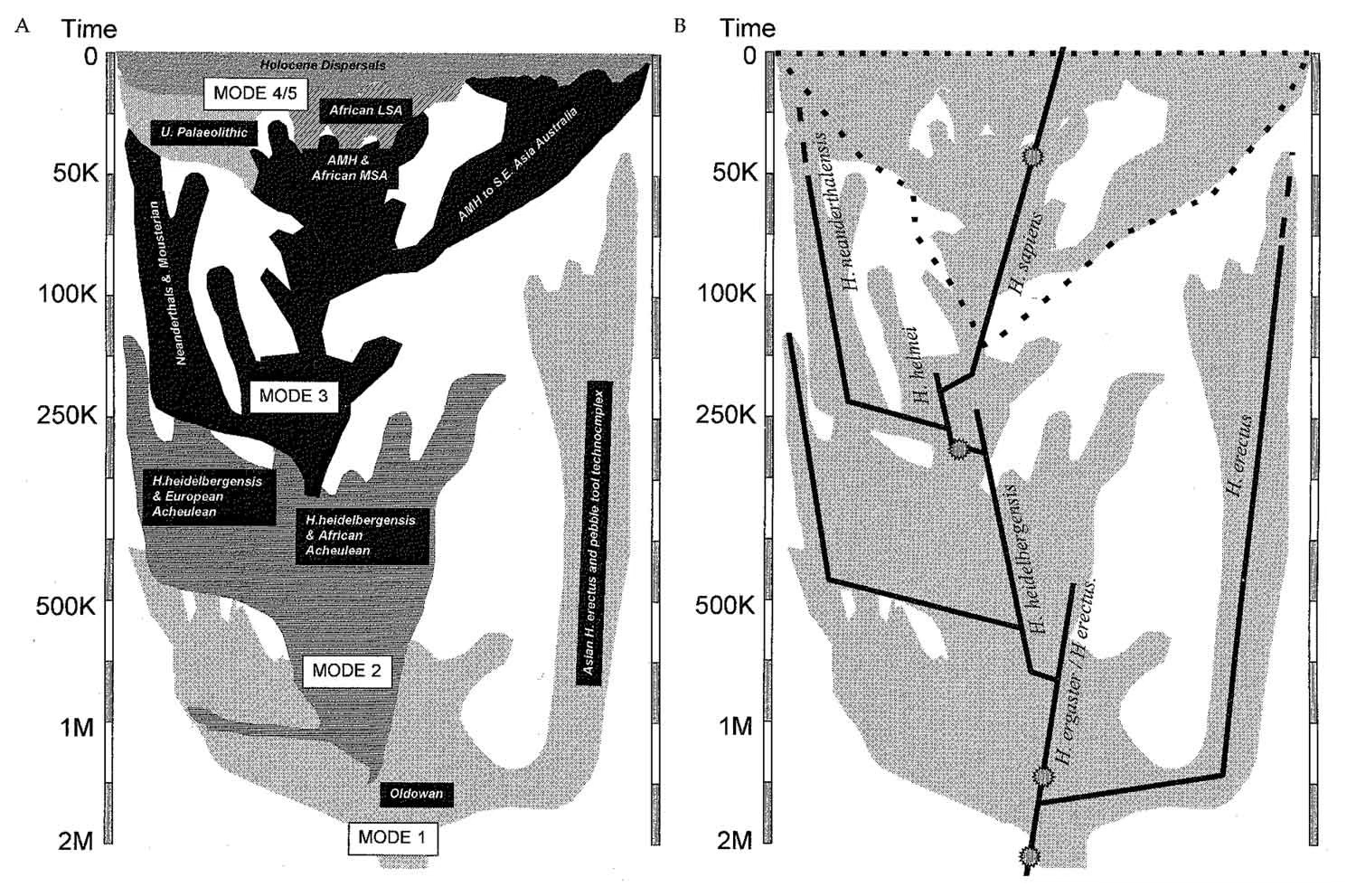
When it comes to the archaeology, Reich’s hypothesis is very close to the “Mode 3 hypothesis” proposed by Rob Foley and Marta Lahr in 1997. Foley and Lahr noted a coincidence of timing of early Levallois assemblages in Europe and Africa starting around 300,000 years ago. Levallois and related methods of stone reduction are known as “prepared core” techniques, because they require the toolmaker to shape the stone core in anticipation of striking one desired flake. The archaeologist Grahame Clark had termed these methods as “Mode 3” technology. The planning required for these techniques seemed to represent an advance over the handaxe-dominated Acheulean (Mode 2) and chopper-based Oldowan (Mode 1) tools that preceded them.
Like Reich, Foley and Lahr thought that Levallois and other prepared core techniques may be markers of a biological dispersal.
Who was this dispersing population? Foley and Lahr proposed that Neanderthals and modern humans both evolved from a Levallois-using common ancestor. Like Reich, they accepted that Neanderthals were aligned with modern humans and different from the “true archaics” in Europe that preceded them.
The Mode 3 hypothesis was a departure from the way most archaeologists thought about material culture and modern human origins. Many archaeologists had focused upon the European Upper Paleolithic as the most important phenomenon, and these toolkits were centered on long, thin flakes called blades—“Mode 4” in Clark’s terminology. But Foley and Lahr considered Mode 4 techniques as a red herring. Blades were not universal across modern human societies, and instead Mode 3 seemed to be a technological common denominator. The interesting twist was that this seemed to include the Neanderthals. These authors provided several different ideas about how to classify the Neanderthal-modern common ancestor. The most memorable (illustrated in their diagram) attributed the first Mode 3 population to Homo helmei.
This wasn’t the only way to sort the archaeological, fossil, and genetic record of the time. I looked at this problem differently in my own work. The trajectory of increasing brain size evolution in Neanderthal populations across the last 400,000 years I interpreted as evidence for genetic exchange with African populations. In this context, cultural exchanges that might be marked by Levallois core reduction and other innovations were not surprising at all. Reich suggests that it’s a “conundrum” that African and Neanderthal populations share Levallois technology, but I don’t think that way. Such exchanges are a normal consequence of past human interactions.
Can a Mode 3 hypothesis work today?
The Mode 3 hypothesis seemed to work in the 1990s when evidence from much of Asia was scarce and poorly dated. Foley and Lahr noted a near lack of archaeological sites between 250,000 and 50,000 years ago in China, and noted nothing between Acheulean (Mode 2) and microliths (Mode 5) in South Asia. In that era, the old idea of a “Movius Line” separating the artifact traditions of eastern and western Asia was still a commonly held assumption.
Today’s record does not support that old way of thinking.
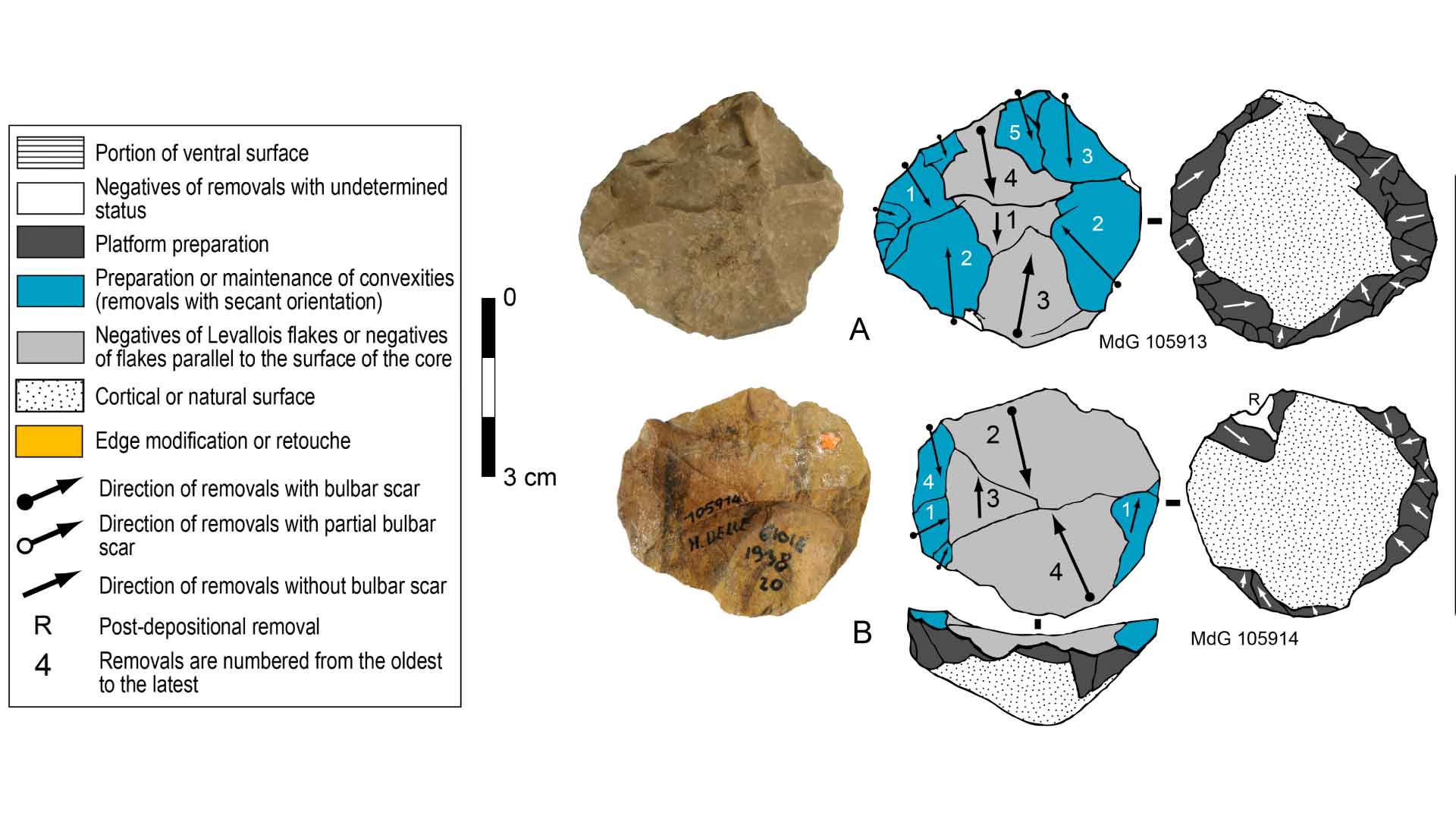
In China, an array of sites present evidence of prepared core techniques or hafting in the time range between 160,000 and 70,000 years ago. Hafting is evidenced at Xigou in central China, Lingjing provides evidence of ochre use and discoidal reduction with some Levallois cores, at a site with archaic human fossil material. Somewhat earlier, as early as 180,000 years ago, Guanyindong has many kinds of Middle Paleolithic core reduction techniques including core-on-flake, discoidal, and Levallois. The Panxian Dadong assemblage, roughly the same age, represents some of these same methods.
These Chinese assemblages are not identical to those from western Europe. They combine polar core reduction, some large cutting tools, and a smaller proportion of prepared core methods. They represent related solutions in different proportions. Almost certainly they were produced by Denisovans.
In South Asia, Levallois-based Middle Paleolithic assemblages at Attirampakkam, India, began by around 385,000 years ago, with representation in several levels before 170,000 years ago. Another site older than 245,000 years with Levallois and discoidal reduction is Hanumanthunipadu in Andhra Pradesh. The hominins of India during the later Middle Pleistocene are represented only by the Narmada partial skull, which is ambiguous. The fraction of Denisovan ancestry in today’s peoples of India suggests that one or more groups of Denisovans may be part of the hominin prehistory of this region.
The strongest evidence that Denisovans used Levallois and other prepared core techniques comes from Denisova Cave itself. The earliest stone assemblages from Denisova include Levallois cores as well as sediment DNA attributable to Denisovans, dating to between around 250,000 and 200,000 years. Throughout the Denisova sequence, these Mousterian-like elements are common, and in a number of layers elongated flakes and true blades. There is no categorical technical distinction between layers with Denisovan fossils and DNA compared to Neanderthals.
All this is to say that the Neanderthals were not the only population with technical similarities and other cultural overlaps with MSA Africans. Denisovans, too, used prepared core techniques, hafted points on spears, used ochre, and made markings. The record in East and South Asia remains underrepresented, but as it stands these techniques are not later or offset in time compared to Europe or Africa.
With this extent of cultural overlap, it is very interesting that Denisovans seem to have had less gene flow from African sources that Neanderthals did. I don’t think it’s likely that gene flow was absent—instead, it’s just an indication that cultural pathways for exchange were not one-to-one matches for gene flow.
Bottom line
When it comes to Reich’s hypothesis, I strongly agree with the parts that are established by other evidence—especially the importance of African mixture into Neanderthals and the possible sex bias of those exchanges. I also fully concur with the general idea that cultural exchanges accompanied these genetic exchanges.
But the part of the hypothesis that sets up a relationship between African range expansion and Levallois technology is a throwback to the 1990s that is out of step with today’s data. Denisovans, too, had Levallois and other material culture similarities with Neanderthals and contemporary African peoples. The Denisovans did not, as far as we can tell, have the same extent of gene flow from African sources. Still, future data might show that we are underestimating African-to-Denisovan genetic exchanges.
The specific idea that the sex bias was the cause of the mitochondrial and Y chromosome replacement in Neanderthals is questionable in my view. Natural selection on these uniparental systems is a better explanation.
When it comes to cultural exchanges, the important questions are how much such technologies may have been coadapted with neuroanatomy and development. Those cultures were the environments to which our species adapted. It does not take much gene flow to move adaptive genes, and understanding the pattern of Neanderthal adaptive evolution with African gene flow is the direction we should go.
Finally, maybe the most valuable part of Reich’s paper is that it reveals the weakness of current search strategies for “modern” genetic adaptations. Most have asserted that the important evolutionary changes in modern humans will be genetic variants that modern people have and Neanderthals lack. But our Neanderthal and African ancestors were part of the same genetic network, overlapping in a fraction of their genomes. To find the evolutionary changes that affected us, we’ll have to look more closely at the genes that found value in Neanderthals.
Notes: The technical modes derive from the classification by Grahame Clark in his 1969 book, World Prehistory: A New Synthesis. These have gone into and out of fashion over the years, and I tend to think they cause more confusion. A more functional technical classification was presented by John Shea in his 2016 book, Stone Tools in Human Evolution. In Shea’s perspective, Levallois and other prepared core techniques are classified as “Bifacial Hierarchical Core” reduction.
References
Akhilesh, K., Pappu, S., Rajapara, H. M., Gunnell, Y., Shukla, A. D., & Singhvi, A. K. (2018). Early Middle Palaeolithic culture in India around 385–172 ka reframes Out of Africa models. Nature, 554(7690), 97–101. https://doi.org/10.1038/nature25444
Anil, D., Chauhan, N., Ajithprasad, P., Devi, M., Mahesh, V., & Khan, Z. (2022). An Early Presence of Modern Human or Convergent Evolution? A 247 ka Middle Palaeolithic Assemblage from Andhra Pradesh, India. Journal of Archaeological Science: Reports, 45, 103565. https://doi.org/10.1016/j.jasrep.2022.103565
Bar-Yosef, O., & Wang, Y. (2012). Paleolithic Archaeology in China. Annual Review of Anthropology, 41(1), 319–335. https://doi.org/10.1146/annurev-anthro-092611-145832
Clark, G. (1969). World Prehistory: A New Synthesis. Cambridge University Press.
Foley, R., & Lahr, M. M. (1997). Mode 3 Technologies and the Evolution of Modern Humans. Cambridge Archaeological Journal, 7(1), 3–36. https://doi.org/10.1017/S0959774300001451
Hawks, J. (2006). Selection on mitochondrial DNA and the Neanderthal problem. In J.-J. Hublin, K. Harvati, & T. Harrison (Eds.), Neanderthals Revisited: New Approaches and Perspectives (pp. 221–238). Springer Netherlands. https://doi.org/10.1007/978-1-4020-5121-0_12
Hawks, J. D., & Wolpoff, M. H. (2001). The Accretion model of Neandertal evolution. Evolution, 55(7), 1474–1485. https://doi.org/10.1111/j.0014-3820.2001.tb00667.x
Ma, D.-D., Pei, S.-W., Xie, F., Ye, Z., Wang, F.-G., Xu, J.-Y., Deng, C.-L., & De La Torre, I. (2024). Earliest Prepared core technology in Eurasia from Nihewan (China): Implications for early human abilities and dispersals in East Asia. Proceedings of the National Academy of Sciences, 121(11), e2313123121. https://doi.org/10.1073/pnas.2313123121
Reich, D. (2026). Hypothesis: A modern human range expansion ~300,000 years ago explains Neandertal origins. Preprint. bioRxiv. https://doi.org/10.64898/2026.03.11.711219
Shea, J. J. (2016). Stone tools in human evolution: behavioral differences among technological primates. Cambridge University Press.
Shunkov, M. V., & Kozlikin, M. B. (2023). The Earliest Paleolithic Assemblages from Denisova Cave in the Altai. Archaeology, Ethnology & Anthropology of Eurasia, 51(1), 18–32. https://doi.org/10.17746/1563-0110.2023.51.1.018-032
Soriano, S., & Villa, P. (2017). Early Levallois and the beginning of the Middle Paleolithic in central Italy. PLOS ONE, 12(10), e0186082. https://doi.org/10.1371/journal.pone.0186082
White, M., & Ashton, N. (2003). Lower Palaeolithic Core Technology and the Origins of the Levallois Method in North‐Western Europe. Current Anthropology, 44(4), 598–609. https://doi.org/10.1086/377653
Yue, J.-P., Song, G.-D., Yang, S.-X., Kang, S.-G., Li, J.-Y., Marwick, B., Ollé, A., Fernández-Marchena, J. L., Shu, P.-X., Liu, H.-Y., Zhang, Y.-X., Huan, F.-X., Zhao, Q.-P., Qiao, B.-T., Shen, Z.-S., Deng, C.-L., & Petraglia, M. (2026). Technological innovations and hafted technology in central China ~160,000–72,000 years ago. Nature Communications, 17(1), 615. https://doi.org/10.1038/s41467-025-67601-y
I think most of us have a real difficulty appreciating the possibile events that humans can experience over 100,000 years. For any population, there were abundant chances of "perfect storms" of climate change, conflict with other populations, and -- indeed -- perfect storms. Even very rare events can occur many times over several hundred thousand years.
Both American continents were populated in less than 20,000 years. The Pacific islands were populated in much less time. There would have been many failures in trial-and-error that do not leave any traces.
This is a long way to say that the actual story is much more complicated than was described a few decades ago. Time and space were both very big, with lots of possibilities.
On the other hand, it also is difficult to understand why there were so few technological changes in the physical record over the millennia. Of course, we know little about wooden and fabric technology, and of the people who were not living in caves.
We look forward to the ongoing research and the rich complexity of our ancestors.
I've read the Reich's preprint and this post again, and it is an interesting indirect exchange of views.
Reich contrasts his model with the idea of a "single episode" of encounter between early HS and N some 300 Kya, and I think he is spot on here - it was likely a long and gradual introgression of HS genes into early N territory. He is puzzled by the fact (as he mentioned many times) of a complete replacement of N mtDNA and Y-DNA by early HS but only modest autosomal input, and I think his simulation model hadn't fully answered that - the actual data is reproduced in the model only with an (unrealistically) strong survival advantage of HS mtDNA relative to N mtDNA. Otherwise there would be much more of HS autosomal admixture into N that would accompany the sweep.
Your view on the matter is that a sweep by uniparental lines can happen at a lower level of admixture and relatively fast. I think it is a valid point and it is known that uniparental time depth is much lower than the whole genomic one. Yet it is not clear if a sweep of both uniparental lines can occur at such a small level of autosomal admixture. Maybe we underestimate the level of admixture from early HS into N.
What I strongly agree with Reich is the idea of the connection of the spread of Levallois technology and other MP innovations with the demographic expansion of some early HS population (during MIS 11-9 time frame) that produced genetic connections both with N and some African archaics (and the ideas of "80-20 stems"). I don't think the lack of HS admixture in contemporary Denisovans that also used Levallois tools disprove it - they could get it from N later.
I actually expressed fairly similar ideas (though without a simulation model) in my post
https://kirillpankratov.substack.com/p/two-million-years-of-human-history
I think this period 400-250 Kya represents a critical juncture in human prehistory and our understanding of what happened will change in a major way.