

My PhD student, Ayken Askapuli, is a specialist on the human genetics of Kazakhstan and nearby areas of Central Asia. Over the last several years he has been engaged in an ancient DNA project, concentrating on the genomes of bodies in medieval tombs attributed to the Golden Horde period. Last week his paper describing some of this work was published by the Proceedings of the National Academy of Sciences.
It’s great to be able to share this work, and I’m so pleased to see Ayken’s success publishing it. My own part in the paper was small. What I’ll do here is try to relate part of this fascinating story, which hasn’t yet come to a conclusion.
The Golden Horde
The “Golden Horde” is the common name for the northwestern extension of the Mongol Empire during the period from 1240 to 1480 CE. This dynasty founded by Joshi, the eldest son of Genghis Khan, ruled over the Kipchak steppe, western Siberia, and the Pontic-Caspian region. It controlled the trade routes of the Silk Road and was important in the formation of modern ethno-linguistic groups like the Kazaks, Tatars, and Özbeks.
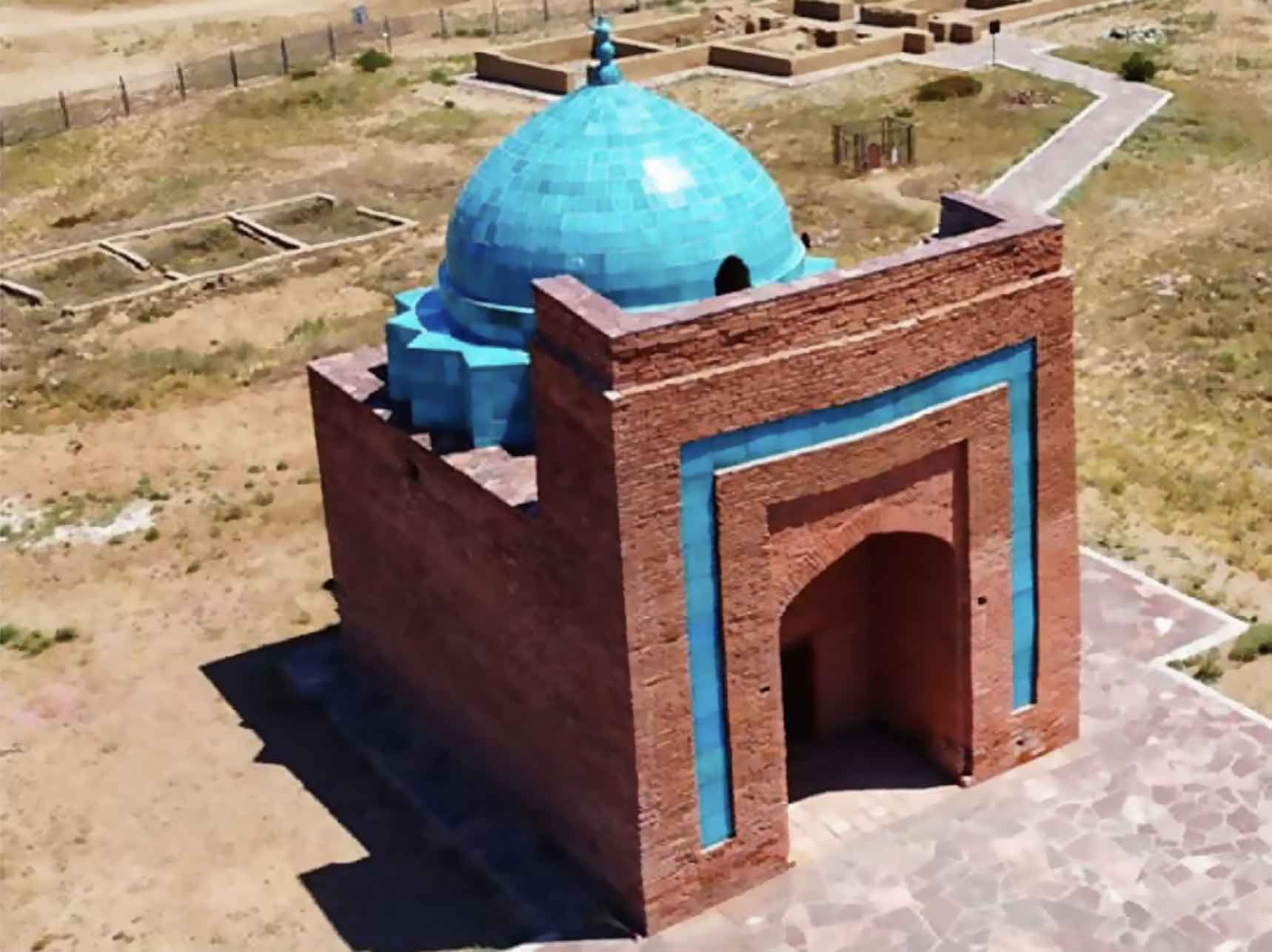
On or near the Kenggir River in central Kazakhstan are several mausoleums that are attributed to the Golden Horde period. Some of these were subject of archaeological work during the Soviet era, and some have been investigated by Kazakh archaeologists more recently, including Ayken’s collaborators in the present study.
Local traditions attribute some of these mausoleums to particular Mongol leaders—one is popularly attributed to Joshi Khan himself, another, Bolghan Ana, is popularly attributed to Joshi’s daughter. However, these local traditions may not be literal historic truths. For example, archaeological work by Irina Panyushkina and coworkers has shown that timbers used in the construction of the Joshi Mausoleum post-date his death by 75 to 100 years. Interestingly, one of the coffins in this mausoleum was made of wood that is roughly the right timing, although no record of reburial or movement of a body exists.
All this is to say that the identity of the skeletal remains in these tombs is not something that can be taken at face value.
Y chromosomes and Genghis Khan
One reason for interest in the Golden Horde mausoleums is their possible connection to the paternal lineage of Genghis Khan, subject of quite a lot of interest in human genetics over more than 20 years. Back in 2003, Tatiana Zerjal and collaborators from Chris Tyler-Smith’s research group published a groundbreaking study on the Y chromosome variation across Asia. Their work drew attention to a common Y chromsome haplogroup in many populations today that originated a fairly short time ago. Due to the pattern of rapid diversification of this lineage, they called it the “star cluster”.
In the 2003 work, the suggestion was that the paternal ancestor of this star cluster lineage had lived within the last 1000 years. From this estimate of age and its current geographic distribution in eastern and central Asia, Zerjal and coworkers suggested it might be the paternal lineage of Genghis Khan.
The logic was based in history. Few men within the last 1000 years have had the long-term offspring number of the Mongol elite, of which Genghis was the founder. Also, Zerjal and coworkers found that the Hazara ethnic group of present-day Afghanistan were especially marked in sharing star cluster Y chromosomes, and according to them, this group maintains an oral tradition of paternal descent from the Mongol elite.
In 2018 that story was revised substantially by Lan-Hai Wei and collaborators. These researchers greatly expanded the sample of Y chromosomes to more than 18,000 individuals, including many whole-chromosome sequences. With so much more data, they could add better resolution of the timing and branching pattern within the “star cluster”, redesignated as C2a1a3-F1918, or C3*. The main innovation of this work was to show that the C3* did not start 1000 years ago but instead closer to 2500 years ago. Wei and collaborators suggested that the present widespread geographic distribution of this C3* is indeed a legacy of the Mongols. But that isn’t because Genghis and his heirs specifically had so many offspring, but instead because ordinary Mongol peoples sharing the same Y chromosome heritage shared more generally in the conquests and dispersal led by Genghis and his heirs.
All this is background to our new study. The Golden Horde presence in Kazakhstan began with the immediate heirs of Genghis Khan. Ayken worked with Japanese collaborators led by Naruya Saitou, who led the DNA extraction from the skeletal material. They obtained data from four ancient individuals, three male and one female individual, excavated from four different mausoleums.
Results of the study
The analysis of the data led to several interesting insights. To begin, the traditional stories that related tombs to particular ancient individuals like Joshi were not supported. One of the individuals, from the Mausoleum of Alisha Khan, yielded radiocarbon results consistent with the 1700s CE, more than 200 years after the Golden Horde period. The other three all were consistent with the early to mid 1300s, so they were the right age to be Golden Horde elite, but not the specific individuals. For example, the radiocarbon results on the individual in the Joshi tomb suggest that this individual lived in the years after 1300 CE, long after Joshi’s historical death in 1227, and close to the era when the mausoleum was built. The woman in the Bolghan Ana mausoleum did not share a first- or second-degree relationship with the man in the Mausoleum of Joshi meaning she was not this individual’s daughter.
Although the local traditions about the occupants of the mausoleums were not upheld by the DNA results, the results did confirm some other aspects of the broader story of the Golden Horde and the Mongol empire. The Kenggir individuals are genetically closer to Mongolian and East Asian populations living today than they are to Kazakh or other local ethnic groups. Ayken undertook an analysis of relatedness using identity-by-descent (IBD) of these genomes, and a broader sample of ancient genomes from Asia. He found several genealogical relatives for these people in ancient genomes from Mongolia, and one from eastern Kazakhstan.
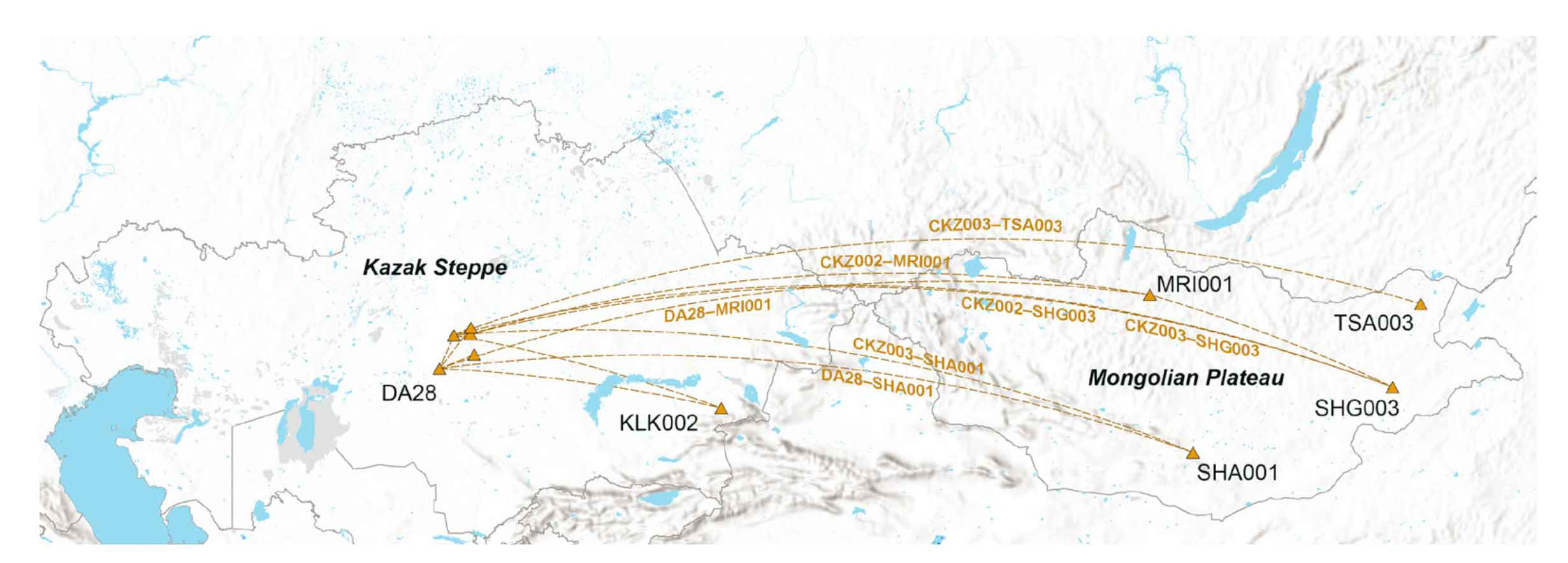
He also found kin relationships among three of the Kenggir individuals, two of which—from the Ayakkamir Mausoleum and the Alisha Khan Mausoleum—seem likely to be ancestor and descendant across around 5 to 6 generations. All of the Kenggir individuals show fairly high numbers of runs of homozygosity (ROH) which are indicative of cousin marriages within their genealogical backgrounds.
All three of the men sampled in the study share the C3* Y chromosome haplogroup. While the data do not connect this haplogroup directly to the genealogical heirs of Genghis Khan, the results do help to establish that the Golden Horde elite did have this haplogroup.
For me, another interesting result of the study concerns the cultural change in the Golden Horde elite. One source of differences in burial customs is religion. In many Mongol burials, bodies are oriented in a north or northeast orientation, and burials of the true elite were all conducted in secret locations. These four mausoleums represent a change in the custom. Bodies were placed in a west or northwest orientation, which is more consistent with Islamic practice. Even so, the few grave goods including a camel head in one burial are not typical of Islamic burials, and may represent a blending of traditions among people who had nominally adopted Islam.
Ayken’s work is continuing on the social and cultural legacies of these genetic connections from the Mongol empire. Already he has a preprint that uses SNP data combined with Y chromosome haplotypes to look at the ways that clan structure and genealogies are reflected in genetics and in oral histories. For me it has been great to learn about the rich histories of human connections across Central Asia. These dynamics in Medieval groups may be different from the prehistoric record, but they nonetheless help inform about the deep evolutionary history of this region.
Notes: The terminology for Y chromosome haplogroups has changed over time, and there is still some inconsistent use of terms in different studies. In our work we discuss the C3* haplogroup, and this corresponds to C2*-ST in Wei and coworkers (2018).
References
Askapuli, A., Kanzawa-Kiriyama, H., Kakuda, T., Kassenali, A., Yessen, S., Schamiloglu, U., Schrodi, S. J., Hawks, J., & Saitou, N. (2026). Genomes of the Golden Horde elites and their implications for the rulers of the Mongol Empire. Proceedings of the National Academy of Sciences, 123(8), e2531003123. https://doi.org/10.1073/pnas.2531003123
Askapuli, A., Vilar, M. G., Zhabagin, M., Sabitov, Z., Zhumadilov, Z., Ragsdale, A., Schurr, T. G., Hawks, J., & Saitou, N. (2026). Genetic Basis of Social Structure in the Pastoral Nomads of Central Eurasia. Preprint. https://doi.org/10.64898/2026.01.27.701587
Panyushkina, I. P., Usmanova, E. R., Uskenbay, K. Z., Kozha, M. B., Dzhumabekov, D. A., Akhatov, G. A., & Jull, A. J. T. (2022). Chronology of the Golden Horde in Kazakhstan: 14C Dating of Jochi Khan Mausoleum. Radiocarbon, 64(2), 323–331. https://doi.org/10.1017/RDC.2022.24
Wei, L.-H., Yan, S., Lu, Y., Wen, S.-Q., Huang, Y.-Z., Wang, L.-X., Li, S.-L., Yang, Y.-J., Wang, X.-F., Zhang, C., Xu, S.-H., Yao, D.-L., Jin, L., & Li, H. (2018). Whole-sequence analysis indicates that the Y chromosome C2*-Star Cluster traces back to ordinary Mongols, rather than Genghis Khan. European Journal of Human Genetics, 26(2), 230–237. https://doi.org/10.1038/s41431-017-0012-3
Zerjal, T., Xue, Y., Bertorelle, G., Wells, R. S., Bao, W., Zhu, S., Qamar, R., Ayub, Q., Mohyuddin, A., Fu, S., Li, P., Yuldasheva, N., Ruzibakiev, R., Xu, J., Shu, Q., Du, R., Yang, H., Hurles, M. E., Robinson, E., … Tyler-Smith, C. (2003). The Genetic Legacy of the Mongols. The American Journal of Human Genetics, 72(3), 717–721. https://doi.org/10.1086/367774