

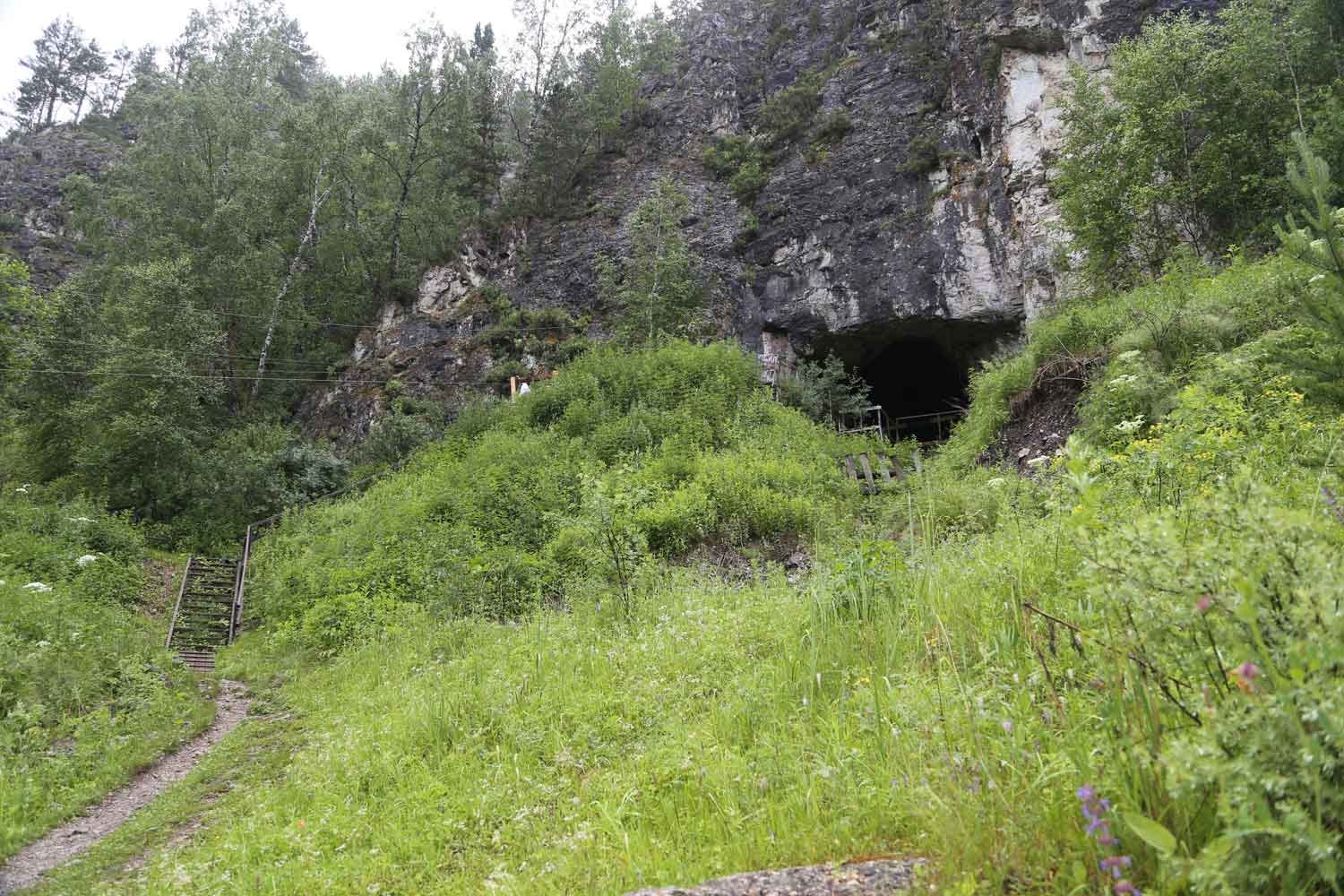
Evolution is a story of events in the past. It is full of characters and interactions between them and environments. At the same time, evolution provides a way of thinking about biological mechanisms. The systems in our body, the course of our development, and the patterns of our social behavior all manifest design that emerged in ancient environments under natural selection.
I’m thinking about these two ways of looking at evolution because of four recent studies of genetic variation from Denisovans. Two were published in Science over the last few weeks, and two are in preprint form on biorXiv. There are some interesting overlaps across the studies, which involve the sources of Denisovan ancestry and the functions of introgressed genes.
Denisovan ancestry is fascinating in part because it comes from different sources. In this post I’m going to look at what two of these studies add to our understanding of this diversity. The Denisovans we know the most about, from Denisova Cave, were neither the largest population nor the greatest contributor of ancestry to today’s people. The main action of Denisovan mixture was far to the south, in India, Southeast Asia, and Indonesia.
The two studies that address Denisovan diversity have large samples of modern human genomes from two of these regions: mainland Southeast Asia and “Near Oceania”, including the Solomon Islands and Bismarck Archipelago. One of the studies was led by Patrick Reilly, looking at islanders both in terms of gene function and in their pattern of Denisovan source ancestry. The other, by Charlotte Antoine-Derouet and coworkers, looked at 30 historically understudied populations in Central and Mainland Southeast Asia.
Studying Denisovan haplotypes
Both studies relied on a similar approach. Their methods begin by scanning modern genomes for regions where the genome has variants that are absent from an outgroup population, chosen from contemporary Africans. Then they filter those regions that have strong linkage disequilibrium, which suggests a source that was relatively isolated from other ancestral groups. Comparing these haplotypes with known genomes from Denisovans (Denisova 3) and from Neanderthals (in these studies, from Vindija) enables them to identify which ones may have come from those two groups.
After this procedure, some haplotypes remain ambiguous, not easily assigned to either of the archaic populations. Almost all the haplotypes identified as Neanderthal are quite similar to the Vindija genome. There are few haplotypes that register as “Neanderthal-like” that have a closer match to other known Neanderthal genomes, or that mismatch the Vindija sequence at more than a small fraction of sites. It’s a good hypothesis that most of the Neanderthal ancestry in today’s people comes from a similar time and place, often assumed to be somewhere in southwest Asia. There are so far no genome data from Neanderthals from this region, so that hypothesis can’t yet be tested directly.
Before getting into the results of the new papers, it is important to remember that all populations have some genetic variation. Even if the Denisova 3 individual had belonged to a group that was the unique source of mixture from Denisovans in later people, those individuals were not identical clones. The haplotypes those Denisovans carried for any one part of the genome would have had a bit under 0.1% genetic difference on average, some more and some less.
The studies of archaic ancestry tend to report a “match rate” between haplotypes and a known archaic genome. This is the fraction of derived variants that match between the two, never less than zero, never more than 100%. Each ancestral population that transmits its variation forward into modern human descendants leaves a smear of similar-but-not-identical haplotypes. If they come from a single population, the match rate to an ancient genome should form a distribution with a single mode. The average match rate is an indication of the genetic distance between the introgressing population and the archaic individual. The dispersion of match rate is a function of the genetic variation in the introgressing group.
The Neanderthal haplotypes compared to the Vindija genome show what this looks like when most of the introgression comes from one ancestral group. This image is from the new paper by Reilly and coworkers. The curves are a beta distribution fitted to the match rate data, which is the method of model fitting preferred by these authors.
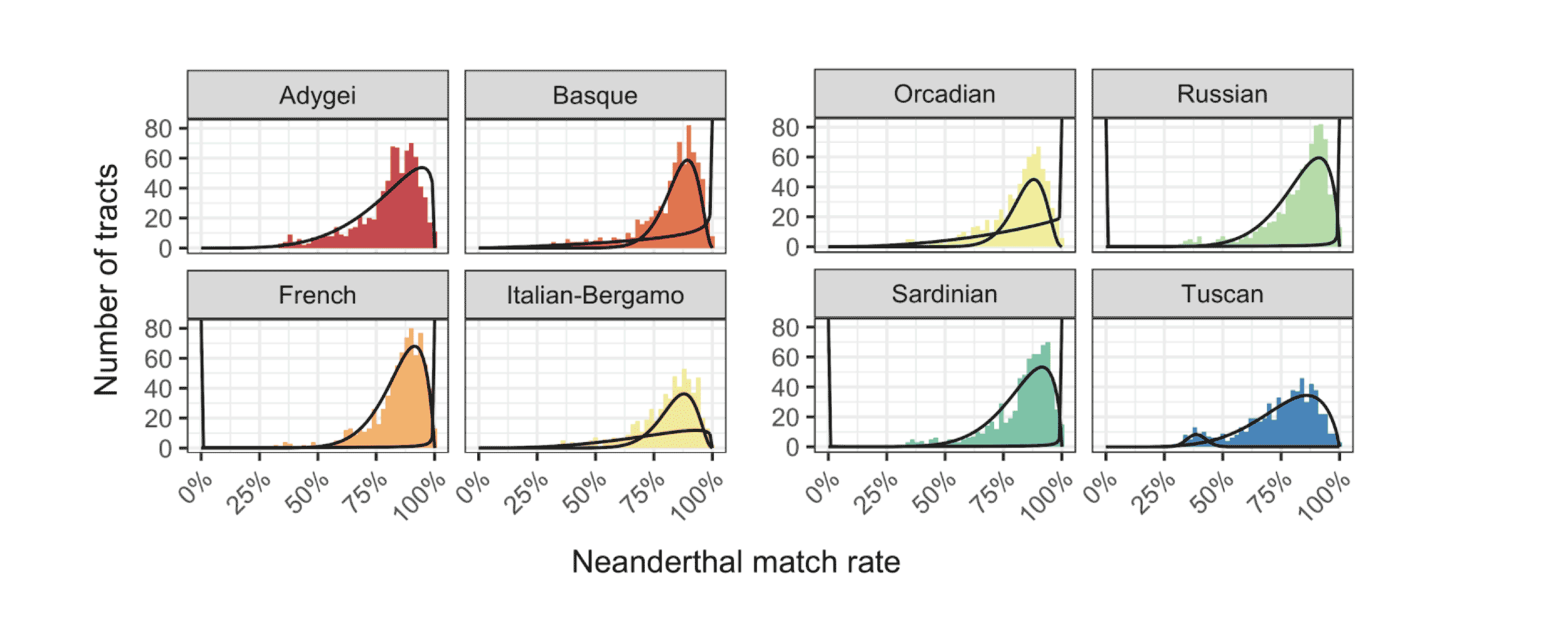
These are all western Eurasian groups, with the number of introgressed haplotypes for different values of match rate plotted as a histogram. For nearly all of these populations, the hypothesis of a single ancestral Neanderthal group is a good fit to the data. Only in the case of the Tuscans, and possibly Russians, does a second, more different hump emerge. Possibly there is a hint of another group; possibly the Neanderthals themselves had ancestry from a more distant source.
Denisovan ancestry shows a different pattern. When the genomes of people in East Asia, South Asia, Southeast Asia, and Oceania are examined, they show some haplotypes that are a close match to the Denisova 3 genome. Those likely came from one or more populations that were in close connection with the later Siberian branch of the Denisovans. But almost all peoples of Asia have haplotypes that are much more similar to Denisova 3 than to any known Neanderthals or any African groups, but still not all that close. These come from other branches that are distant relatives of the Siberian Denisovans. In other words, what looks like Denisovan mixture actually came from two or more different sources.
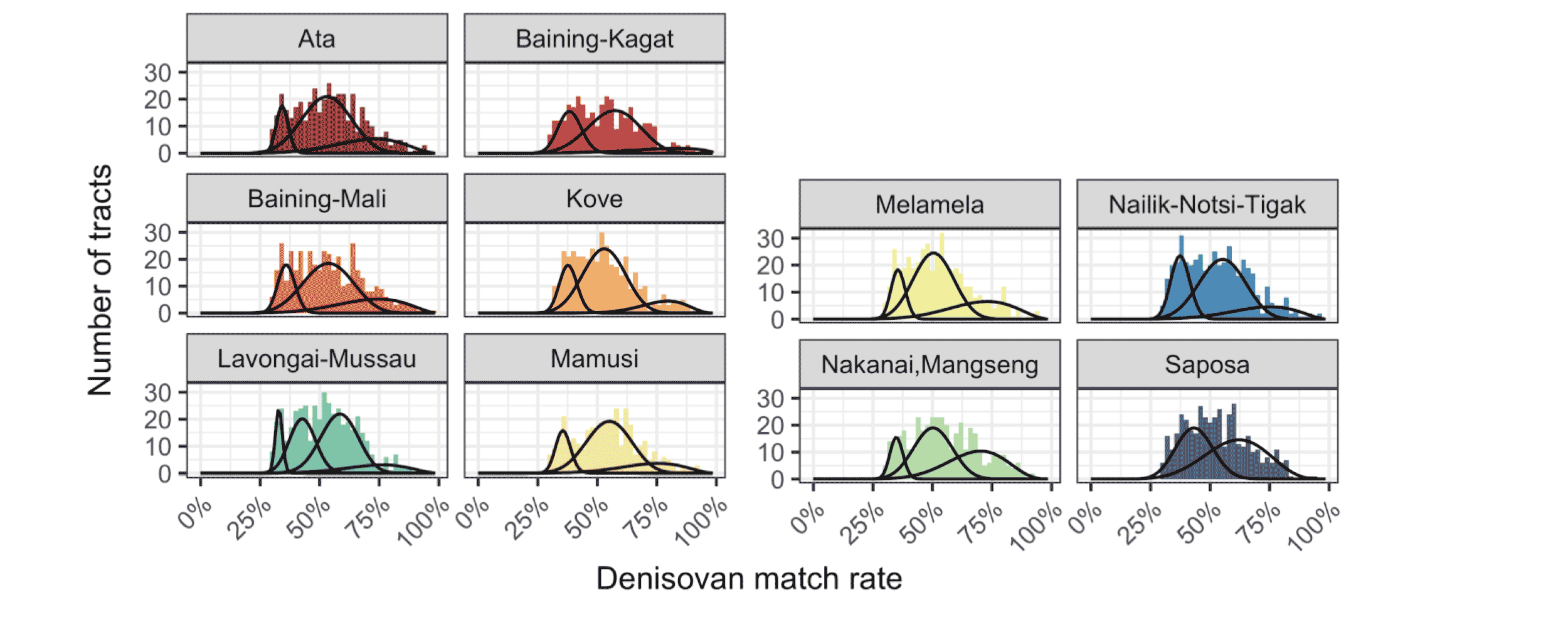
The results from the Near Oceanian groups are much the same when looking at Neanderthal introgressed haplotypes. But looking at the introgressed haplotypes that are more like Denisova 3 is a different story. There are fewer overall. Only a small number are close matches to Denisova 3. And in many groups, they seem to be an extended, stuttery distribution, not a smooth unimodal one. In the model-fitting, two distinct ancestral groups seem a good fit for some of the populations, like the Baining-Kagat, which have very few haplotypes with a high match rate to Denisova 3. For most of the samples, three ancestral groups give a better fit to the data.
This kind of observation was first made by Sharon Browning and coworkers in a 2018 paper, which described the general statistical approach. They found that many populations across much of Asia share this same basic pattern. Some haplotypes are a close match to Denisova 3 and others are further.
Guy Jacobs and collaborators in 2019 examined a large sample of genomes from Indonesia, from Papua, and from New Britain. Papua and New Britain have groups of living people that have a much larger fraction of Denisova-like DNA than mainland Asian peoples. In these groups, only a small number of the introgressed haplotypes are very close to Denisova 3. Nearly all are in the “close, but not too close” category. In fact, Jacobs and coworkers found that those actually fell into two distinct clusters, some mismatching the Denisova 3 genome about twice as much as the others. Jacobs and coworkers hypothesized that there were not just two Denisovan branches, but three. They named them D0, D1 and D2. The D0 population was most similar to Denisova 3 and its introgressed haplotypes were the most common ones in mainland East Asia. D1 and D2 were much more common in Papua.
Which of these had Browning and coworkers found in their samples from mainland Asia? Or was it yet another group? It wasn’t clear.
Last year Elise Kerdoncuff and coworkers published results from a sample of more than 2000 genomes from living people across India. Like Browning and coworkers, they found that people in India carry Denisovan DNA from two sources. One is a close match to the Siberian Altai Denisovan, while the second source was separated from the Altai Denisovans for a long time, roughly half the total duration of evolution of the Altai branch. The geographic pattern in India shows a cline of Altai-like Denisovan ancestry from north to south, and a more uniform pattern of divergent Denisovan ancestry across the subcontinent. When I wrote about that work last year, I speculated that the divergent pattern here might be the same as the D2 Denisovan group identified by Jacobs and coworkers. Or maybe it was yet another South Asian group of Denisovans.
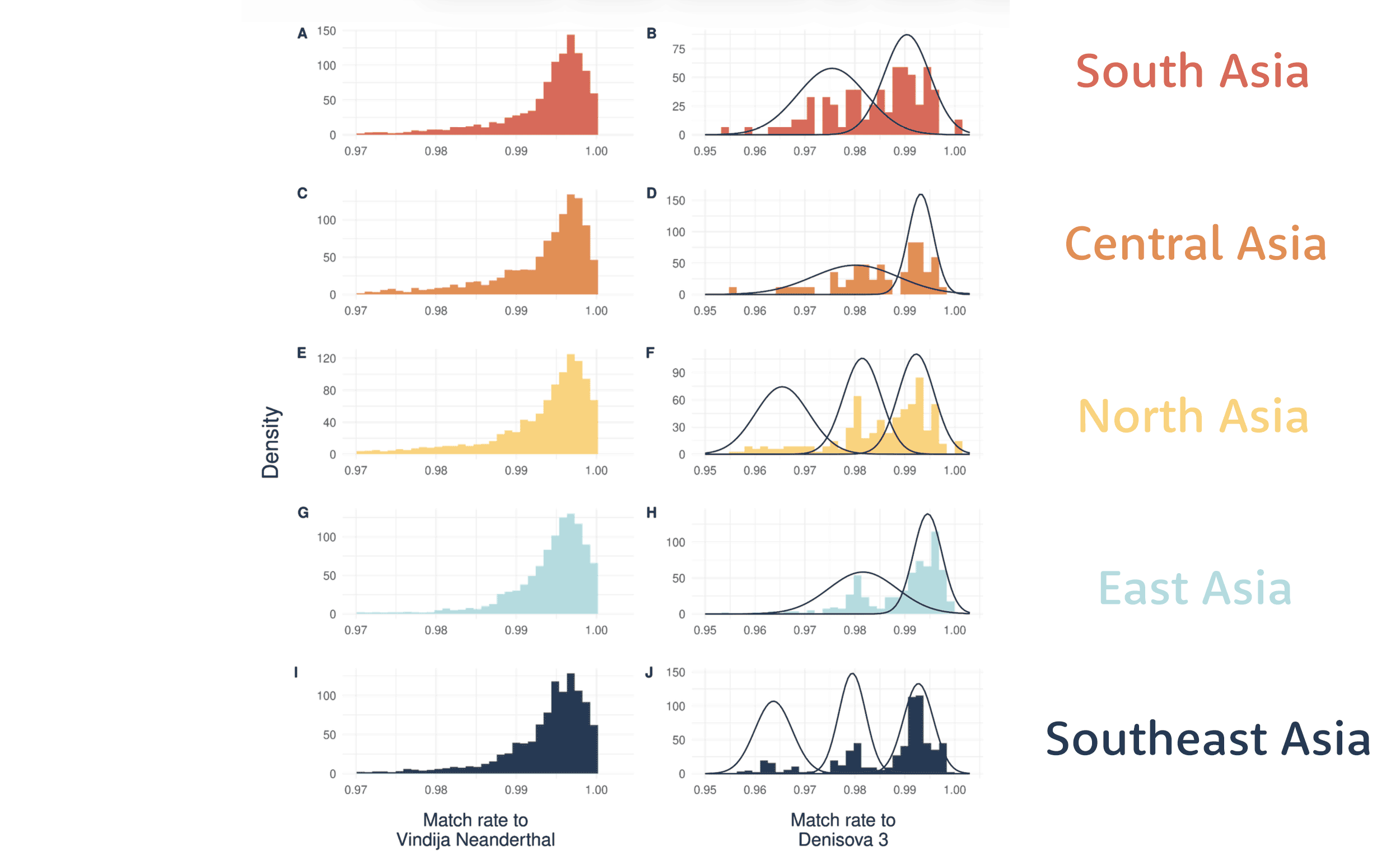
The other new results from Antoine-Derouet and coworkers on populations of Southeast Asia look cleaner. This is largely for two reasons: first, they applied larger sample sizes to some of the living populations, and second, they lumped together all samples from a region in one of their figures. This makes the contrast of Neanderthal and Denisovan introgression patterns extremely clear. It also makes it more clear that a three-ancestral-group model works better for Denisvoan ancestry in Southeast Asia. From this comparison, the three-group model also seems to work better for North Asia and Central Asia. Replicating the results from Kerdoncuff and coworkers, Antoine-Derouet and coauthors find a two-group model works for Denisovan ancestry in South Asia.
The match rate is reported differently in this figure because Antoine-Derouet and coworkers calculate it as a fraction of all variable sites, not only of derived sites in the archaic group. The curves in this study are Gaussian, which is another difference in approach. Reilly and coworkers have a good theoretical rationale for preferring beta distributions in their models, the data being limited to between zero and one, and I wouldn’t be surprised in reviewers start asking for this in addition to the Gaussian modeling.
Bottom line
The natural thing to look at these new studies compared to Jacobs and coworkers’ 2019 work and conclude that they support the same basic scenario: Three ancestral Denisovan groups, all contributing at different times and places to the modern human population of Asia and Oceania.
But when I examine the details of these different studies, I find it hard to distill them into a common picture. There are too many puzzling contrasts.
It doesn’t make geographic sense for North Asia and Papua to have the same three Denisovan components, especially if East Asia has only a slight amount of one of these.
It doesn’t make a lot of sense for the extremely stuttery distributions found by Reilly and collaborators to smooth out into the three highly distinct Denisovan clusters in some of Antoine-Derouet and colleagues’ figures, or even the two tight pulses that seemed to be indicated in Jacobs and coworkers’ 2019 results.
The concern that Reilly and coworkers express about overfitting is real. But I read this the other way. More solutions would not be a worse fit. The sample of introgressed haplotypes is just too small to answer the question.
I think these mixture models are oversimplifying the real history. Here are some ways that the reality was more complex:
Denisovans were never three highly distinct branches. They mixed with each other across a broad geographic range, spinning off populations into local population sinks like the Altai.
That complexity is evident from the Denisova 25 genome, much older than Denisova 3 and more closely connected in the mitochondrial DNA tree to the Harbin skull, which shows that some earlier Denisovan groups had diversified a good deal only to be replaced locally by other groups. That same process at other times and places might lead to dozens of equally distinct groups, intermittently connected.
The “superarchaic” introgression in the Denisovans added a deep time component to their variation. To the extent that pattern manifested in the haplotypes that introgressed into modern humans, it would look like a cluster of lower match rate.
Introgression of Neanderthal haplotypes into Denisovans, and vice-versa, contributed somewhat to the variation of both groups. The MUC19 gene is a neat example of a modern human haplotype with both Denisovan and Neanderthal components, all smashed together. Some of these would contribute to the “ambiguous” category, others might be sorted with Denisovan haplotypes and consequently have a low match rate with Denisova 3.
These are all statistical tests on big datasets. To track down the mechanisms of mixture and evolution will require characterizing haplotypes one by one with detailed comparisons across populations. It’s a big job.
The bottom line is that we are far from understanding when and where the Denisovans mixed with dispersing modern humans. Ancient DNA is not going to come to the rescue very soon, although in the long run ancient DNA results from Australia, Southeast Asia, and Oceania will be valuable. I have to say I started this post thinking that the different studies were indeed converging on a solution. But taken together their statistical results just emphasize for me the need to understand the details.
Note: I’ll follow up soon with another post looking at the functional interpretations of Denisovan introgression, including some fascinating results on the aspects of genome structure some people borrowed from this ancient group.
References
Antoine-Derouet, C., Adam Doucet, J., Leakhena Phoeung, C., Dorzhu, C., Hegay, T., Heyer, E., Chaix, R., Bon, C., Détroit, F., Toupance, B., & Laurent, R. (2026). The genetic legacy of archaic hominins in Central and Southeast Asia uncovers three distinct Denisovan populations. bioRxiv. https://doi.org/10.64898/2026.05.06.723201
Browning, S. R., Browning, B. L., Zhou, Y., Tucci, S., & Akey, J. M. (2018). Analysis of Human Sequence Data Reveals Two Pulses of Archaic Denisovan Admixture. Cell, 173(1), 53-61.e9. https://doi.org/10.1016/j.cell.2018.02.031
Jacobs, G. S., Hudjashov, G., Saag, L., Kusuma, P., Darusallam, C. C., Lawson, D. J., Mondal, M., Pagani, L., Ricaut, F.-X., Stoneking, M., Metspalu, M., Sudoyo, H., Lansing, J. S., & Cox, M. P. (2019). Multiple Deeply Divergent Denisovan Ancestries in Papuans. Cell, 177(4), 1010-1021.e32. https://doi.org/10.1016/j.cell.2019.02.035
Kerdoncuff, E., Skov, L., Patterson, N., Banerjee, J., Khobragade, P., Chakrabarti, S. S., Chakrawarty, A., Chatterjee, P., Dhar, M., Gupta, M., John, J. P., Koul, P. A., Lehl, S. S., Mohanty, R. R., Padmaja, M., Perianayagam, A., Rajguru, C., Sankhe, L., Talukdar, A., … Moorjani, P. (2025). 50,000 years of evolutionary history of India: Impact on health and disease variation. Cell, 188(13), 3389-3404.e6. https://doi.org/10.1016/j.cell.2025.04.027
Reilly, P. F., Rong, S., Tejada-Martinez, D., Miller, S. L., Tjahjadi, A., Liu, C., Akers, J., Pomer, A., Prentice, M. E., Merriwether, D. A., Friedlaender, F. R., Koki, G., Friedlaender, J. S., Reilly, S. K., & Tucci, S. (2026). Long-term isolation and archaic introgression shape functional genetic variation in Near Oceania. Science, 392(6803), eadr6749. https://doi.org/10.1126/science.adr6749
Great analysis as always! I really appreciate your ability to discern caveats and alternative interpretations.
One thing striking in the Reilly et al. paper was their findings increased the volume of Denisovan variants introgressed into living populations to almost 70% of the Denisovan genome. It sure speaks to Denisovan genomic closeness to us on a gene-functional level, despite the long time of separation from our common ancestor.
Very nice explanation, I now understand the Reilly paper (which is very difficult to read) considerably better!
One interesting thing standing out in the other paper (last figure of this post) is how divergent various Denisovans from modern humans compared to Neanderthals. Human genomes are >99.9% similar to each other, and the similarity to Vindija Neanderthals seems to peak around 99.6-99.7%, which is consistent with previous estimates.
But with Denisovans there is a significant percentage at much lower similarity - 97% and even 96%. If I understand it correctly, this is a huge divergence, must be of erectus-like scale (though we don't have genomes of the latter) or even bigger, almost all the way to chimps. Should it be surprising or is it expected?