

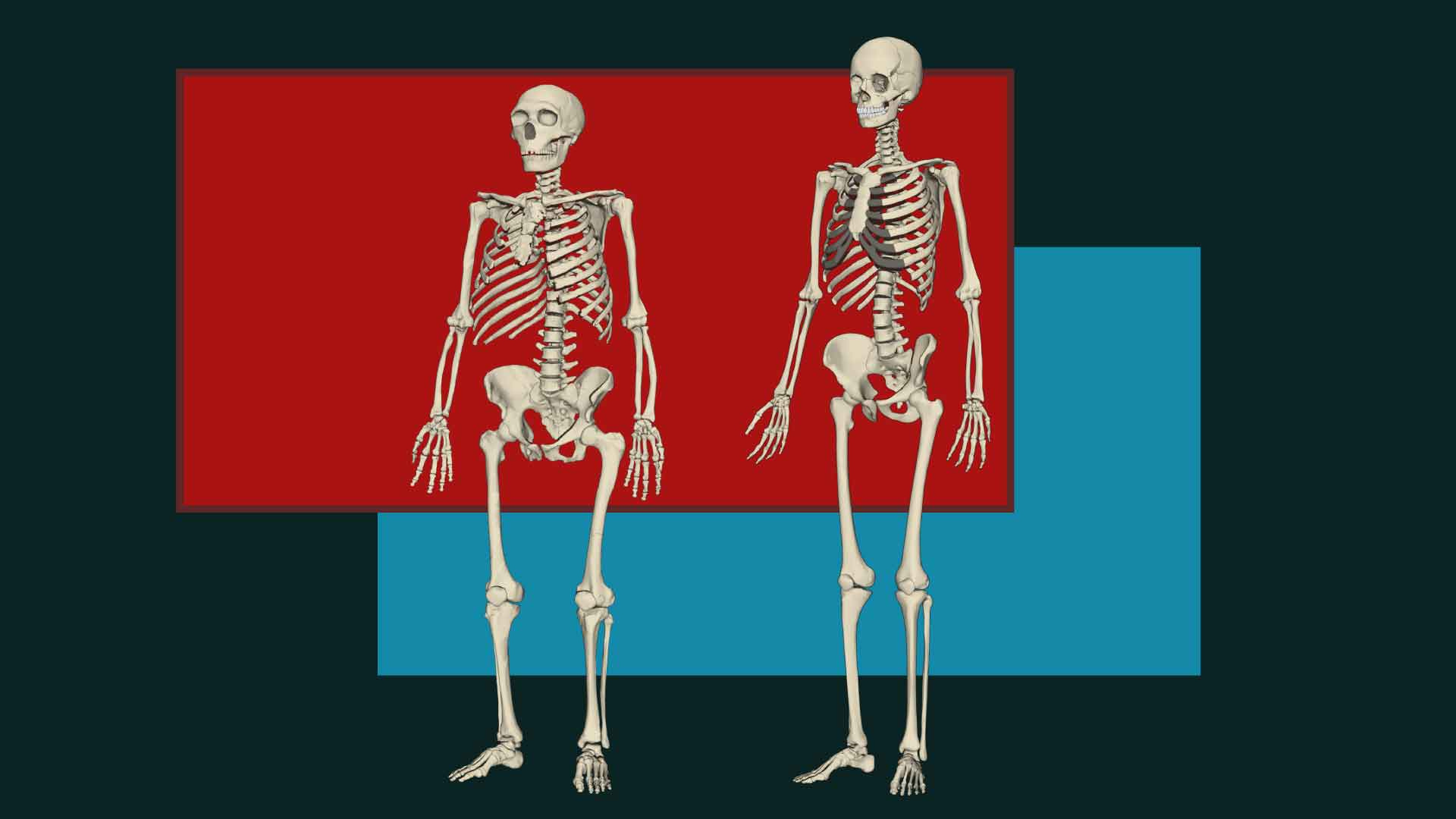
Some of the regular occurrences in my inbox are messages from women who think their husbands have an excess of Neanderthal genes. Usually the clues are stereotypical. Excessive body hair is a common theme. A sloping forehead, bulky frame, maybe a unibrow.
Somehow it’s never men writing to me about their Neanderthal wives. Still, men do write sometimes on their own behalf. More than one has offered himself up for research.
Caveman traits come from cavemen, the logic goes. People readily apply this kind of folk reasoning. Many people think their dark-haired grandfather must have Native American ancestry, or that their “Roman nose” came from Italian ancestors. Mostly this kind of folk reasoning is wrong. Skeletal structure, hair patterning, and facial shape are highly polygenic. Such traits are not easily attributed to distant ancestors like Neanderthals. The effects those genes may have are much more subtle, a small proportion of the variation of traits that can be measured.
As geneticists study larger and larger samples of living people, they are beginning to sort out such subtle effects of genes from Neanderthals. A new paper from Philipp Kanis and colleagues is a really good example of this kind of work. These researchers characterized a Neanderthal haplotype including the GHR gene, the growth hormone receptor. Working with biobank-scale data from more than a million individuals, they found that people who carry the Neanderthal haplotype have a bit higher lean muscle mass, are a bit taller, and have some differences in their mandibular growth from other people.
Those traits don’t all fit the Neanderthal stereotype. More muscle, maybe. But the greater height of Neanderthal GHR carriers may surprise people. After all, the textbooks say that Neanderthals had shorter stature than modern humans.
However, this is a case where the stereotype was based on limited and unrepresentative data. The European Neanderthals were indeed a bit shorter in stature than the Upper Paleolithic-associated modern people that followed them in Europe. Those Upper Paleolithic people themselves were among the tallest people in prehistory. Looking at a broader range of populations, most people have been shorter through most of history.
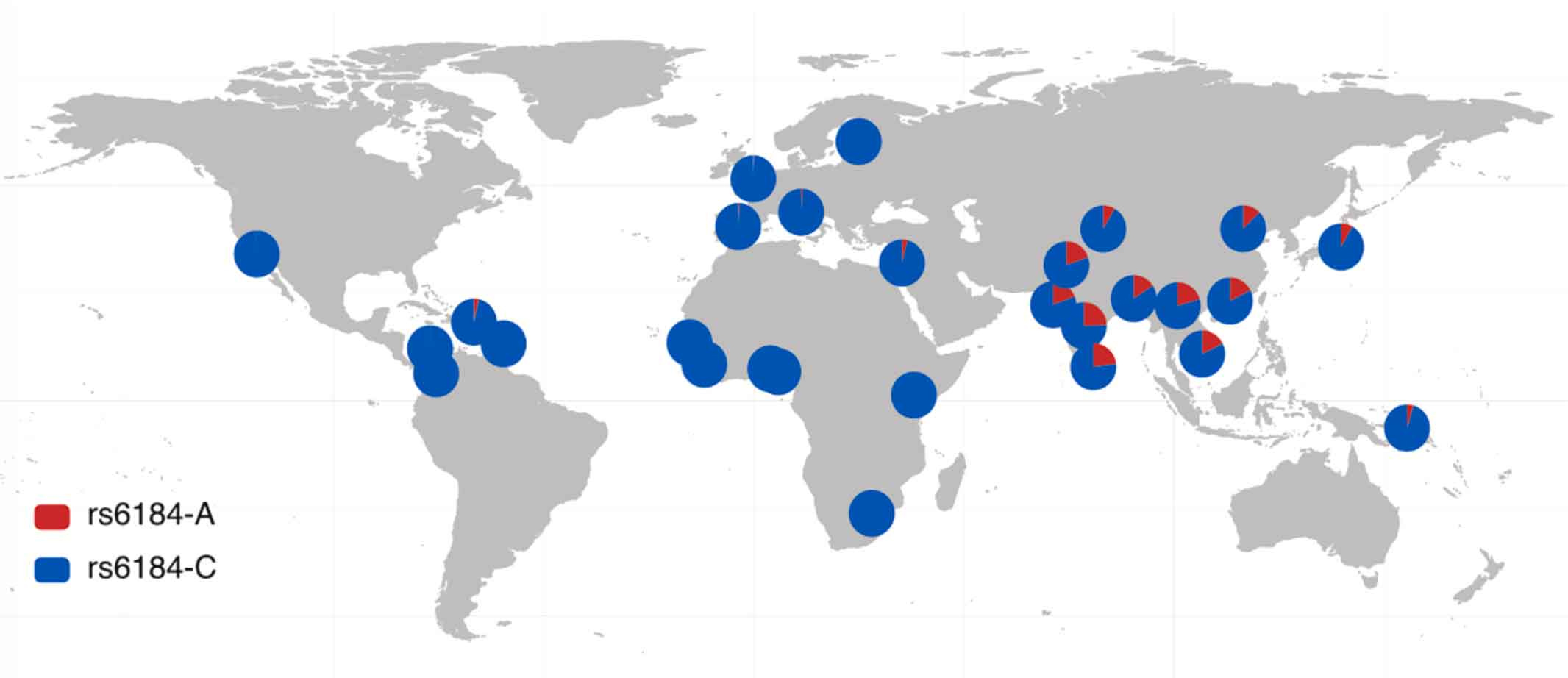
In large parts of Eurasia today, living people average shorter than Neanderthals. Those populations happen to include many where the Neanderthal GHR haplotype has the highest frequencies, in South and Southeast Asia.
The GHR difference
The study by Kanis and coworkers began from a survey of genes in the hypothalamic-pituitary-somatotropic (HPS) axis, involved in regulation of growth. The growth hormone receptor is one of these, and has several differences in Neanderthals that are also carried by many people today. One key difference is the deletion of one of the exons of the gene, which is shared by all known Neanderthal and Denisovan genomes. Two amino acid-coding changes in another part of the gene are shared across the three high-coverage Neanderthal genomes, as well as most living people who have inherited this haplotype.
Kanis and coworkers report on cell line experiments to understand the effect of the Neanderthal variants. They found that cells engineered with the Neanderthal GHR variant grow faster. This faster growth only happened in response to pituitary growth hormone, and not from placental growth hormone. That’s an indication that prenatal development is not strongly affected by this Neanderthal variant, which Kanis and coworkers could confirm by looking at birth weights in their biobank datasets.
The faster cell growth in experimental cell lines does seem to reflect something about the growth of people with this haplotype, although the differences are subtle. The most consistent measured differences are a slight increase in stature (3 millimeters per copy) and body mass (285 grams per copy). That increase in mass is largely explained by lean mass.
Those differences are highly statistically significant within the very large samples included in the study, more than a million individuals across all samples. But their effect size is not gigantic. Three millimeters of height is just not all that much for any one individual.
The study mentions other differences that have previously been investigated by other researchers interested in skeletal development. Those include differences in jaw shape, tooth roots, and hip circumference, and these are also subtle but consistent. The previous research on jaw growth shows the Neanderthal variant associated with shorter mandibular ramus height that sometimes leads to malocclusion. It seems to me a very interesting question how this gene interacts with others in their effects on mandibular variation.
The frequencies of the Neanderthal GHR variants are not generally high enough to make me suspect they must have been under selection, but they are more common than most Neanderthal genes today. Was this pattern useful? A bit of extra height and ten ounces of muscle seem like they might matter to variation on athletic performance, or normal growth and development. There have not been any studies to show that these GHR variants matter to athletic performance or aspects of health where strength or endurance matter. But these too will be interesting areas to examine.
Overall this study is a lot like many other studies of genetic influences on traits in today’s people. Most traits are affected by many, many genes, and each gene has a small effect on the overall variation in the trait.
Neanderthals and body size
Richard Clark recently completed a PhD thesis looking at growth and development in fossil humans, including Neanderthals. This has a current list of Neanderthal stature estimates. The average stature estimate across 19 Neanderthal individuals assessed as male is 166.2 cm, ranging from 155 to 181 cm. Across 13 individuals assessed as female, the average is 156.8 cm and range from 149 to 163.
Those numbers are often compared to contemporary European populations. In that context, the Neanderthals seem short. The average height of men across European countries today varies between 6 and 10 or more centimeters taller than the Neanderthal average. The tallest Neanderthal is close to average for today’s Dutch or Serbs.
But that picture is quite a narrow window in a rapidly changing landscape. Stature in human populations has been increasing across the last century, at a rate that differs in different countries. This is explained largely by nutritional improvements but lower disease and parasite burden also makes a difference.
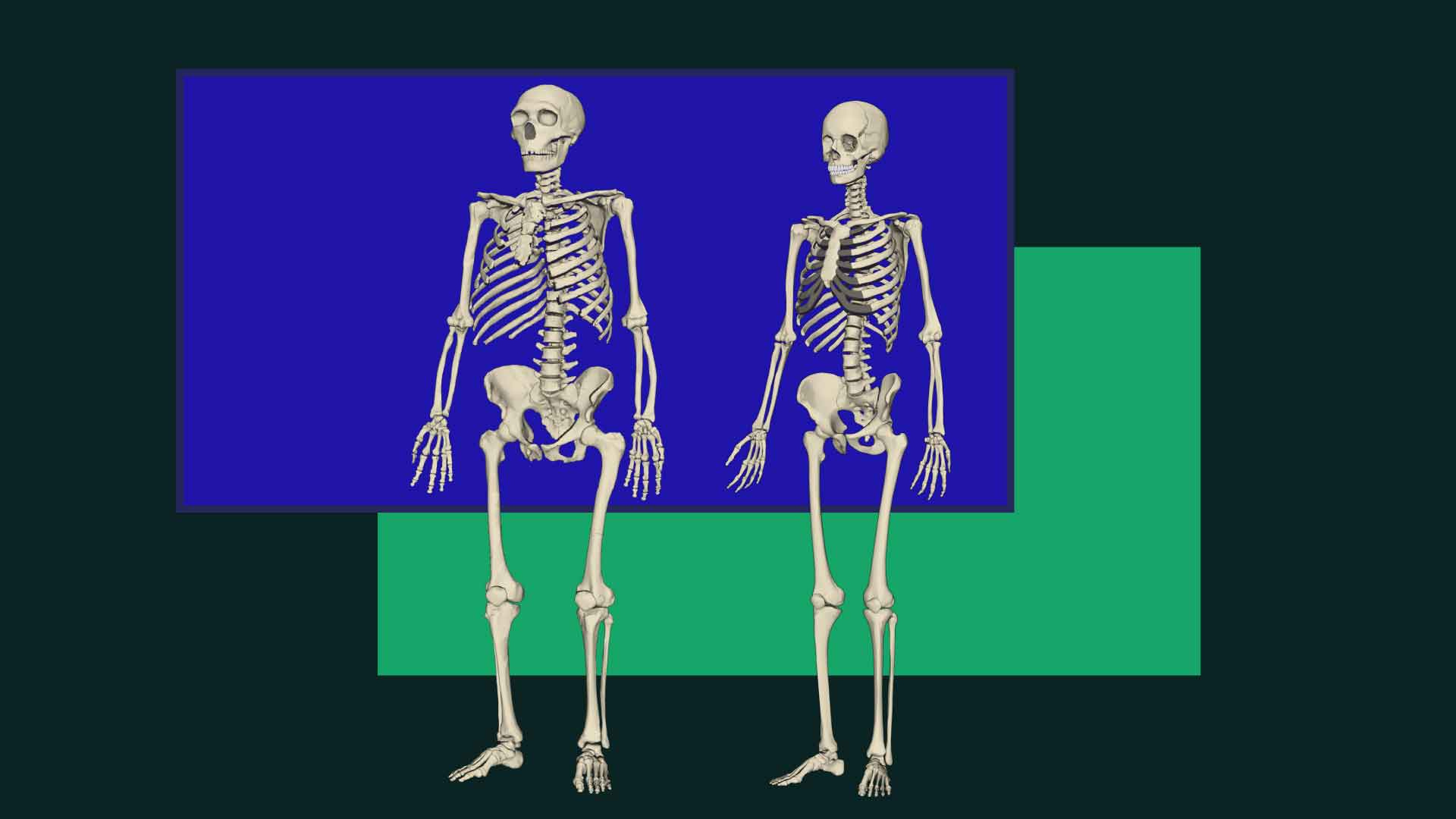
The right comparison to make with a prehistoric group like Neanderthals is not obvious; clearly they did not have the nutritional circumstances of present-day Americans but also some of the shortest populations in the world like Guatemala may not be good analogies. Present-day hunting and gathering peoples have short stature. In a 2020 paper, Michael Little reviewed data from these groups, finding there are no present-day foragers with male average stature above 160 cm and none with female average stature above 150 cm. By this standard, Neanderthals were giants.
The groups today with the highest frequencies of the Neanderthal GHR haplotype are in South Asia, Southeast Asia, and East Asia. Here, the Neanderthals compare as a bit larger than most but not all present-day countries.
Angus Deaton in 2008 reviewed the stature and health statistics of populations in India, using the National Family Health Survey conducted by the Indian government in 2005-2006. He gives statistics for 29 states, 20 of which had average male height below 166.2 cm. None of the 29 states had female stature above 154.9 cm. Yet stature in India has increased in the last two decades, and in North India the average man is larger than the Neanderthal male mean, even though the 1996 birth cohort nationwide has not yet reached that average. The story is different for women, who average shorter than Neanderthal estimates.
Some of the most comprehensive global statistics on height come from the NCD Risk Factor Collaboration. These have been widely cited including within the “Our World in Data” website sections on human height. A 2016 paper in eLife reports on “A century of trends in human height” with data from 1896 to 1996. The 1996 birth cohort has adult male stature below 166.2 cm in all countries of Southeast Asia except Thailand. The 1896 birth cohort has all countries of East and Southeast Asia below 166.2 cm in height for male adults. The pattern for female height is largely the same, below 156.8 in the 1996 birth cohort for all South, Southeast Asia countries other than Thailand, and the 1896 birth cohort all countries across the region.
Bottom line
A lot of the biological work on Neanderthals has been based on stereotypes of their differences from modern humans. Too often, these studies have ignored the variability within the Neanderthal sample. They also have tended to obscure the vast overlap in body sizes across human populations, using values for “modern humans” that are globally unusual.
Genes like GHR provide biological reasons for extensive overlap in stature, muscle, and other aspects of body size and proportions among human populations. The variation in this gene has been selected in some small-bodied human groups, including Central African forest hunter-gatherers. The Neanderthals may represent a different pattern of selection, for faster growth. The recent work on childhood growth and development in Neanderthals has pointed to the possibility of faster somatic growth and maturation compared with many modern people. I’ll be interested to see how GHR may factor into those observations from skeletal data.
Still, the overarching pattern there, too, may be variability. Today China, India, Indonesia, and adjacent areas have more than 750 million copies of the Neanderthal GHR variants, based on estimated frequencies in these populations. An average effect size of 285 grams per copy means that around 200,000 metric tons of human muscle can be attributed to this Neanderthal inheritance. That’s two aircraft carriers worth of mass. Adding up the three millimeters of height across all those copies would reach from Beijing to Hong Kong.
The effects of these genes are small for any one individual. It’s not about hair on your back or massive biceps. But those effects add up in today’s immense populations, becoming visible across biobank-scale samples. That’s the reality of our inheritance from these archaic people.
References
Clark, R. (2026). Neanderthal Growth and Development: A Survey [PhD]. University of Sheffield.
Deaton, A. (2008). Height, Health, and Inequality: The Distribution of Adult Heights in India. American Economic Review, 98(2), 468–474. https://doi.org/10.1257/aer.98.2.468
Kanis, P., Berreiter, M., Sieme, D., Wootton, O., Ju, X.-C., Holzwart, N. E., Hu, D. Z., Tadaka, S., Taira, M., Kinoshita, K., Ågren, R., Olsen, J. G., Maricic, T., Martin, H. C., Kragelund, B. B., Pääbo, S., Brooks, A. J., & Zeberg, H. (2026). Increased signaling of the Neanderthal growth hormone receptor. Current Biology, S0960982226008900. https://doi.org/10.1016/j.cub.2026.07.025
Little, M. A. (2020). Evolutionary Strategies for Body Size. Frontiers in Endocrinology, 11, 107. https://doi.org/10.3389/fendo.2020.00107
NCD Risk Factor Collaboration (NCD-RisC). (2016). A century of trends in adult human height. eLife, 5, e13410. https://doi.org/10.7554/eLife.13410
If these alleles weren't under selection, why would they be so much more common amongst contemporary East compared to West Eurasians? It's been pretty well established, I think, that there was only a single Neanderthal pulse into the common pan-Eurasian ancestral population, as opposed to the multiple different Denisovan populations which were introgressed into East Eurasians. East and West Eurasians both have the same Neanderthal ancestors, but something in the East Eurasian context drove these alleles under at least a moderate selection, it seems.
I also see the paper references another super interesting growth hormone receptor allele, GHRd3, a deletion in one of the GHR exons which has had some literature around it over the years. The deletion is associated with low-birth rate but otherwise accelerated post-natal growth. It was fixed in archaic humans, remains most common in Africans, but less common in Eurasians, with East Eurasians having the lowest occurrence. So we have here multiple different GHR alleles, this deletion being strongly negatively selected in EEs but these two new reported alleles maybe being mildly selected for - maybe as compensation for negative selection on GHRd3?