

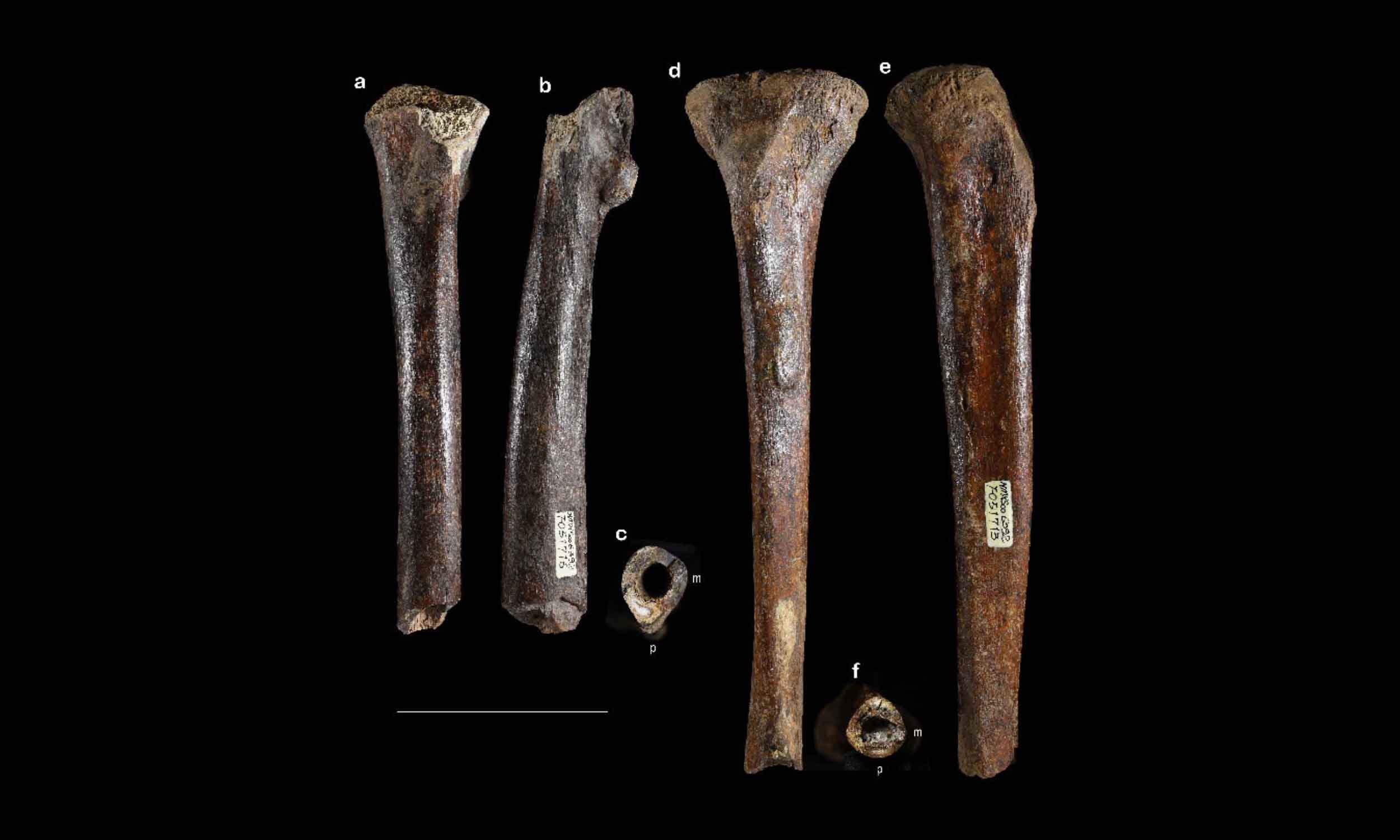
Two new Denisovan fossils have emerged from the seafloor of the Penghu Strait, near Taiwan. The fossils, a partial femur (Penghu 2) and tibia (Penghu 3), belong to two different individuals and were first identified as hominin in 2010, found among fossils collected by Mr. Li-Ren Hou, a Taiwanese artist. Described in a new preprint by Yousuke Kaifu and coauthors, the two bones are both identified as Denisovan based on collagen protein sequences.
An accompanying preprint led by Minoru Yoneda looks at the evidence of stable isotopes from these bones to understand their dietary niche. The results show their diet to have been a lot like European Neanderthals, focused on protein from large mammals.
The two fossils give a new perspective on the later part of the Denisovan existence in eastern Asia. They provide more evidence of the value of exploring fossil deposits on the now-submerged continental shelves.
The importance of late Denisovans
There has been a paradox in the Denisovan record up to now. Their western relatives, the Neanderthals, are abundantly known from archaeological contexts dating to the period between 70,000 and 45,000 years ago. The nature of the Neanderthal record is so skewed toward this time period that many researchers have called these the “classic Neanderthals”.
The fossil record of eastern Asia, by contrast, has few hominin fossils from this same time period, and none of them have been attributed to Denisovans.
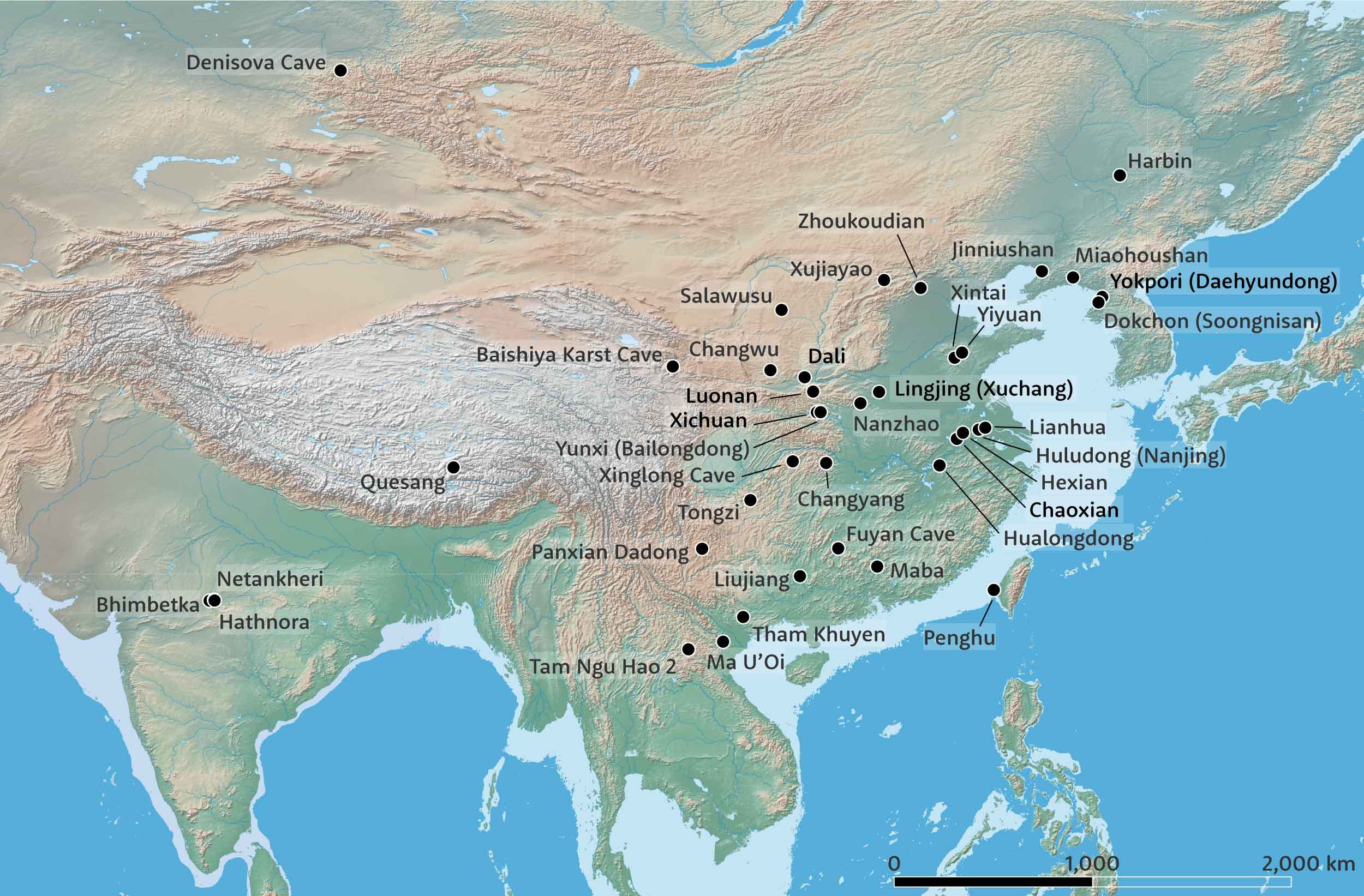
That the Denisovans were present in some parts of the region is made clear by evidence from Central Asia and Tibet. The Denisova 3 finger bone does not have a direct geological date, but an approach from the genome itself known as Bayesian tip dating suggests this individual lived between 76,000 and 52,000 years ago. The Denisova 4 molar is of comparable age. The latest ages detected from sediment DNA for Denisovan presence at the site are between 51,000 and 45,000 years ago. That coincides with the time of modern human arrival in the sediment record at Denisova. At Baishiya Karst Cave, sediment DNA gives strong evidence for Denisovan presence in the period between 100,000 and 60,000 years ago. There’s a hint of evidence there from later periods, even down to 30,000 years ago, although the team responsible for those results has suggested that such results might reflect sediment reworking.
Puzzlingly there is no site in mainland China with clear fossil evidence from this time interval attributable to Denisovans, nor to any other archaic form of human. The well-known Harbin skull, along with fossils from Dali, Xujiayao, and Jinniushan, are all Middle Pleistocene in age. The latest fossil material in mainland China that may be Denisovan include the crania from Xuchang, from the earliest Late Pleistocene, and the Penghu 1 mandible from the Taiwan Strait is thought to be older than 70,000 years. Possible Denisovan fossils from island Southeast Asia, such as the Ngandong series of fossil hominins, are also in excess of 100,000 years.
The few East Asian sites with fossils dated to this interval between 70,000 and 45,000 years ago have been wrapped in a different controversy: whether an early branch of modern humans may already have been present. Fossil material from several cave sites ranging from 120,000 to 70,000 years ago, has been called “modern”, including fossils from Fuyan Cave, Liujiang, and Zhirendong. Each of these sites has attracted critics who argue that the geological ages are incorrect, or the context of the fossils is not clear. That’s a big topic beyond this post. But one reason for this controversy is the lack of any equivalent to “classic Neanderthals” at this end of Eurasia.
This mismatch of evidence between eastern and western Eurasia has confused a lot of people about the nature of Denisovan evolution. In Europe, the later Middle Pleistocene of early Neanderthals is extensive, starting with Sima de los Huesos and running through fossils from Caune d’Arago, Petralona, and Steinheim. These are the right fossils for comparison with the contemporary record from East Asia. The Harbin mtDNA is closest to the Denisova 25 individual, which represents the earlier frame of Denisovan presence in central Asia. Late Pleistocene Neanderthals are a misleading comparison for this earlier Denisovan population.
Penghu dating
For me the major value of the new Penghu 2 and Penghu 3 fossils is that they may be a first step in filling this vacuum. This is because of the radiocarbon date from the Penghu 3 tibia, a calibrated date of 45,575 to 44,522 cal BP.
Yoneda and collaborators screened 72 of the fossils from the Penghu collection including all three of the hominins for collagen preservation sufficient for radiocarbon dating. Penghu 3 was one of four they found with adequate collagen, together with three bones of other animals. Two of those yielded dates slightly younger than the tibia, but still over 40,000 years ago. The result from one other specimen was not reported.
I was very interested to see that both Penghu 3 and 2 were examined by Rainer Grün, who carried out uranium-series dating on the bones. These results, reported by Grün and Stringer in 2023, showed that the femur Penghu 2 lacks a basis for U-series age determination, but the Penghu 3 tibia seemed to have a consistent signature of early uranium uptake consistent with an age in excess of 160,000 years ago. The radiocarbon results obviously are a direct conflict with this U-series data. This is not a minor difference, the two methods yield divergent estimates of geological age by a factor of four.
What does this conflict mean? For fossils inundated by seawater less than 20,000 years ago, maybe a U-series determination is just likely to be wrong. That’s one possibility. But uptake in the Penghu case should be one of the simplest to model. Uranium isotope abundances in seawater should have been fairly stable, and the question is whether inundation was limited to the end of the last glaciation after 20,000 years ago, whether there was inundation during the previous interglacial before 130,000 years ago, or whether the bones were deposited in sedimentary conditions by water at the time of their deposition, possibly earlier.
Finding a radiocarbon age from purified collagen is pretty convincing evidence that all the uranium modeling was wrong. This has broader implications for the many, many other cases where a radiocarbon age is impossible to obtain. Many of the East Asian fossils are dated by U-series uptake in bone or teeth. Many of those dates have been the subject of critiques, but not often in cases where a radiocarbon date can immediately test the validity of the U-series modeling. I wonder how many of the U-series dates are just like the Penghu 3 date, wrong by a factor of 4 or more.
That would include date estimates for the Harbin skull, for example, which lacks contextual information.
The radiocarbon ages from Penghu 3 and the two faunal bones leave open the question of whether some or all of the other Penghu fossils are of similar age. The source of the fossils is indiscriminate trawling across the seafloor. They may come from entirely different depositional situations, and need not represent any single range of time.
“There is no record to know when and where in Penghu Channel each of these leg bones was collected…”—Yousuke Kaifu and coworkers
One way of looking more at the context might be increased proteomic or DNA evidence about relationships. For the current data, it’s not clear among Penghu 1, 2, and 3 whether they form a single group or whether one of them may be closer to other Denisovan populations. The Bayesian trees from the protein data leave it ambiguous how they connect to Denisova 3.
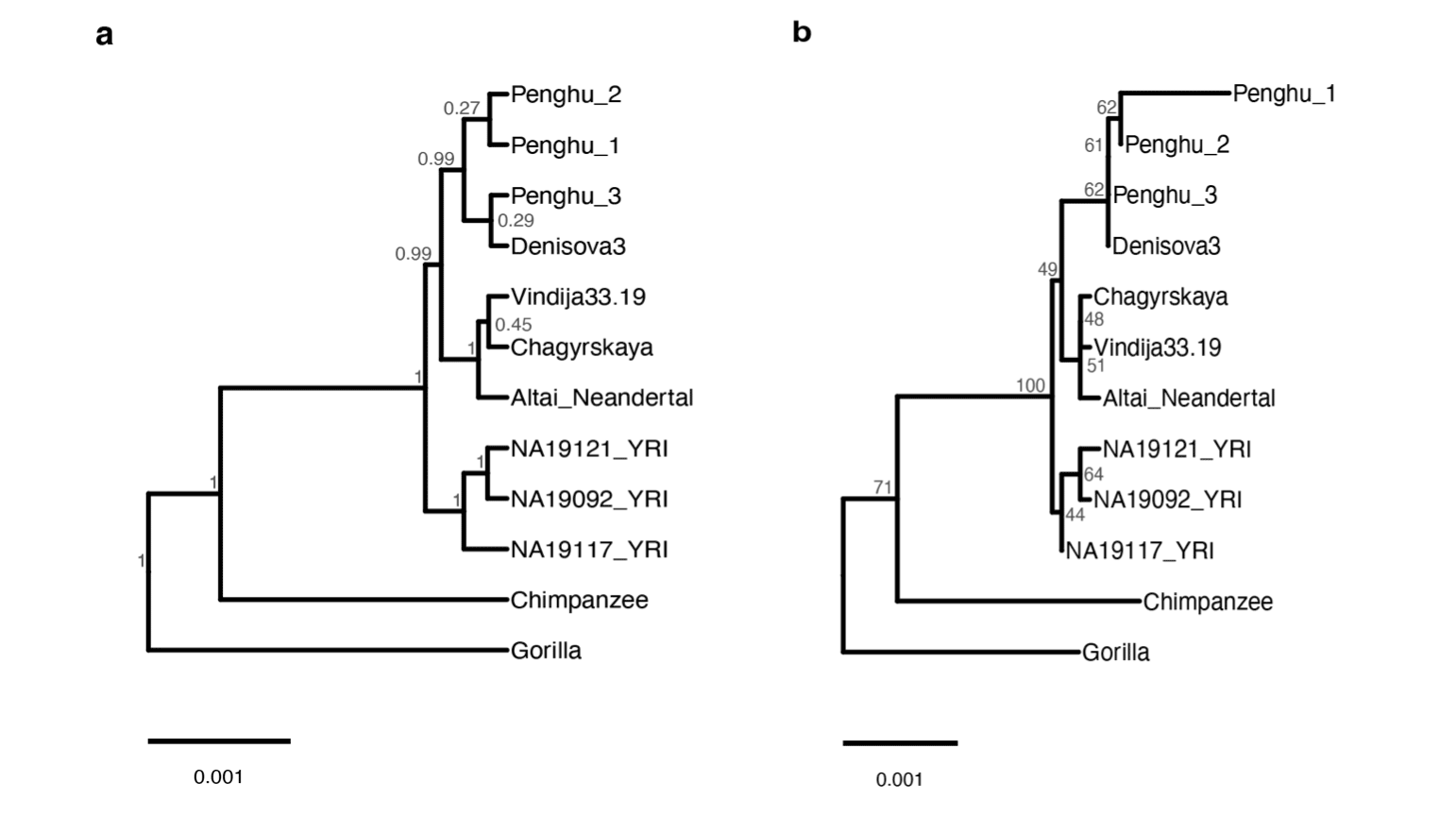
If collagen is well preserved in Penghu 3, I’m hopeful that DNA may also be present. That may provide vastly more information about late Denisovans than we have had to date, particularly by looking in detail at the relationships with the Denisova 3 genome.
At any rate, the papers suggest that modern humans were already present in China and eastern Asia at the time that the Penghu individuals lived. This to me is questionable. We lack a clear resolution of what hominins were present prior to the 40,000-year-old Tianyuan skeleton, which shows full evidence of connection to the main dispersal of modern humans, after 50,000 years ago.
Biology of the late Denisovans
Kaifu and collaborators focused on the relatively large size of the two lower limb elements. These suggest ancient individuals upwards of 80 kg in mass and 180 cm in stature, among the larger known body sizes for Pleistocene humans. Those are near the top of the Neanderthal range. They are certainly large in comparison to known Asian Homo erectus fossil postcrania, but the sample sizes for groups other than Neanderthals are pretty small, so I wouldn’t make too much out of the sizes of these elements other than to say that they are human.
I’ve pointed before to the sample bias among the known Denisovans, which seems to include mostly male individuals. With the Penghu material, there are several possible avenues for a size bias to propagate. Larger and thicker elements are more likely to be caught up in the trawling nets and survive damage to preserve identifiable morphology. For a collector, these morphologically well-preserved elements are more likely to stand out, while especially thinner and juvenile elements are less likely to be readily recognizable.
Those biases are less likely to affect the stable isotope composition of the bones, and that’s where the study by Yoneda and coauthors may have a broader application than the conclusions on body size. The nitrogen stable isotopes show that the Penghu 3 individual had a trophic level similar to carnivores, which is also similar to Neanderthals. Meanwhile, the individual’s carbon came from a mainly C4 plant landscape. That’s not surprising for the southern and coastal situation of Penghu, but is a bit different from Neanderthals and from the early modern human from Tianyuan, in northern China, where a C3 plant landscape existed.
That suggests the ecology and subsistence of the Denisovans in this time interval was a lot like that of Neanderthals. These little details are always useful in thinking about the adaptability of these human populations across a very wide geographic range.
Note: Thanks to an alert reader for flagging these new preprints the day they appeared. I always appreciate tips on great new work that merits reading.
References
Chang, Chun-Hsiang, Yousuke Kaifu, Masanaru Takai, Reiko T. Kono, Rainer Grün, Shuji Matsu’ura, Les Kinsley, and Liang-Kong Lin (2015) The first archaic Homo from Taiwan. Nature Communications 6:6037 doi:10.1038/ncomms7037
Grün, R., & Stringer, C. (2023). Direct dating of human fossils and the ever-changing story of human evolution. Quaternary Science Reviews, 322, 108379. https://doi.org/10.1016/j.quascirev.2023.108379
Kaifu, Y., Chang, C.-H., Tarusawa, Y., Sawafuji, R., Yonemoto, S., Shimamura, S., Takai, M., Kono, R. T., Sun, C.-H., Tsai, C.-H., Yoneda, M., & Tsutaya, T. (2026). Denisovan leg bones from Taiwan reveal large body size. bioRxiv. https://doi.org/10.64898/2026.08.07.743438
Tsutaya, T., Sawafuji, R., Taurozzi, A. J., Fagernäs, Z., Patramanis, I., Troché, G., Mackie, M., Gakuhari, T., Oota, H., Tsai, C.-H., Olsen, J. V., Kaifu, Y., Chang, C.-H., Cappellini, E., & Welker, F. (2025). A male Denisovan mandible from Pleistocene Taiwan. Science, 388(6743), 176–180. https://doi.org/10.1126/science.ads3888
Yoneda, M., Chang, C.-H., Itahashi, Y., Tsutaya, T., Sun, C.-H., Tsai, C.-H., & Kaifu, Y. (2026). Habitat and feeding ecology of a Denisovan from Late Pleistocene Taiwan. bioRxiv. https://doi.org/10.64898/2026.08.07.743455
Zhang, D., Xia, H., Chen, F., Li, B., Slon, V., Cheng, T., Yang, R., Jacobs, Z., Dai, Q., Massilani, D., Shen, X., Wang, J., Feng, X., Cao, P., Yang, M. A., Yao, J., Yang, J., Madsen, D. B., Han, Y., … Fu, Q. (2020). Denisovan DNA in Late Pleistocene sediments from Baishiya Karst Cave on the Tibetan Plateau. Science, 370(6516), 584–587. https://doi.org/10.1126/science.abb6320
Wow, it's great to have more Denisovan bones! Even greater if some of them would yield DNA.
Regarding presence of HS around 40 kya in SE in this are, my view is that it should be nearly certain. By 45 kya we have confirmed modern human presence in such a wide area with a huge variety of landscapes and climates - in very low temperatures (from Ust Ishym to estuaries of Yenisey, Lena and Yana), in Sahul and likely in Tibet. Settlements of Japan and Andamans are also estimated before or around 40 kya. Why would not they be present in a subtropical coastal region near Taiwan?
There are even indications that early humans might be present in Americas by that time, as there are several credible sites that go to this time depth, such as Pedra Furada and maybe Hartley.