

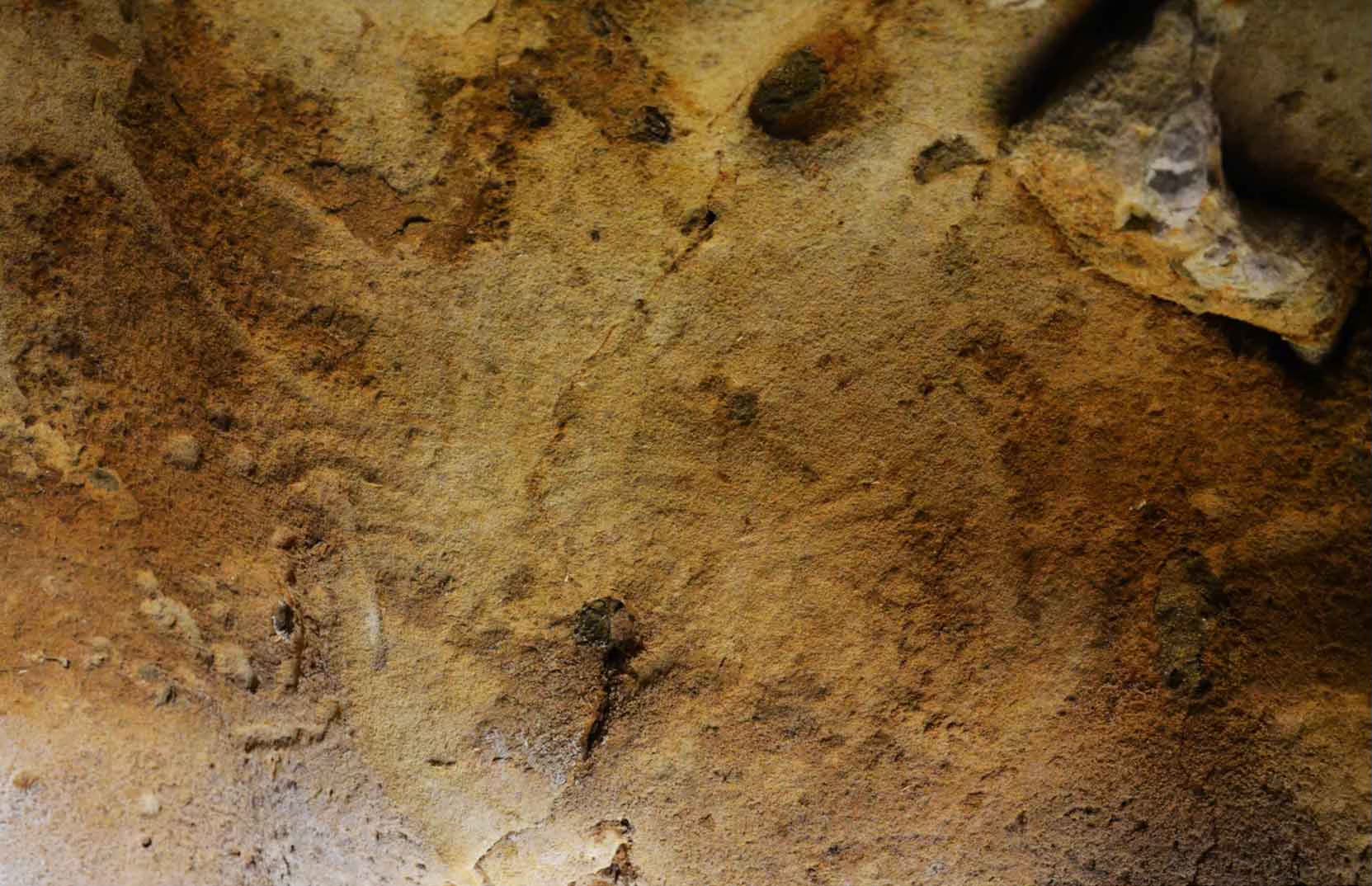
A few weeks ago I looked at the remarkable underground structures in Bruniquel Cave, created by Neanderthals more than 170,000 years ago and sealed until their recent discovery by cavers. Another cave with a similar history is La Roche-Cotard, around ten kilometers west of Tours, France.
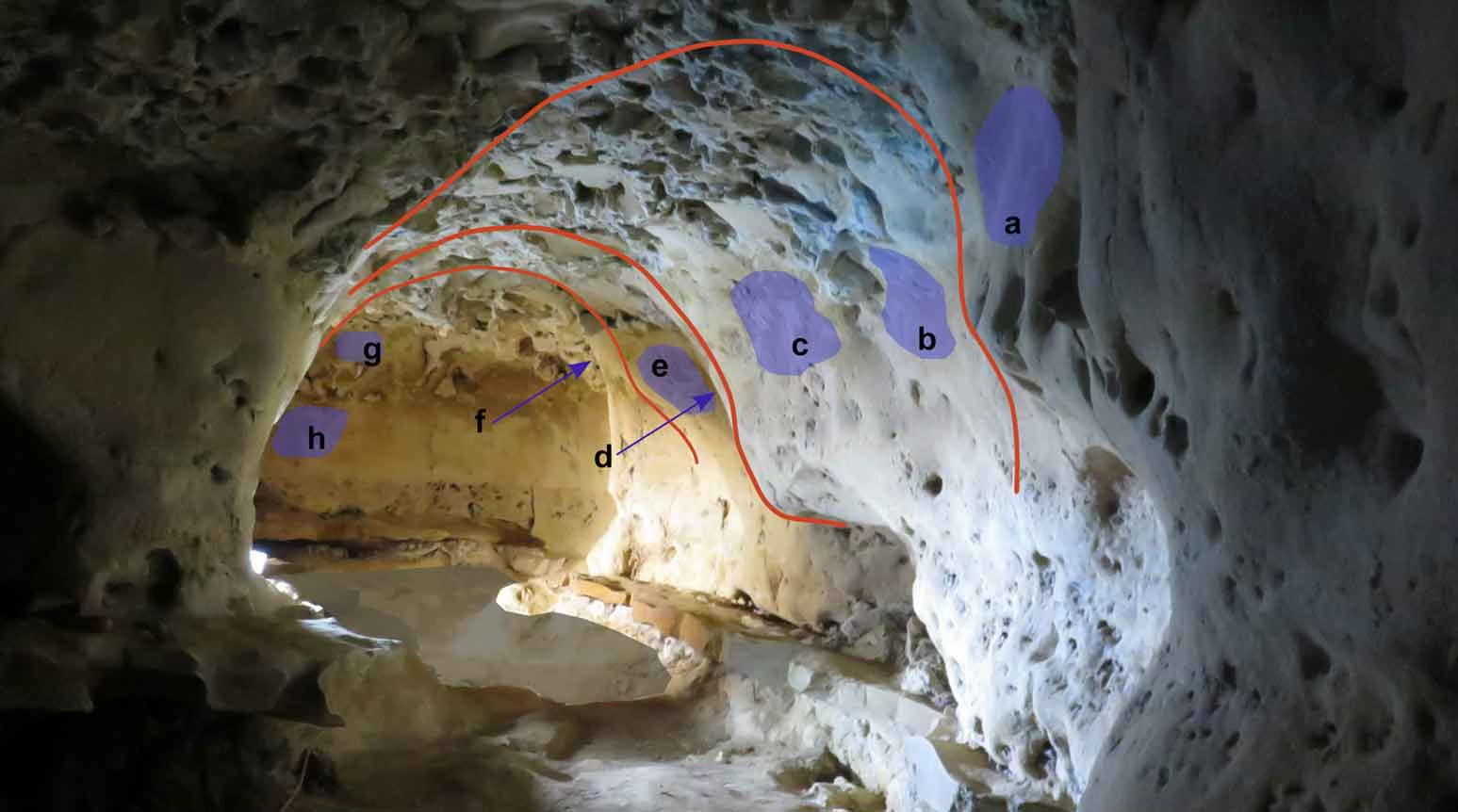
Within an area known as the Pillar Chamber, around 15 to 20 meters from the current cave entrance, Neanderthals marked several parts of the cave wall. They made these marks with their fingers, tracing them firmly into a soft surface layer of the cave wall that still covers the harder bedrock beneath.
The entrance of the cave was uncovered in 1846 when railway workers were quarrying sand and gravel to build an embankment. Before that, the cave had been sealed under deep layers of sediment.
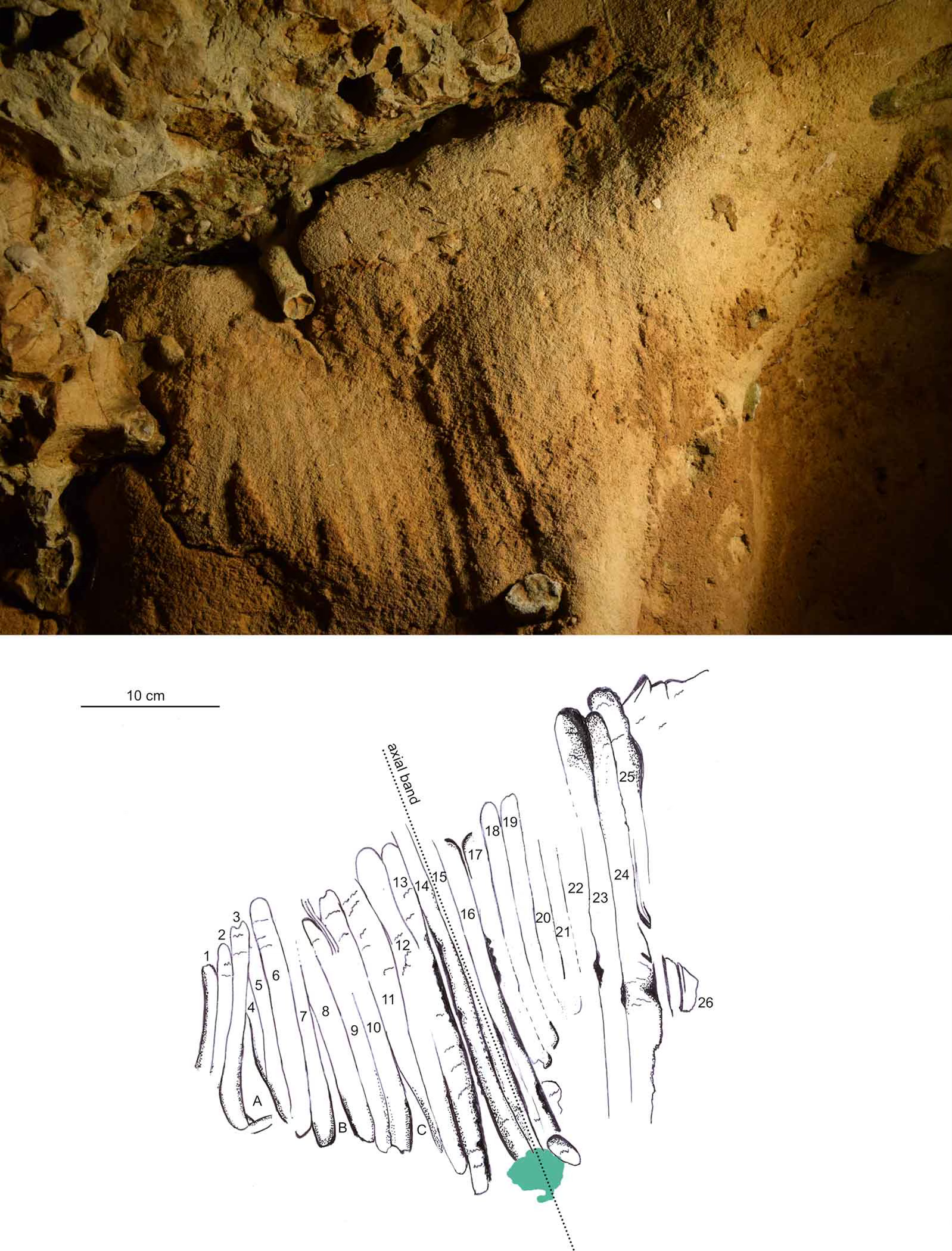
In a recent paper, Jean-Claude Marquet and coworkers described the panels of finger markings, each including dozens of parallel lines often converging into shapes or filling areas of the wall. The researchers also applied OSL dating to remaining sediments outside the cave entrance, to better understand the time that these sediments closed up the cave entrance. They determined that the cave closed around 57,000 years ago, with a minimum (95%) age of 51,000 years. This date is only a minimum for the engraved markings inside the cave, which may have been made much earlier. Whatever their true age, they were made before any evidence of modern humans in this region of France.
Finger-flutings
The cave of La Roche-Cotard formed within a Cretaceous limestone that has a crumbly, sandy texture. The cave formed by gradual dissolution of the rock, which has left a relatively soft, thin clay surface still adhering to the hard cave walls. It is this surface that the Neanderthals could shape with their fingers, plowing little furrows.
The finger-flutings at La Roche-Cotard are the only ones known so far from Neanderthal times. Finger flutings and similar trace markings within soft sediment occur very widely in the ancient rock art record.
Hand and footprints in travertine at Quesang, China date to between 220,000 and 170,000 years ago, probably made by Denisovans.
On the southern coast of South Africa, geometric tracings made in ancient sand surfaces date to more than 100,000 years ago.
Finger flutings occur at many sites in Australia, with some of the oldest noted at Koonalda Cave, dating to more than 20,000 years.
Some Upper Paleolithic contexts in Europe have finger flutings, with notable examples including some of the earliest-known painted caves, El Castillo, Spain, and Chauvet Cave, France.
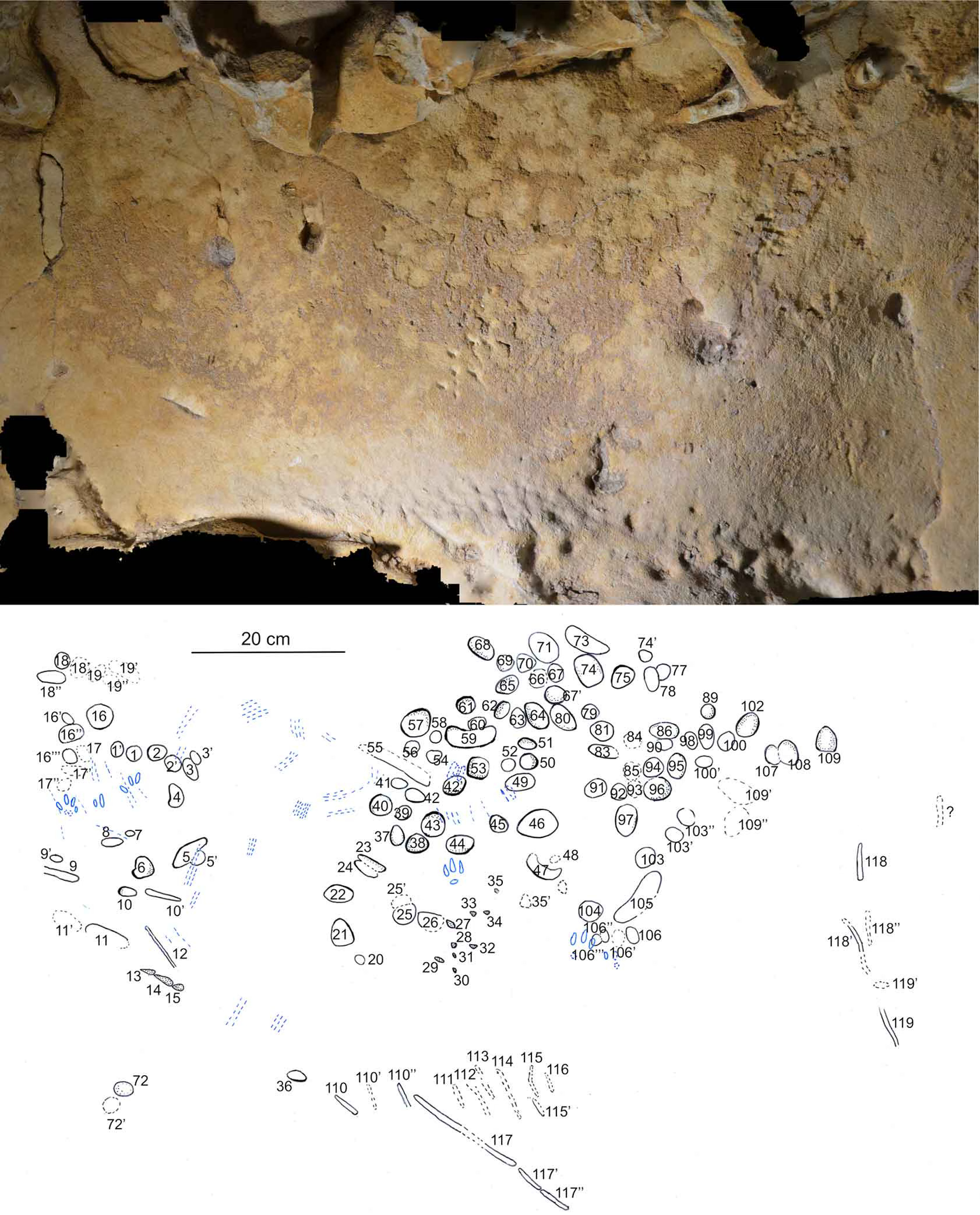
Why were these markings made? In some caves and rockshelters, the finger flutings are only a part of a more extensive corpus of painted or engraved markings. They were made in many different contexts, extended across different periods of time and different geographic regions.
This gives little reason to think there was a single impetus for these marks wherever they occur. They are just one of many ways that people have marked their environments. For the Neanderthals, geometric or repeated linear marks have been recovered from engraved pieces of bone from many sites, as well as from the floor of Gorham’s Cave, Gibraltar.
Over the years some researchers have suggested that finger-flutings were often made by children. The idea initially came from the unusual places where markings occur, including the high ceilings of cave chambers. Keryn Walshe, April Nowell, and Bruce Floyd evaluated this idea in a 2024 article, testing whether finger sizes could reliably be assessed from fluted markings. They found that the errors from measurement of such markings outweigh the small differences separating the sizes of adult and child fingers, and fingers of men and women, giving no basis for estimating the age or sex of people who made Upper Paleolithic fluted markings.
In La Roche-Cotard, Marquet and coworkers used an experimental approach to better understand the way the fluted markings were made. They were especially concerned to ensure that the marks could not be attributed to nonhuman species such as cave bears or hyenas—important because some claw marks consistent with cave bears do occur in the cave. But in their experiments, Marquet and coworkers found the smooth, repeated parallel nature of the finger-flutings were unmistakably human in their manufacture.
Red ochre markings
Evidence for pigments is quite abundant at many Neanderthal sites, including red ochre and black manganese dioxide. In some places it is clear that the pigments were reduced to powder and mixed with fluid. In others, small blocks or “crayons” of pigment show traces of wear upon them.
Pigment marks on perishable items do not survive long in archaeological settings. Rock walls inside of caves may sometimes retain such markings, but archaeologists have attempted to find minimum ages for only a few such marks in European cave sites.
Some of those date to Neanderthal times. Cueva de Ardales, Spain, has pigment marks with estimated minimum ages of 68,000 years ago. At other sites, marks on walls or red ochre stains on natural objects like shells show that the Neanderthals were applying pigment.
La Roche-Cotard also has a few red ochre marks, described briefly by Marquet and coworkers in a 2014 article. These small pigment spots occur within the area just beyond the Pillar Chamber and its fluted markings, in the passage toward the Hyena Chamber. Whether these were deliberately placed marks or incidental results of a painted hand or body surface placed on the rock surfaces is not clear.
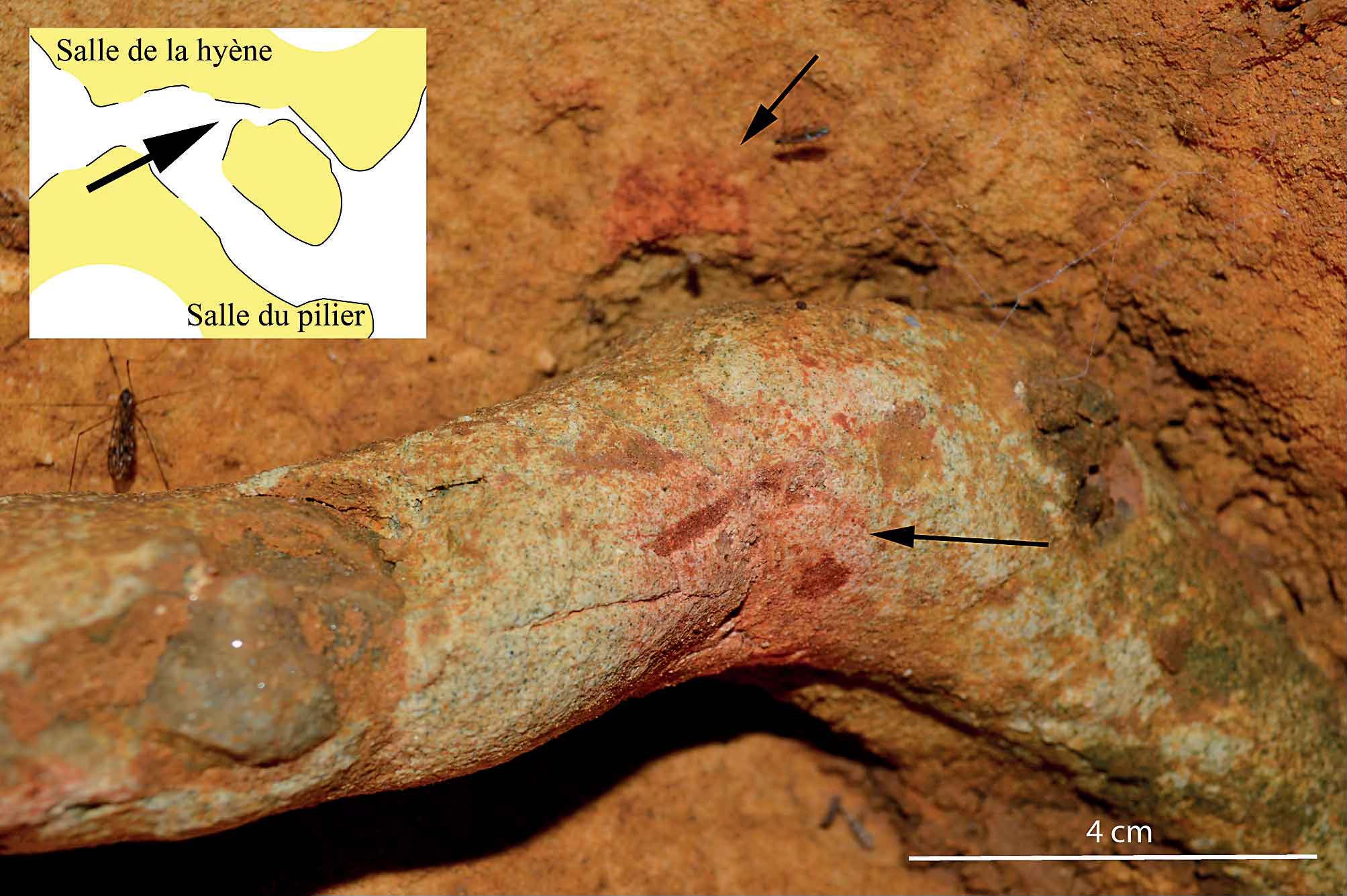
Marks like these occur in many cave sites, some much better known for figurative paintings that date to the Magdalenian or earlier Upper Paleolithic periods. In such contexts it has been common for rock art specialists to assume that all marks were made by artists from the same time period. But increasingly, researchers are recognizing that caves are palimpsests with marks made in very different eras by different populations of humans. Sometimes modern people walked into caves where Neanderthals had made their mark.
In La Roche-Cotard, they didn’t get the chance. The Loire River changed its course away from the north side of the valley in front of the cave. Sediments built up, no longer swept clear by the river, and covered the cave entrance, sealing the work of the Neanderthals within.
The “Mask” of La Roche-Cotard
The most enigmatic object comes not from inside the cave but from the sedimentary layers outside its entrance. In 1975, archaeologists put a trench into the terrace outside the cave to understand what lay beneath. Within layer 7 they found an array of Mousterian artifacts, butchered animal bones, and an apparent hearth. Among them was a curiously-shaped flint core.
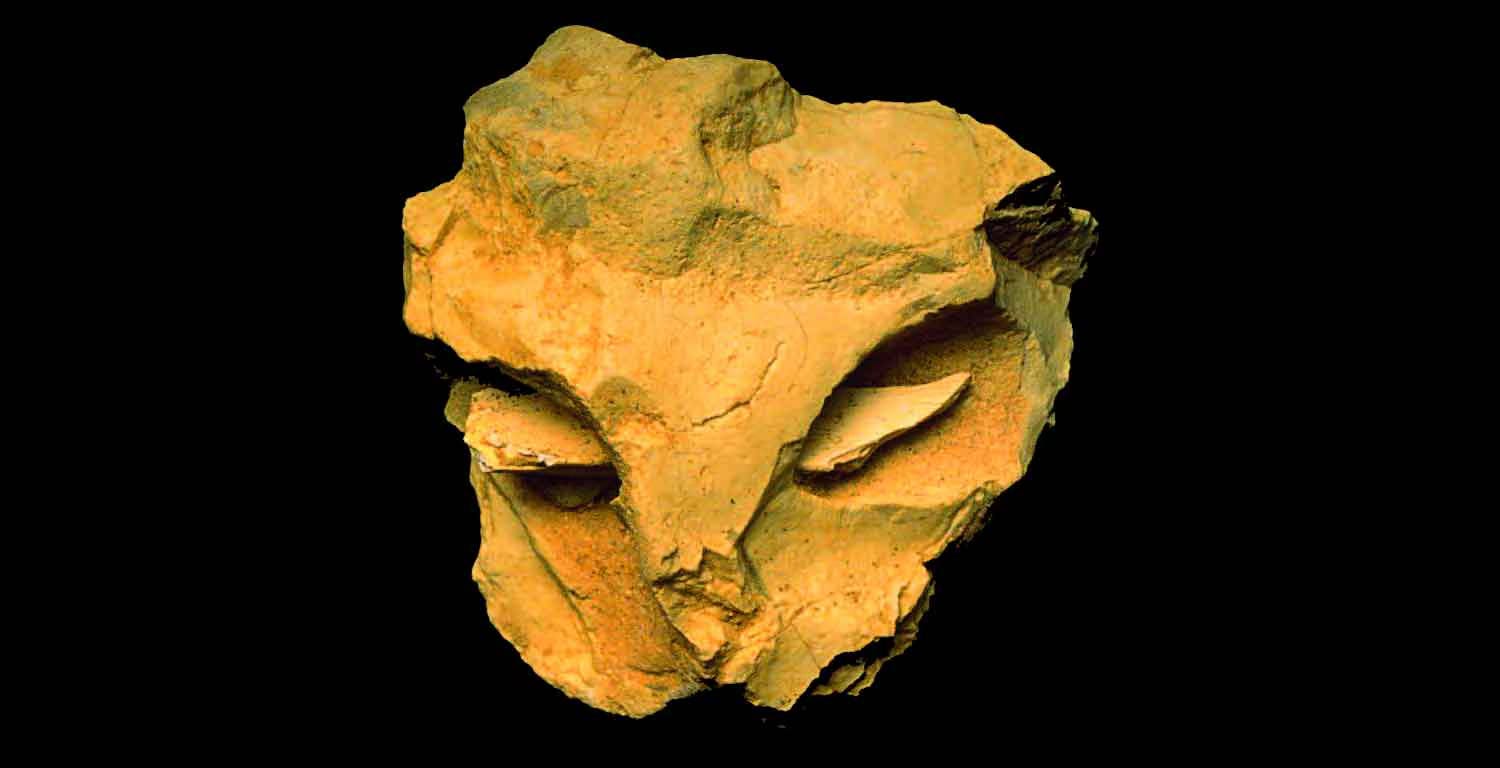
It has a roughly trapezoidal shape, flaked around the edges so that the shape and size were chosen by the maker or makers. There is a natural hole passing through the rock in the shape of a tube. Within this tube is wedged a long bone splinter, 74 millimeters in length, held in place by small pieces of flint.
The shape gives it the striking appearance of a face with eyes. After its discovery, Michel Lorblanchet called it a “mask”, and that is how it has been known ever since: the mask of La Roche-Cotard.
In 2016, Marquet and coworkers undertook a redating of the site using OSL, which reaches into time periods earlier than the 1970s-era radiocarbon results allowed. This is the same work that ultimately showed the cave closed before 51,000 years ago. They found that the layer 7 Mousterian assemblage outside the cave, including the mask, dates to 75.6 ± 5.8 thousand years ago.
As I started investigating this object, the thing that surprised me is how big it is. It’s roughly four inches in diameter and weighs just under a pound, 299 grams. This is no incidental product; somebody wanted it to look the way it does.
Does the object represent a human (or animal) face? Anyone who reads this site will not be surprised to hear that archaeologists have diverse opinions about this question.
Marquet and coworkers have proposed that the mask is similar to other objects from the deep archaeological record that resemble human forms, slightly shaped to enhance the resemblance. These pierres-figures, or figure stones, include such varied artifacts as the so-called “face” from Makapan dating to more than 2 million years ago, and the Berekhat Ram figure from Israel, more than 230,000 years old.
Bottom line
What do these markings say about the Neanderthals? As I’ve written many times, it is abundantly clear that these ancient people had an aesthetic sense. Markings like these cannot speak for themselves; they were part of a broader system that is invisible to us today.
There were hundreds, more likely thousands, of different Neanderthal cultures across their long existence. People within each culture came to know each other, and many of them found markings a way to reinforce their similarities or signal their differences. Some left signs for each other. Others marked places as a way of expressing their connection, ownership, or spiritual bond to their homes.
This cave site, with its south-looking entrance on the slopes above the great Loire River was no doubt the kind of place that the Neanderthals noticed and valued. When they built a fire outside it, eating their kill, who can say what a curious stone with a hole perforating it may have meant to them? Did it strike their fancy, inspiring a bit of play that one of them shared with the others?
I think once sitting by a fire with friends I may well have done the same.
Notes: We owe a great deal to Jean-Claude Marquet and coworkers, who have published most of their work in open access journals under Creative Commons licenses, including Paléo and PLOS ONE.
References
Hoffmann, D. L., Standish, C. D., García-Diez, M., Pettitt, P. B., Milton, J. A., Zilhão, J., Alcolea-González, J. J., Cantalejo-Duarte, P., Collado, H., de Balbín, R., Lorblanchet, M., Ramos-Muñoz, J., Weniger, G.-Ch., & Pike, A. W. G. (2018). U-Th dating of carbonate crusts reveals Neandertal origin of Iberian cave art. Science, 359(6378), 912–915. https://doi.org/10.1126/science.aap7778
Kelly, M., David, B., Rivero Vilá, O., Garate Maidagan, D., Delannoy, J.-J., Mullett, R., Birkett-Rees, J., Petchey, F., Barker, A., Arnold, L. J., Green, H., Fresløv, J., & GunaiKurnai Land and Waters Aboriginal Corporation. (2025). Finger flutings at New Guinea II Cave, lower Snowy River valley (Victoria), GunaiKurnai country. Australian Archaeology, 91(2), 133–163. https://doi.org/10.1080/03122417.2025.2529627
Marquet, J.-C., Freiesleben, T. H., Thomsen, K. J., Murray, A. S., Calligaro, M., Macaire, J.-J., Robert, E., Lorblanchet, M., Aubry, T., Bayle, G., Bréhéret, J.-G., Camus, H., Chareille, P., Egels, Y., Guillaud, É., Guérin, G., Gautret, P., Liard, M., O’Farrell, M., … Jaubert, J. (2023). The earliest unambiguous Neanderthal engravings on cave walls: La Roche-Cotard, Loire Valley, France. PLOS ONE, 18(6), e0286568. https://doi.org/10.1371/journal.pone.0286568
Marquet, J.-C., Lorblanchet, M., Oberlin, C., Thamo-Bozso, E., & Aubry, T. (2016). Nouvelle datation du « masque » de La Roche-Cotard (Langeais, Indre-et-Loire, France). Paléo, 27, 253–263. https://doi.org/10.4000/paleo.3144
Marquet, J.-C., & Lorblanchet, M. (2003). A Neanderthal face? The proto-figurine from La Roche-Cotard, Langeais (Indreet-Loire, France). Antiquity, 77(298), 661–670. https://doi.org/10.1017/S0003598X00061627
Pettitt, P. (2003). Is this the infancy of art? Or the art of an infant? A possible Neanderthal face from La Roche-Cotard, France. Before Farming, 2003(4), 1–3. https://doi.org/10.3828/bfarm.2003.4.11
Walshe, K., Nowell, A., & Floyd, B. (2024). Finger Fluting in Prehistoric Caves: A Critical Analysis of the Evidence for Children, Sexing and Tracing of Individuals. Journal of Archaeological Method and Theory, 31(3), 1522–1542. https://doi.org/10.1007/s10816-024-09646-9
What did Neanderthal visual culture mean?

Over roughly the last fifteen years, archaeologists and other scientists have uncovered much evi…