

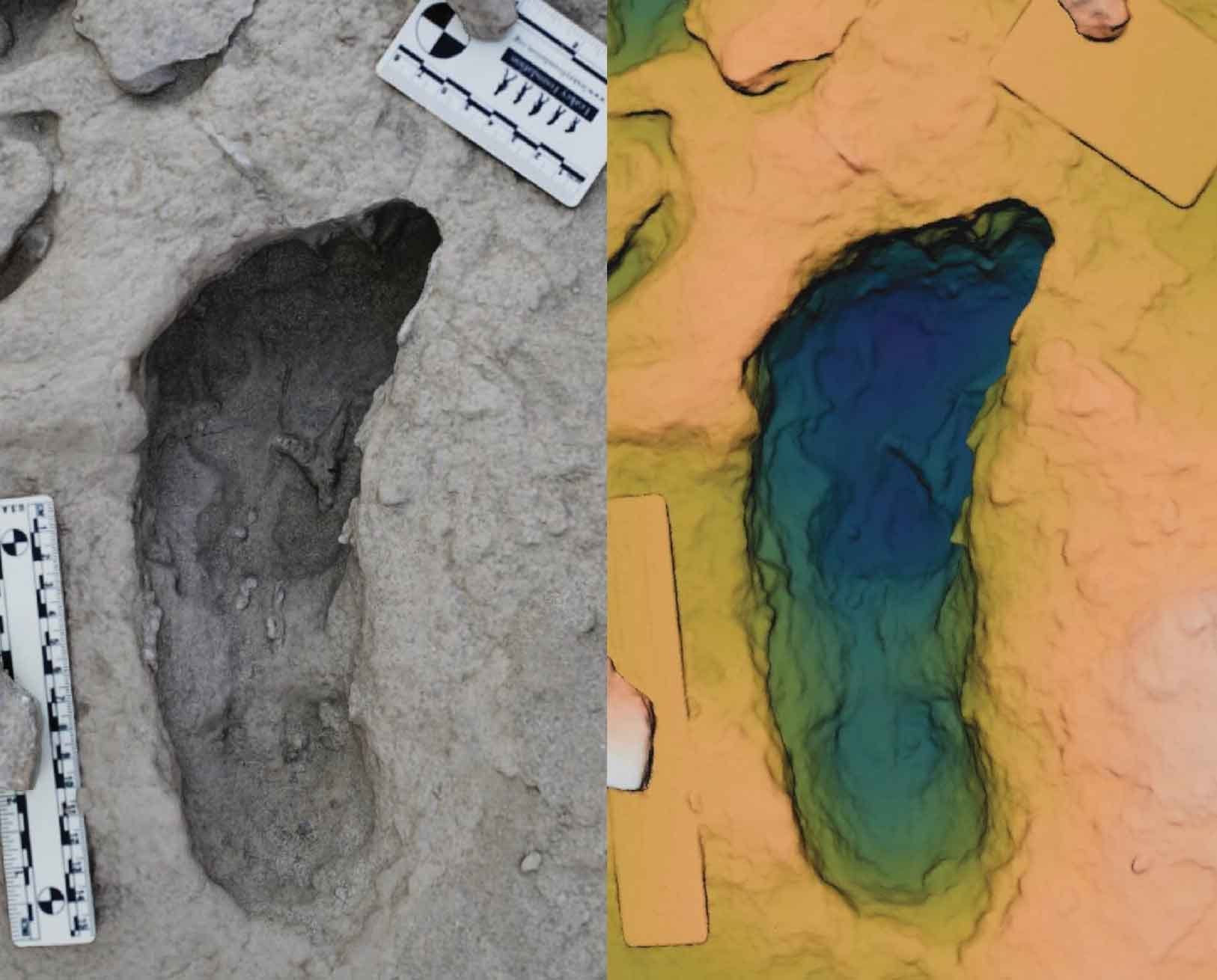
A couple of years ago I wrote about footprints attributed to Homo erectus and Paranthropus boisei from the eastern margin of Lake Turkana. Two species walked on the same muddy shoreline, hours apart. That conclusion was based on the idea that the feet of the two species worked differently.
Kevin Hatala and coworkers worked out the details and did experiments with modern people to see their variation in footprint form. Modern people leave footprints with a deep arch and with the big toe aligned with the lateral toes. That’s even true of members of foraging societies who do not wear shoes. Nobody has a big toe that splays outward all that much. Many of the ancient Turkana basin footprints were like this, fitting into the mold of the prints that people leave today.
Others ancient footprints from the Turkana sites were flatter. These flat footprints nearly always had their big toe diverging from the others a bit. Those characteristics point to a different mechanics for the foot, and Hatala and coworkers concluded that these were likely left by Paranthropus boisei.
Recently Hatala and coworkers published a new study focusing on a particular site at Koobi Fora, GaJi10. The story of this site begins in 1978, as outlined in the new work. Muteti Nume was an experienced excavator who began working with Richard Leakey in 1970. In the 1978 season, working with the archaeologists Kay Behrensmeyer and Léo Laporte, he dug a trench and noticed hippopotamus tracks. As the team cleared overlying sediments from the layer with these tracks, Kimolo Mulwa and Bernard Kanunga discovered a hominin print. In that year, around 12 square meters were excavated, uncovering seven hominin tracks and those of many other animals. Later, first in 2008 and then in a massive expansion in 2016, the excavated area would ultimately cover 40 square meters and include 21 hominin tracks made by an estimated 8 individuals.
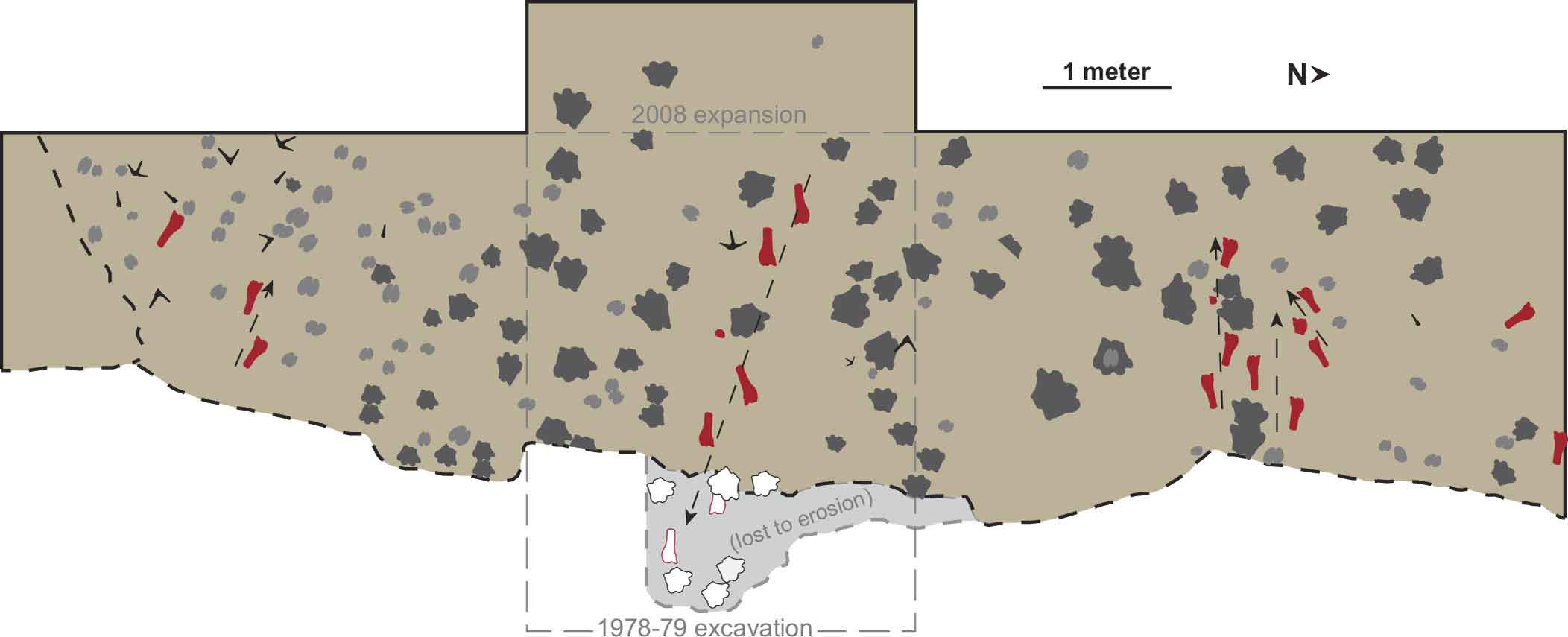
The anatomy of these tracks is pretty clear. With abducted big toes and flat arches, they don’t look like human footprints. They are P. boisei tracks.
But Hatala and coauthors note what they consider a puzzle. The tracks are kind of big. Big tracks were once thought to be unlikely to belong to P. boisei because that species was supposed to be a lot smaller than H. erectus. In the end, Hatala and coworkers run the numbers both ways. They favor the idea that the tracks belong to P. boisei but acknowledge that the body sizes seem more consistent with what researchers have considered to be H. erectus body size.
I think it’s pretty likely that the field was just wrong in imagining that P. boisei was small in body size. “Big” in this study is not especially very big. The footprints provide a reasonable basis for estimating stature of the individuals who made them, with some error. These estimates range from around 130 to just over 175 cm, with five of the individuals in the 155 to 165 cm range. That’s without knowing whether P. boisei had big feet for its stature. Considering the massive jaws and teeth of large P. boisei individuals, I don’t find this range of sizes surprising.
It’s also possible to estimate body mass, although with even more uncertainty. Those estimates are in the 55 to 65 kg range for five individuals, upwards of 75 kg for the largest, and under 40 kg for a small individual.
Hatala and coworkers suggest that if the individuals are P. boisei, then their sizes suggest that most of them were likely male. I think it’s right to be cautious about possible sex bias in the observed footprints. Several social scenarios might fit the data, such as a male foraging group, or a bachelor group of young male adults.
“At a minimum, the trackways indicate mutual tolerance of multiple P. boisei adult males on the same landscape at approximately the same time, and perhaps within the same social group.”—Kevin Hatala and coauthors
The range of body sizes suggested by the footprints would make P. boisei at 1.4 million years ago indistinguishable in body size or stature from humans. That’s consistent with the 2024 study of the ET-2022-103-FE22 site at Koobi Fora. In that study Hatala and coworkers found a probable P. boisei individual walking in the same area as probable H. erectus individuals. The P. boisei prints come from a larger individual than any of the H. erectus prints at that site.
The idea of small P. boisei been unreasonably hard to shake. Back in 1991, the anthropologist Henry McHenry ran the numbers on body size for the “robust australopithecines” as they were then known. His conclusion is evident from his title, “The petite bodies of the robust australopithecines”. McHenry’s analysis aligned with the idea earlier presented by Alan Walker and Richard Leakey, that H. erectus was different from all earlier hominins in its larger body mass and stature.
“These were the petite-bodied vegetarian cousins of our ancestors.”—Henry McHenry
But the data were always thin. The diagnostic traits of P. robustus or P. boisei are in the teeth, skulls, and mandibles. Their molar and premolar teeth and their mandibles are bigger than any humans. But as big as those may seem, the story of their bodies must rely upon postcranial bones. The problem is that hardly any fossil skeletons exist to connect the two.
That problem is manifest in South Africa. The site of Swartkrans has the largest number of fossils of Paranthropus (then usually called Australopithecus) robustus. None of the cranial or dental fossils are in association with postcranial bones. From Kromdraai, the first of the P. robustus finds, TM 1517, includes a small talus and partial humerus, a handful of other bones, and a big-toothed jaw and partial skull. At the time of their discovery, Robert Broom thought these all came from a single individual. But later research has tended to question the association of these bones with each other, a story detailed in a recent review by Michael Lague and Carol Ward. Maybe they’re a skeleton, maybe not.
That leaves isolated postcranial bones and a statistical argument. The three key sites with P. robustus fossil teeth and skulls, Swartkrans, Kromdraai, and Drimolen, also have other teeth, jaws, or skulls thought to belong to some form of Homo. At Drimolen and Swartkrans, many researchers think some of those teeth, jaws, or skulls are Homo erectus. None of the postcranial remains at any of the three sites are particularly big. The largest elements, on the basis of their joint size, are estimated to correspond to body masses around 52 to 62 kg. These are generally attributed to Homo. The fragments that include joints provide little basis for estimation of stature but the tallest estimates run up to around 160 cm. All these are in the size range normal for modern people and known H. erectus, but none are especially big. The smaller bones have mostly been attributed to P. robustus, with estimates of body mass in the 30 kg to 45 kg range.
That seems a stark difference until you consider the statistical argument. At Swartkrans, Jacopo Moggi-Cecchi has estimated that more than 90% of the hominin cranial and dental fossils belong to P. robustus. But considering the postcranial fossils from which body mass or stature estimates have been made, researchers have attributed more than half to Homo. That suggests a bias in the attribution of the postcranial fossils. Researchers have been misattributing P. robustus fossils to Homo.
For P. boisei, the evidence has started to shift. For many years the partial skeleton KNM-ER 1500 was thought to be the only evidence of associated postcranial bones with a small piece of P. boisei mandible. Carol Ward and collaborators studied the skeleton and presented new data in support of this hypothesis in a 2023 article. That skeleton is small. With an estimated body mass around 28 kg and stature around 116 cm, it’s the size of the much earlier “Lucy” skeleton of Australopithecus afarensis.
But the last 15 years have seen several finds of partial skeletons with larger body sizes than KNM-ER 1500. The OH 80 partial skeleton is one, matching a partial femur and radius with teeth of a P. boisei individual. The arm, shoulder, and hand of KNM-ER 47000 are very different from any H. erectus individual and likewise have been attributed to P. boisei. These come from individuals in the 45 to 50 kg range. These discoveries helped researchers to understand that large isolated limb bones like the KNM-ER 739 humerus and OH 36 ulna also likely belonged to P. boisei. Last year, the publication of the massive hand from KNM-ER 101000 showed a P. boisei individual with gorilla strength.
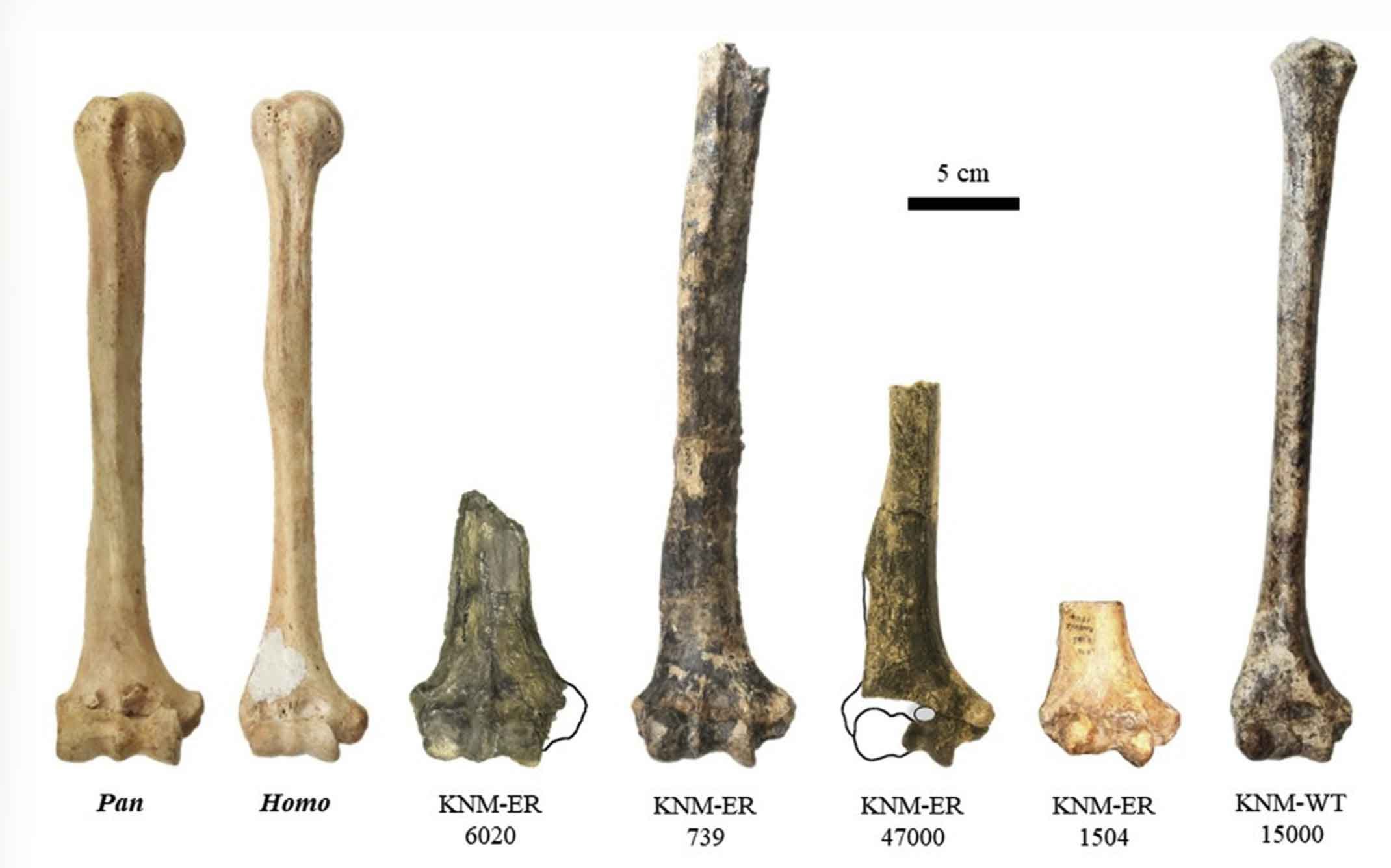
Modern people exhibit a lot of body size variation in eastern Africa today. I suspect that any hominin species sampled across hundreds of thousands of years likely encompassed populations that fluctuated in body mass and stature over time. So I would hesitate to generalize a handful of body mass estimates into a clear picture of variation at any one time.
Still, it seems clear that P. boisei overlapped with human body sizes a great deal. At the same time, some individuals were smaller than typical female adults in any living human group. That may suggest a greater sexual dimorphism in body size in this species than in today’s people.
That brings us back to the GaJi10 muddy, marshy shoreline, where several male P. boisei individuals may have been rooting around for food. I do think we may be looking at some kind of sex-structured behavior. These individuals may have been part of a multi-male group with foraging differences between male and female adults. Or maybe these males belonged to a coalition that was patrolling the edges of their territory. It may be impossible to test today, but the footprints seem to be abundant enough that we may find some interesting answers in the future.
References
Hatala, K. G., Roach, N. T., Harris, J. W. K., Kiura, P., Ndiema, E. K., Sila, B., Kipkebut, D., Waweru, J., Kisale, P., Longaye, A. A., Sale, H., & Behrensmeyer, A. K. (2026). Insights into hominin body size, locomotion, and behavior from Early Pleistocene trackways in northern Kenya. Proceedings of the National Academy of Sciences, 123(31), e2530996123. https://doi.org/10.1073/pnas.2530996123
Hatala, K. G., Roach, N. T., Behrensmeyer, A. K., Falkingham, P. L., Gatesy, S. M., Williams-Hatala, E. M., Feibel, C. S., Dalacha, I., Kirinya, M., Linga, E., Loki, R., Alkoro, A., Longaye, Longaye, M., Lonyericho, E., Loyapan, I., Nakudo, N., Nyete, C., & Leakey, L. N. (2024). Footprint evidence for locomotor diversity and shared habitats among early Pleistocene hominins. Science, 386(6725), 1004–1010. https://doi.org/10.1126/science.ado5275
Jungers, W. L., Grabowski, M., Hatala, K. G., & Richmond, B. G. (2016). The evolution of body size and shape in the human career. Philosophical Transactions of the Royal Society B: Biological Sciences, 371(1698), 20150247. https://doi.org/10.1098/rstb.2015.0247
Lague, M. R., & Ward, C. V. (2026). The Paranthropus Postcranial Puzzle. In P. J. Constantino, K. E. Reed, & B. A. Wood (Eds.), The Forgotten Lineage(s) (pp. 131–163). Springer Nature Switzerland. https://doi.org/10.1007/978-3-032-05485-2_7
McHenry, H. M. (1991). Petite bodies of the “robust” australopithecines. American Journal of Physical Anthropology, 86(4), 445–454. https://doi.org/10.1002/ajpa.1330860402
Mongle, C. S., Orr, C. M., Tocheri, M. W., Prang, T. C., Grine, F. E., Feibel, C., Patel, B. A., Laureijs, O., Hobbs, T. E., Maiolino, S., Rossie, J., Mbogo, W., Du Plessis, A., Lonyericho, J., Woto Huka, W., Sale, H., Umuro, A., Yirgudo, P., Dalacha, I., … Leakey, L. N. (2025). New fossils reveal the hand of Paranthropus boisei. Nature, 647(8091), 944–951. https://doi.org/10.1038/s41586-025-09594-8
Richmond, B. G., Green, D. J., Lague, M. R., Chirchir, H., Behrensmeyer, A. K., Bobe, R., Bamford, M. K., Griffin, N. L., Gunz, P., Mbua, E., Merritt, S. R., Pobiner, B., Kiura, P., Kibunjia, M., Harris, J. W. K., & Braun, D. R. (2020). The upper limb of Paranthropus boisei from Ileret, Kenya. Journal of Human Evolution, 141, 102727. https://doi.org/10.1016/j.jhevol.2019.102727
Ward, C. V., Hammond, A. S., Grine, F. E., Mongle, C. S., Lawrence, J., & Kimbel, W. H. (2023). Taxonomic attribution of the KNM-ER 1500 partial skeleton from the Burgi Member of the Koobi Fora Formation, Kenya. Journal of Human Evolution, 184, 103426. https://doi.org/10.1016/j.jhevol.2023.103426
Will, M., Pablos, A., & Stock, J. T. (2017). Long-term patterns of body mass and stature evolution within the hominin lineage. Royal Society Open Science, 4(11), 171339. https://doi.org/10.1098/rsos.171339