

Last year around this time, my students asked me, “How threatened do you feel the current political climate is regarding human evolution, medical genetics, and your own research?” I gave them my honest answer and shared it here with readers.
Now it’s time for an update. My outlook on the science has gotten stronger. We are seeing advances like never before. Meanwhile, the federal funding outlook for human origins research is worse than any time since the Second World War.
It’s understandable that many U.S. scientists are dispirited by the challenges coming from the current administration. This is not, as I’ve seen some say, the end of the science—far from it. Our scientific work is racing forward faster than ever. But this is a turning point. The future depends on building better relationships for people and science.
For my regular readers, I first want to thank you. Your support for this site is making an enormous difference. One of the reasons why I’m able to keep my research at the highest level is because of you, and I have some really exciting work coming up.
I plan to continue to keep all my writing here free for anyone to access. Many people all over the world for whom a Substack subscription would be a big part of their monthly budget are able to read here for free. Teachers from all over the U.S. and internationally are relying on the site in their work. So again I want to especially thank all the supporters who are making this possible with your founding memberships and paid subscriptions.
The big news on federal science funding in recent weeks is that the National Science Foundation (NSF) has made its fiscal year 2027 budget request, including the elimination of its Directorate for Social, Behavioral, and Economic Sciences (SBE). That is the part of NSF that includes anthropology and archaeology. Biological anthropology, cultural anthropology, and archaeology programs are among the many that will be eliminated at NSF by this proposal.
I’ve been expecting this move for a long time. For two decades or more, federal funding for social sciences has received more and more criticism from legislators, especially—but not only—Republicans. Once, the biggest threats to federal funding in archaeology and anthropology were members of Congress and lobbyists who saw evolutionary biology as a threat to creationist teachings. That’s changed over the last two decades. Public acceptance of evolution has reached new highs. At the same time, more and more people now oppose public spending on scientific work related to social, racial, or political issues. The deep history of humankind is not a partisan subject. Yet understanding the social, racial, and political aspects of humans and the history of those ideas matters a lot to the study of human origins—always has, and always will.
Of course the final decision on budget is not with the Executive Branch but with Congress. Last year, Congress eventually allocated much more money to NSF than the Executive Branch requested. Many saw that as a positive step for support of science, and it might happen again during the budget negotiations for next year.
But what we’ve seen in 2026 is that NSF is not spending the funds that Congress approved. A number of graphs have been going around, showing the drop-off of grants in 2025 from earlier years, and the incredible reduction so far in 2026. The Grant Witness site is compiling this information from public data, with declines in funded awards across all areas of NSF. For the SBE directorate, the situation is especially dire. The agency’s change in priorities has already taken effect:
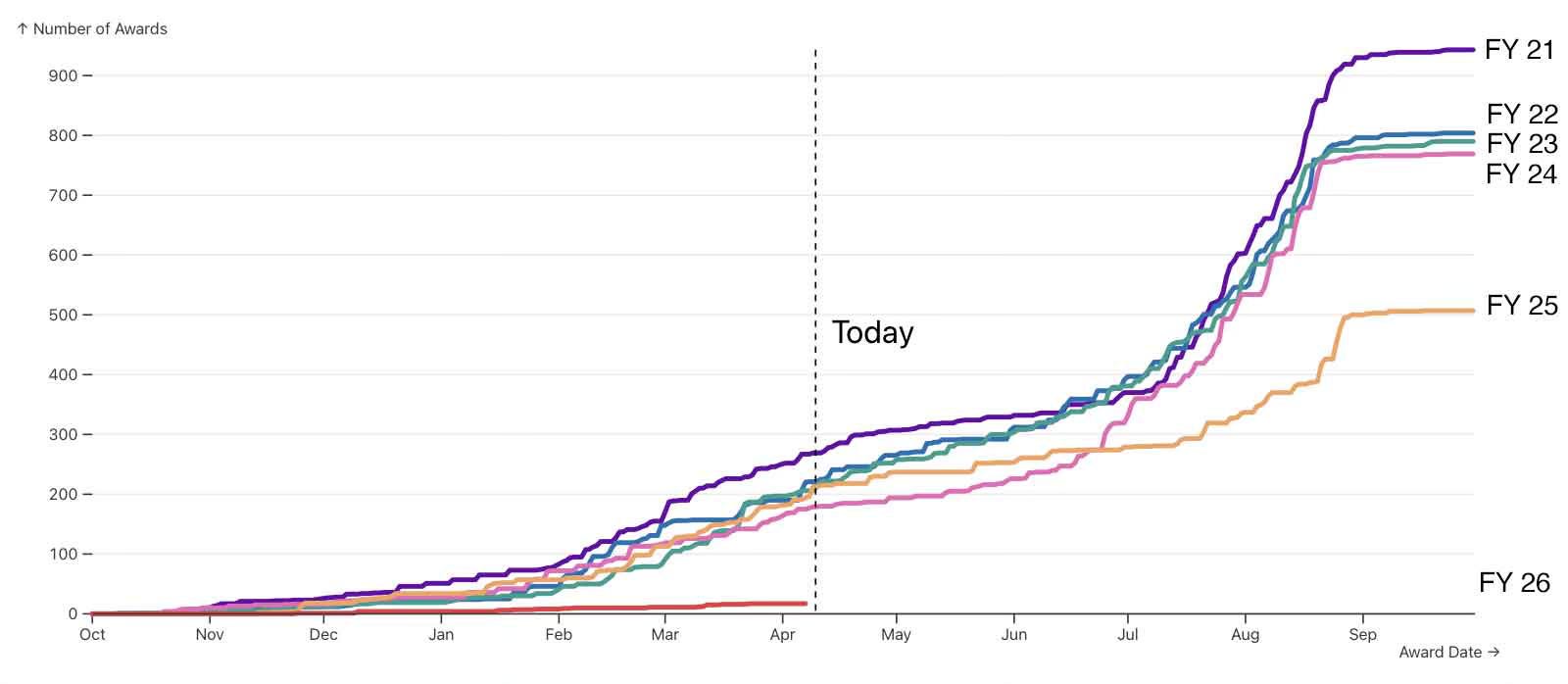
Again, nearly all anthropology and archaeology funding comes under the SBE budget line. As of this writing, zero grants have been approved in these areas of study in fiscal year 2026 so far.
How big will be the effect on these research fields? Taking biological anthropology as an example, the number of grants to PhD scientists in biological anthropology has averaged twenty or so per year for the last decade. Fourteen researchers were awarded grants with start dates in 2025; twenty-five with start dates in 2023 and 2024, nineteen with start dates in 2022. In terms of the number of active researchers in the field, that’s not so large—but it will have a strongly negative effect on some kinds of research by some of the most active researchers. NSF has higher impact on dissertation research by graduate students. In biological anthropology, around 25 to 30 dissertation proposals have been funded each year for the last decade. This program was “archived” by NSF last year, effectively ending it.
The federal funding scene for human origins is wider than NSF. Some biological anthropology and evolution research is funded by the National Institutes of Health (NIH), especially those areas that impact lifespan, genetic variation, and pathogens. These are tiny parts of the overall NIH funding landscape, but because NIH is so much larger than NSF it plays an important role, especially in the area of human genetics. Like NSF, NIH has also seen massive shifts in priorities and a strong reduction in new programs under the Trump administration. It’s hard to assess at present how much the changed priorities will reduce support for work that has importance in understanding things like Neanderthal genetics and population history—but it is certain to be a substantial reduction, not an increase.
Fulbright has also been an important source of federal funding for field research in human origins, through international exchange. My research was greatly advanced by a Fulbright as I began working in South Africa, and these grants enable many students to complete their dissertation research. The Fulbright program is continuing, but I know people whose proposals have been rejected during the last year due to their inclusion of language related to climate and environment. Again, changing priorities are excluding some research in biology, anthropology, and archaeology.
I also have to say that human origins research is a broad topic that draws on results and methods in geology, genetics, biology, and other fields. A lab doing geochronology may be supported through a geosciences funding stream. Comparative DNA research may be supported by a funding stream for human genome research. In the U.S., these other areas are experiencing their own funding disruptions, but they are not ending. They were always supported more reliably than archaeology or biological anthropology. What suffers when redirecting funding into those other areas is fieldwork and original data collection on ancient people and their relatives.
The changes under the current administration are abrupt and severe. But they are not a sudden reversal; they represent an acceleration of the long decline in federal support for this kind of science. To be sure, there was never a golden age of federal support for human origins. Still, twenty years ago and longer, there was relatively more support for field research from NSF, including programs such as the HOMINID grants that were important to a small number of larger-scale projects. In recent years, NSF has prioritized fields like physics, computer science, and artificial intelligence. Grants related to human origins have gotten smaller in direct costs (correcting for inflation), more of the funding has gone to indirect costs, and fewer have been funded. In fact, if you look at the graph above, every year of the Biden administration saw a decline in SBE awards.
I strongly support increased federal funding for human origins research. It’s a smart investment. Even though I’ve never received funding from NSF, and even though I don’t always agree with the direction that funds have gone, this is an area where a federal role just makes sense. The research in this field does not merely benefit institutions or corporations, it benefits everyone. It’s an area where public leadership can be transformative: helping scientists share their data more broadly, work across disciplinary boundaries, and build research connections across international borders.
Other nations, including China, Canada, many individual European nations as well as the European Union, have increased their investment in this area of scientific research. (For readers in those nations, thank you for your support!)
The field regularly generates “top ten science stories” every year. Last year it was the “Dragon Man” DNA and proteomic discoveries, and a spectacular partial skeleton of Homo habilis described already this year with more to come. What it takes to maintain substantial field research at a significant archaeological or fossil site including staffing is generally on par with the budget of one single laboratory in biomedical research. Very few opportunities for discovery come at such low cost relative to the scientific results. Moreover, almost every project in this area of research involves people from many disciplines solving problems together—a model for transdisciplinary work that is increasingly important in bigger, more expensive fields.
Consider the enormous achievements in just the last decade. Ancient DNA and other molecular evidence have transformed our understanding of human variation and its history. Research at known fossil sites has generated abundant new information about human ancestors and relatives, while exploration has turned up many new sites—some in unexpected places and times. Technology is opening windows into how sites formed, how ancient hominins behaved, how they grew and developed, and how they overcame or succumbed to disease. The leverage right now on new problems is extraordinary.
All that being said, I have a broader call to action. Most research in human origins is funded by foundations, universities, and private donors. My work has been almost entirely funded by university, foundation, and small individual contributions. Connecting people with research in this field is more important than it’s ever been to its future.
I know a lot of researchers who are waiting to hear from NSF, but I don’t know any who are standing still. They’re finding other ways to support their work and building new innovative collaborations.
I’m going to keep doing as much as I can to bring attention to new work, especially the work that is making me think. I hope that you’ll join me. If you’re an active supporter, thank you once again for helping keep this going. And if you’re just reading along, please spread the word about the discoveries that are changing our view of deep human history. Whether it’s a lecture, or an outreach event at your local institution, or a shared email, there’s a place for you as we uncover our shared past.
Update: As of August, 2026, no new NSF grants have been awarded in the Social and Behavioral Sciences areas including Archaeology, Biological Anthropology, and Cultural Anthropology programs.