

I may be feeling cranky about the new research on Homo erectus teeth from Guangxi, in southwestern China. The reason is some missing comparisons.
The new fossils come from two caves, Baxian and Naxian. The four Baxian hominin teeth are estimated to be between 324,000 and 184,000 years old; six Naxian teeth are between 319,000 and 241,000 years. At those ages, if the teeth do belong to H. erectus, they would be among the latest attributed to that species on the Asian mainland. The results are described in two papers: one by Wei Liao and coworkers presents protein and morphological analysis of the hominin teeth, and a second paper led by Kira Westaway describes the paleoenvironmental context of the sites.
The challenge is being sure the teeth don’t belong to the Denisovans.
Understanding how Denisovans and Homo erectus may have differed, what their relative geographic and temporal ranges were, and how those lineages interacted, are some of the big questions in paleoanthropology today. Ancient proteins have become an important source of data to address those questions. Several recent papers have aligned Chinese or Southeast Asian fossils with the Denisovan lineage from protein data, and one study attributed teeth from three 400,000-year-old sites to Homo erectus in part from protein data.
But protein data are very slim. Only one or two amino acid positions have been central to these recent studies. So it is important to have multiple lines of evidence to consider, and for isolated teeth like those from Baxian and Naxian, anthropologists consider how tooth shape and internal structure compare to other fossil samples.
For that, you need the other samples to be well-represented. Unfortunately, this new research includes only one possible Denisovan tooth in its key comparisons. With such a slim sample, this leaves unanswered whether we actually know these teeth are Homo erectus or whether instead they are one of several divergent lineages of Denisovans that we know existed.
Baxian and Naxian
Despite some crankiness about the tooth comparisons, I think the caves and their fauna are really cool discoveries. The hominin teeth were excavated together with thousands of other animal teeth and fossils from breccia deposits, originally accumulated by porcupines. Porcupines drag parts of animal carcasses and bone back to their dens and gradually gnaw down the bones, absorbing calcium and phosphorus from them. They don’t consume the teeth, as enamel and dentine are much harder than bone. In the Baxian and Naxian caves, there are no reported artifacts or other evidence of hominin activity.
Indeed, hominins were only a tiny part of the faunal assemblage, which numbers tens of thousands of teeth across both sites. Most are pigs and deer, and there are many, many more fossil orangutan teeth than fossil hominin teeth: 423 orangutan teeth at Baxian; 328 at Naxian. With large orangutan assemblages, picking out a few hominin teeth can be a challenge. I’m not surprised that it has taken some time since the excavations (2017 in Naxian; 2015–2022 in Baxian) to bring attention to the hominins there.
The presence of orangutans, giant pandas, and many other forest species is a clue about the ancient environments around these caves. Westaway and coworkers characterize the environment as “rainforest”. They support their assessment not only with the species identification of the overall bone and tooth assemblage but also with stable isotope analysis of many of the teeth of different species. Everything points to a closed-canopy forest system at the time the fossils were deposited, which Westaway and coworkers compare to the western Amazon basin.
Fifteen years ago, the paleoanthropologist Russell Ciochon published an essay in Nature suggesting that the environment of southern China wasn't right for Homo erectus. Most of the caves in the region during Early and Middle Pleistocene times had a faunal community with key species like the extinct elephant-like Stegodon, and giant pandas, Ailuropoda. This Stegodon-Ailuropoda community included the extinct ape Gigantopithecus at many sites, abundant fossil orangutans, and some smaller teeth that researchers tended to identify as extinct hominins. Ciochon argued that such teeth might belong to a “mystery ape”. The idea was that hominins were limited to the savanna and open woodland environments represented to the north in China as well as in Java and surrounding regions of Sundaland to the south. The rainforest was its own distinct ecology, one where a diversity of apes might have evolved and persisted.
Baxian and Naxian have no Gigantopithecus, possibly due to the relatively late Middle Pleistocene age of the two cave assemblages. The last known occurrence of the giant ape Gigantopithecus is estimated between 295,000 and 215,000 years ago, overlapping with the Baxian and Naxian date estimates, and might precede either site.
The work by Westaway and collaborators is pretty persuasive that the hominins represented at Baxian and Naxian were probably representative of local groups, and suggest they existed within a forest ecology. It would be very interesting to see whether ecological adaptations helped to separate hominin lineages here in East and Southeast Asia; that might give clues about other regions where multiple lineages of hominins may have existed, such as Africa. I’m eager to hear more of these stories.
Homo erectus protein data
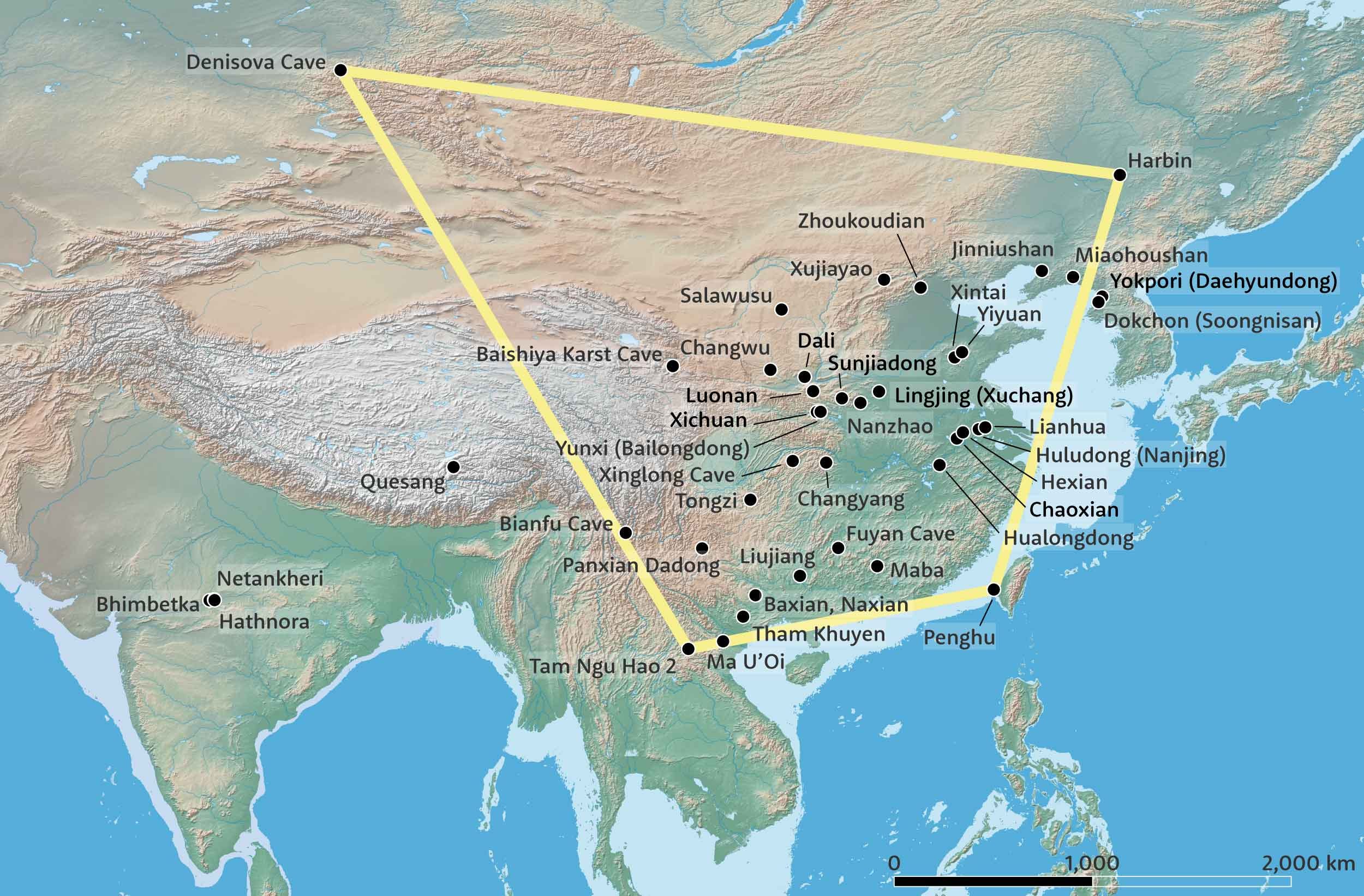
Earlier this year, I reviewed the new work by Qiaomei Fu and her team on the proteomic data from Zhoukoudian, Hexian, and Sunjiadong. Six teeth sampled from these three sites come from the interval of time just before 400,000 years ago, and anthropologists had considered them to represent Homo erectus. Fu and coworkers tested their enamel peptides and found that all six teeth carry two derived amino acid substitutions in the protein ameloblastin. One of these, a change from alanine to arginine at position 253, or A253G, had not been seen before. The other, M273V, is also present in the high-coverage Denisova 3 and Denisova 25 genomes, as well as the Harbin and Penghu 1 proteomes.
Fu’s team accepted the hypothesis that these teeth do represent a different lineage from the Denisovans, likely H. erectus. In their hypothesis, Asian Homo erectus evolved both these derived mutations at some point in their evolution within Asia. Later, some H. erectus individuals interbred with Denisovans, and passed M273V along into the Denisovan gene pool—and ultimately into some of their living descendants.
This could be a great story of mixture at three levels in our evolution, one that I would usually be primed to like. But it’s based on two amino acid changes.
At the time, I offered an alternative. What if those 400,000-year-old teeth aren’t Homo erectus at all? Denisovans separated from Neanderthals more than 500,000 years ago, and have not been connected biochemically to known fossils earlier than the 250,000-year-old Denisova 25 genome. I wondered whether 400,000-year-old fossil teeth from China might be early Denisovans. Just as the 430,000-year-old Sima de los Huesos fossils represent early Neanderthals rather than a distinct species, these Zhoukoudian and Hexian fossils might simply record early regional differentiation within an emerging Denisovan population network. Under that idea, M273V emerged early in the Denisovans and was widely shared; A253G evolved locally in China and disappeared from later groups.
Admittedly, there are reasons to be skeptical of my alternative. The Zhoukoudian and Hexian sites have not only teeth but also cranial remains long attributed to H. erectus. At Zhoukoudian some come from localities estimated to be up to 700,000 years or older. Surely some of those are not Denisovan. (I would say, how are we so sure they are the same groups across 300,000+ years?)
On the more recent end, fossils from Java suggest to many anthropologists that Homo erectus survived into the period between 117,000 and 108,000 years ago. If these fossils, from Ngandong, are H. erectus as many believe, it’s harder to argue that the species could not be present much earlier in the forests of Guangxi. (I would say, why are the Ngandong fossils not Denisovans themselves? It would solve the origin of the genomic mixture from Denisovans into populations of Wallacea and Sahul.)
The real problem is that the protein data are very sparse. A human genome offers three billion base pairs; a dental proteome yields a few hundred amino acids. In the Zhoukoudian-Hexian-Sunjiadong sample, only two variable sites carry all the information. That’s like scanning a barcode that only has two stripes.
The new data from Naxian and Baxian add a few interesting data points to the amino acid sequences. Liao and coworkers report data from five teeth, two from Baxian, three from Naxian. Four of them share the A253G variant that is found in the Zhoukoudian-Hexian-Sunjiadong sample. This is the one protein variant supporting their identification as Homo erectus.
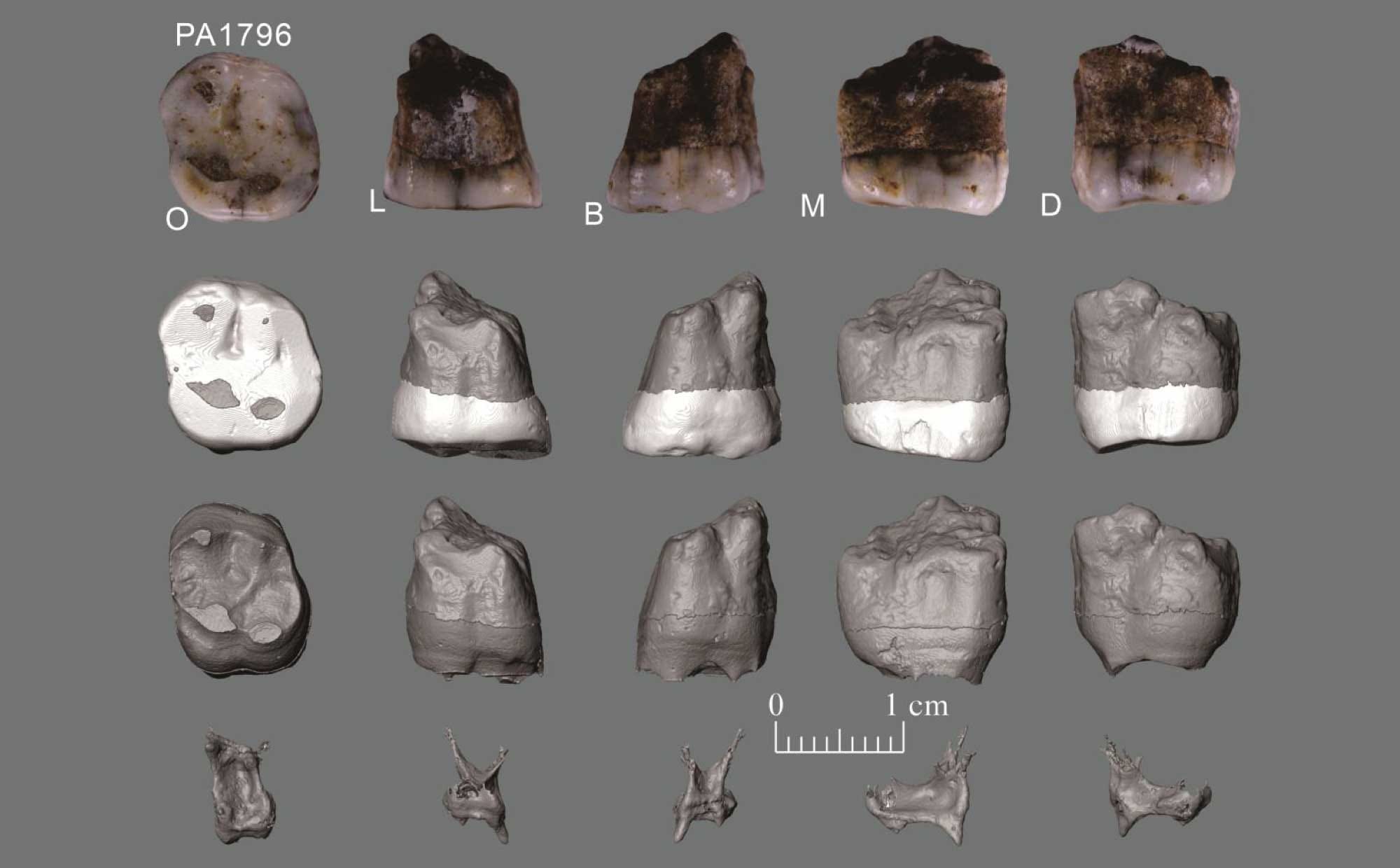
None of the Naxian or Baxian teeth have the derived M273V variant shared by the known Denisovans and Zhoukoudian-Hexian-Sunjiadong. One of the teeth from Baxian, PA1796, differs from the other four in ameloblastin sequence; it lacks the derived “Homo erectus variant” A253G, and also lacks the derived “Denisovan variant” M273V. In the reported protein data, this tooth shows no differences from modern humans or Neanderthals.
One of the teeth from Baxian has an ancestral arginine in the COL1A2 collagen sequence (R996K) that is different from the derived lysine coded by the Denisova 3 genome. The other teeth lack information from this position. That might suggest a second difference from Denisovans, at least for one individual, but I wouldn’t go very far interpreting an ancestral variant as evidence for lack of relationship.
Dental morphology
In the new study of Baxian and Naxian samples, Wei Liao and colleagues present morphological comparisons of nine of the hominin teeth. Eight in their view share the features seen in East Asian H. erectus teeth, including short, square-to-rhomboidal upper molar crowns, asymmetric lower premolars with developed trigonid basins, complex protostylids (or cingulum features), and highly wrinkled EDJ surfaces. These are similar to traits seen in the Zhoukoudian, Hexian, and Sunjiadong teeth. Liao and coworkers compared the teeth with samples of modern, Neanderthal, and H. erectus-attributed teeth, showing that most of the Baxian and Naxian teeth fall closer to H. erectus.
The one tooth that is a proteomic outlier is also a morphological outlier. PA1796 is an upper second molar from Baxian, and has a more Neanderthal-like shape, especially lacking the wrinkled EDJ surface of the other teeth.
But the weird thing to me in these analyses is the near-total lack of comparisons with known or suspected Denisovans. In their analyses of EDJ shape, Liao and coworkers included only one tooth identified as Denisovan, the Tam Ngu Hao 2 molar from Laos.
This leaves out quite a number that have proteomic identification as Denisovans and previously-published microCT data. The Xiahe 1 mandible, the first Denisovan identified by proteomic data from outside Denisova Cave, has lower first and second molars to compare. The Xiahe 1 M2 in particular falls within the range of H. erectus second molars in the earlier analysis by Fabrice Demeter and coworkers (2022). That earlier study included many of the coauthors on the new study of the Baxian and Naxian teeth, so it’s strange to see the new study was done with only one Denisovan in the sample. The Xujiayao teeth, which were attributed to Denisovans by protein analysis by Song Xing and collaborators earlier this year, also have been examined in previous work. In a 2015 study, Xing and coworkers argued that Xujiayao molars are similar in size and morphology to Early Pleistocene Homo erectus teeth.
It’s hard for me to understand why so many relevant Denisovan teeth were left out of the current study. The Xujiayao and Baxian/Naxian results were under consideration in the same journal across nine months prior to either being published, as well as being produced by many of the same authors, so it seems like these aspects could easily have been corrected.
Without them, I can only guess at the likely results of a more comprehensive analysis. My guess, based on the earlier research prior to protein analysis, is that “Denisovans” and “Homo erectus” overlap a lot in dental morphology. The current study makes it appear that a clear division existed, but that’s partly an artifact of the analytical procedures, especially the decision to group African H. erectus and Indonesian H. erectus teeth together. That decision leads to a pre-defined result for teeth that happen to lack derived similarities with modern humans and Neanderthals: It shifts any ancestral-looking teeth toward H. erectus. This morphological test is poorly designed to separate Denisovan from H. erectus if these groups actually were different.
Bottom line
I always hesitate to be critical of studies that report new data. It’s bad karma. I would always rather see the fossils be widely reported and accept any shortfalls as opportunities for more research. At some times and places, those fossils are rare enough that we need every data point.
Still, that’s exactly the reason I want to see studies include all the data that do exist. Missing data points nag at me.
There’s an awful lot of good information in the new research, despite my misgivings. We have come now a good way into the use of protein data to characterize ancient fossil samples. Some of the limitations are becoming evident. In modern human samples, we can assess the polymorphism of amino acid sequences in large samples. Fossil samples are small and statistically unrepresentative. Even so, already several studies have identified interesting amino acid polymorphisms in groups like Paranthropus robustus, Neanderthals, Denisovans, and now possibly Homo erectus. Anthropologists are often (but not always) hesitant to accept any single morphological trait as sufficient to identify a species or lineage. That’s because such traits vary within samples.
Protein variants can be shared by introgression among lineages. That seems inevitable when considering the variation seen in the East Asian Middle Pleistocene proteomic data. If some of these fossils belonged to Homo erectus, the data suggest that they were mixing with Denisovans. That conclusion is already manifest within the Denisova 3 and Denisova 25 genomes, with their evidence of “superarchaic” mixture.
Sex has emerged as one of the most important contributions of proteomic data to understanding the fossil record. Again this new study of Baxian and Naxian finds a male-biased sample: four out of five individuals with proteomics data. This adds to the existing five out of six from the Zhoukoudian-Hexian-Sunjiadong samples and the male bias I’ve noted across the Denisovan sample.
The results here might also bring back into the spotlight three Middle Pleistocene sites from Vietnam, Ma U’Oi, Kang Trang and Tham Khuyen. At all three sites, teeth attributed to fossil Homo occur at ages in the later Middle Pleistocene, or possibly Late Pleistocene at Ma U’Oi. Ciochon’s 2009 essay associated such teeth with his hypothesized “mystery ape”, undercutting their status as hominin. With other hominins nearby in Guangxi, these teeth may be rich targets for re-examination.
For the samples from Baxian and Naxian, I see a bright future. As interesting as hominins can be, these sites are much more informative about the variation in extinct populations like the orangutans, Pongo weidenreichi. It would be remarkable to see how this extinct lineage compares to the surviving diversity of Bornean, Sumatran, and Tapanuli orangutans.
Getting at the diversity of the late Middle Pleistocene rainforest fauna may finally answer some of the questions raised by Russ Ciochon more than a decade ago. They might even uncover a mystery ape.
References
Ciochon, R. L. (2009). The mystery ape of Pleistocene Asia. Nature, 459(7249), 910–911. https://doi.org/10.1038/459910a
Fu, Q., Wu, Z., Bennett, E. A., Xing, S., Ji, Q., Dong, Z., Rao, H., Gu, X., Dang, Y., Xing, J., Zhou, K., & Feng, X. (2026). Enamel proteins from six Homo erectus specimens across China. Nature. https://doi.org/10.1038/s41586-026-10478-8
Liao, W., Zanolli, C., Ásmundsdóttir, R. D., Wu, Z., Yi, Z., Villa-Islas, V., Fagernäs, Z., Troché, G., Zhou, K., Feng, X., Liu, F., Olsen, J. V., Shao, Q., Yu, W., Quinn, M., Bacon, A.-M., Liang, H., Pan, Y., Yang, L., … Welker, F. (2026). Evidence for late Middle Pleistocene Homo erectus in mainland East Asia. Nature. https://doi.org/10.1038/s41586-026-11271-3
Peyrégne, S., Massilani, D., Swiel, Y., Boyle, M. J., Iasi, L. N. M., Sümer, A. P., Mesa, A. B., De Filippo, C., Viola, B., Essel, E., Nagel, S., Richter, J., Weihmann, A., Schellbach, B., Zeberg, H., Visagie, J., Kozlikin, M. B., Shunkov, M. V., Derevianko, A. P., … Kelso, J. (2025). A high-coverage genome from a 200,000-year-old Denisovan. bioRxiv. https://doi.org/10.1101/2025.10.20.683404
Rogers, A. R., Islam, M. T., Brand, C. M., & Webster, T. H. (2026). The Genetic Legacy of Introgression from Two Deeply Divergent Lineages in the Genus Homo. bioRxiv. https://doi.org/10.64898/2026.03.22.713509
Westaway, K. E., Joannes-Boyau, R., Liao, W., Shao, Q., Yu, W., Quinn, M., Bacon, A.-M., Liang, H., Bourgon, N., Zhao, J. -x., Roberts, P., Kono, R., Pan, Y., Yang, L., Wang, Y., Jin, C., Wu, Z., Murray, S., Zanolli, C., … Zhang, Y. (2026). Rainforest adaptation in late Homo erectus from southern China. Nature. https://doi.org/10.1038/s41586-026-11155-6
Xing, S., Martinón‐Torres, M., Bermúdez De Castro, J. M., Wu, X., & Liu, W. (2015). Hominin teeth from the early Late Pleistocene site of Xujiayao, Northern China. American Journal of Physical Anthropology, 156(2), 224–240. https://doi.org/10.1002/ajpa.22641
Xing, S., Martinón-Torres, M., & Bermúdez De Castro, J. M. (2018). The fossil teeth of the Peking Man. Scientific Reports, 8(1), 2066. https://doi.org/10.1038/s41598-018-20432-y
Xing, S., Martinón-Torres, M., Bermúdez De Castro, J. M., Zhang, Y., Fan, X., Zheng, L., Huang, W., & Liu, W. (2014). Middle Pleistocene Hominin Teeth from Longtan Cave, Hexian, China. PLoS ONE, 9(12), e114265. https://doi.org/10.1371/journal.pone.0114265
Xing, S., Wu, Z., Shao, Q., Ge, J., Bennett, E. A., Rao, H., Lin, S., Zhao, Y., Liu, F., Liu, Y., Zhou, K., Feng, X., Jiangzuo, Q., & Fu, Q. (2026). The proteome of Middle Pleistocene Xujiayao and common Denisovan morphology. Nature. https://doi.org/10.1038/s41586-026-11132-z
Zhou, L., Li, X., Gu, X., Du, B., Shi, J., & Gao, X. (2018). Middle Pleistocene hominins from the Sunjiadong site, Luanchuan county, Henan Province, Central China. Acta Anthropologica Sinica, 37(2), 192–205.
"but also cranial remains long attributed to H. erectus"
Perhaps theres enough reason now to start assessing if the term erectus now needs more refinement. I look at various skulls attributed to it...to my layman eyes they can look quite distinct. What if a lot of asian erectus just isn't, same for african erectus.