


Across the southern part of Africa for thousands of years have lived ancestors and close relatives of today’s speakers of Khoe-San languages. More than 200,000 people today speak languages in the Khoe-San family. They mostly live in Namibia, Botswana, Angola, and South Africa. Many are pastoralists who herd cattle and sheep, such as the Nama and Damara; others are traditional foragers such as the Ju/’hoansi and ǂKhomani San.
During the last decade Mattias Jakobsson and a team of collaborators, notably Carina Schlebusch, have expanded the ancient DNA record from southern Africa. I’ve written about some of their work before. In the population network that gave rise to modern humans around the world, the traditional groups of southern Africa are descendants of one of the earliest nodes. Khoe-San-related peoples carry genetic variation that began to differentiate from other African groups as early as 250,000 to 300,000 years ago.
Jakobsson and team published a new analysis last year including data from 28 ancient skeletal remains from South Africa. The oldest are around 10,200 years and the most recent only 150 years. Six of them were new whole genome sequences at moderate coverage, making a total of seven with the individual designated as “Ballito Bay A” sequenced in 2017. This year, a paper by Weerachai Jaratlerdsiri and coworkers reported on whole-genome data from 150 living people from Khoe-San groups in Namibia. Together these data are helping to put some of the evolution of southern African peoples into clearer context.
A Late Stone Age cultural transition
Some of the clearest interpretations from this new work apply to the Holocene time range covered by the ancient genomes. The location with the largest ancient DNA sample in the work by Jakobsson and coworkers is the Matjes River rock shelter on the southern Cape coast. The burials there span 8,000 years of human presence, from 10,200 down to 2,330 years ago. With this time transect Jakobsson and colleagues could test for genetic shifts at the time of a Late Stone Age technological transition, from Oakhurst to Wilton technocomplexes.
The earlier Matjes River individuals were associated with a tradition known as Oakhurst, based on large flakes made from course-grained local materials like quartzite beach cobbles. Burials during this period were covered by large stones and red ochre. Around 8000 years ago, the Wilton technocomplex replaced the Oakhurst. This was based on tiny flakes from fine-grained material like silcrete or crystalline quartz. The toolkit also includes many tools for boring holes and shaping wood. Some of these were aimed at creating wooden digging sticks for tuber foraging.
Oakhurst and Wilton technologies reflect different ways of relating to local ecology. Both traditions extended across a large area of South Africa at the times they were produced. At Matjes River, both were made by hunter-gatherers who used marine shoreline resources like fur seals, fish, and shellfish. Wilton assemblages reflect a different approach to balancing these with intensive plant foraging, focusing on more complex, composite tools, and producing objects for gift exchanges with other groups.
Some archaeologists wondered whether these two technologies may represent different populations. Jakobsson and coworkers provide a clear answer: There was no genetic break separating earlier and later groups. These changes in technology reflect cultural transformation within a single, large metapopulation that was genetically stable over this period of time.
The bounce
That stability would change with growing influence from eastern Africa. Exactly when Holocene people began to increase their connection between eastern and southern Africa was one of the key questions examined by Jakobsson and coworkers.
The stage was set in work from 2017, when Pontus Skoglund and collaborators looked at hunter-gatherer and early pastoralist genomes from Malawi. Malawi is at the southern end of the East African Rift System. Its most prominent connections lie to the north into Tanzania, and west into the Congo Basin. Skoglund and coworkers found that hunter-gatherers from Malawi underwent a pulse of gene flow from southern Africa as early as 8000 years ago. At the time, ancient DNA data from southern Africa were scarce, leaving it unclear whether this gene flow might have been reciprocal.
Jakobsson and coworkers could answer that question with their data. There was no comparable gene flow from eastern into southern Africa as early as 8000 years ago. Instead, signs of East African pastoralist ancestry arrived in South Africa around 1400 years ago. Somewhat later, West African-related Bantu ancestry also began to arrive.
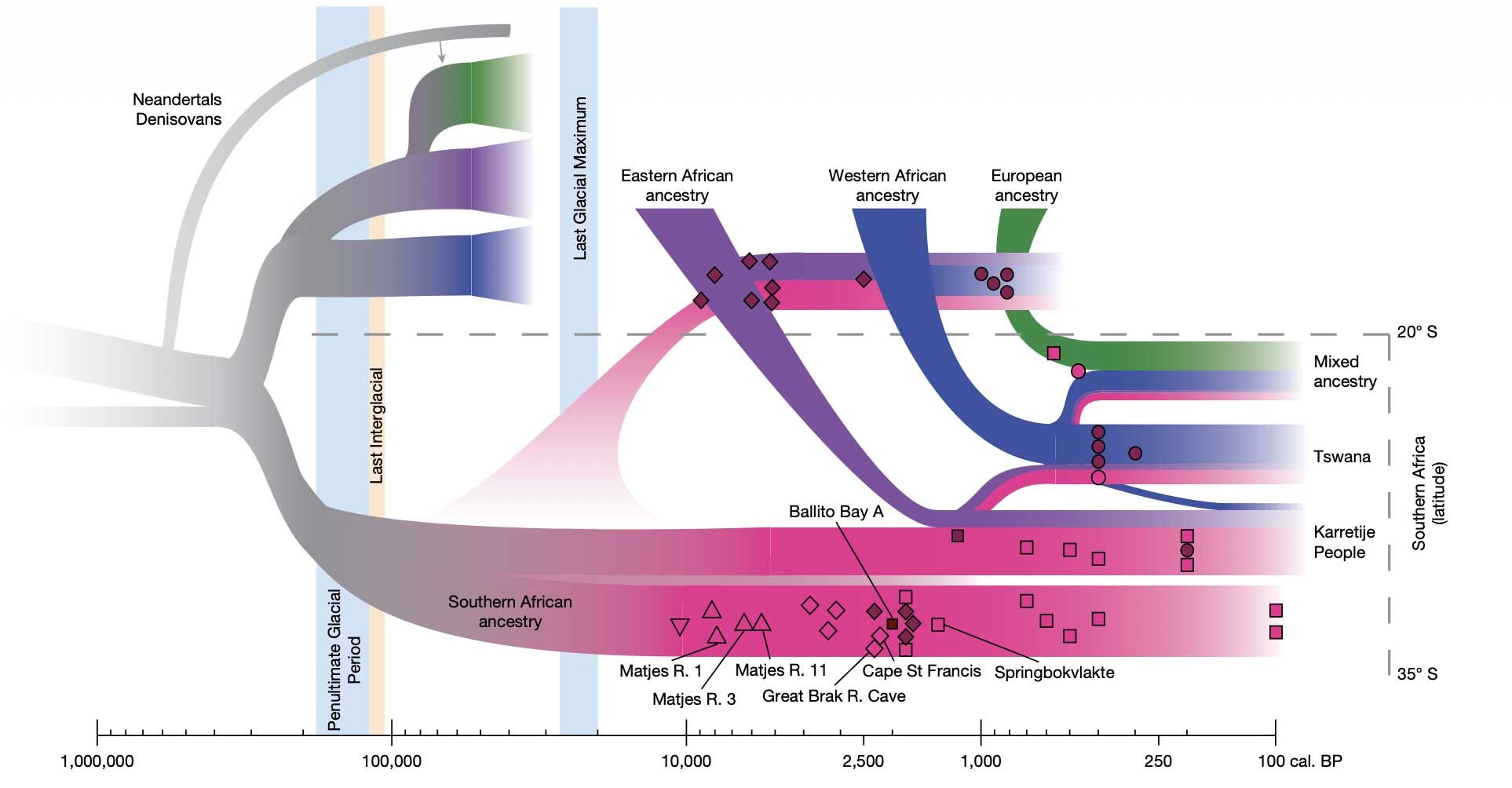
What about deeper time, long before the Holocene? Recent mixture is critical to understanding the ancient structure of populations. Today’s Khoe-San populations carry between 10% and 30% recent admixture from incoming groups: first from East Africa, then West and Central Africa, and finally within the last few hundred years from Eurasia. This high degree of recent mixture led Schlebusch and coworkers in their 2017 work to recalculate the estimated time of divergence of these groups from other African populations. The team estimated that the ancestors of the southern African Khoe-San people had begun to establish their own distinctive pattern of variation by 260,000 years ago.
As I’ve written before, this date is as good an estimate as we have of an “origin” of modern humans. It reflects the initial diversification the historic peoples of Africa. But it was not the first time that partially-distinct lines of genealogy became important to our evolution. Our current best picture suggests that modern humans evolved from a mixture of much deeper population streams, dating to more than a million years ago. Some of the descendants of those million-year-old streams had merged with each other in the time leading up to 300,000 years ago.
When subsequent groups leading to southern African Khoe-San ancestors and other African populations began to differentiate, it was not a “Big Bang” for modern humans. It was a bounce.
Whenever we put a number on a process, it creates the potential for misunderstanding. Numbers sound precise. Processes are muddy and happen gradually over long periods of time.
No model is yet precise enough to test whether the process leading to modern humans today was a gradual intermixture of long-established lineages over hundreds of thousands of years, or whether instead that process involved a cycle of convergence and divergence. Natural selection within a network can give the appearance of a demographic bottleneck or heightened gene flow, especially polygenic selection on many traits.
The first step is understanding the more recent events that affected populations. These are a lens that shapes the lingering echoes of earlier history.
Looking at a chart presented in the work by Jaratlerdsiri and coworkers helps to show the effects of recent history. They present a “cross-coalescence” chart that shows the extent that genetic diversity between groups is a product of ancient structure between them. In the chart, the genetic diversity between two samples is represented by a stepwise line. Going back in time, toward the right of the chart, more and more of the genomes of two populations tend to share common ancestral sequences—that is, they tend to coalesce. Groups like the Damara and Yoruba have a high cross-coalesence rate around 40,000 years ago. This shows their origin from populations that shared high gene flow, or were random-mating, across that time.
At the other extreme, the comparisons of Neanderthal and modern human genomes show low cross-coalescence until we look back to the time they shared a common ancestor, around 800,000 years ago.
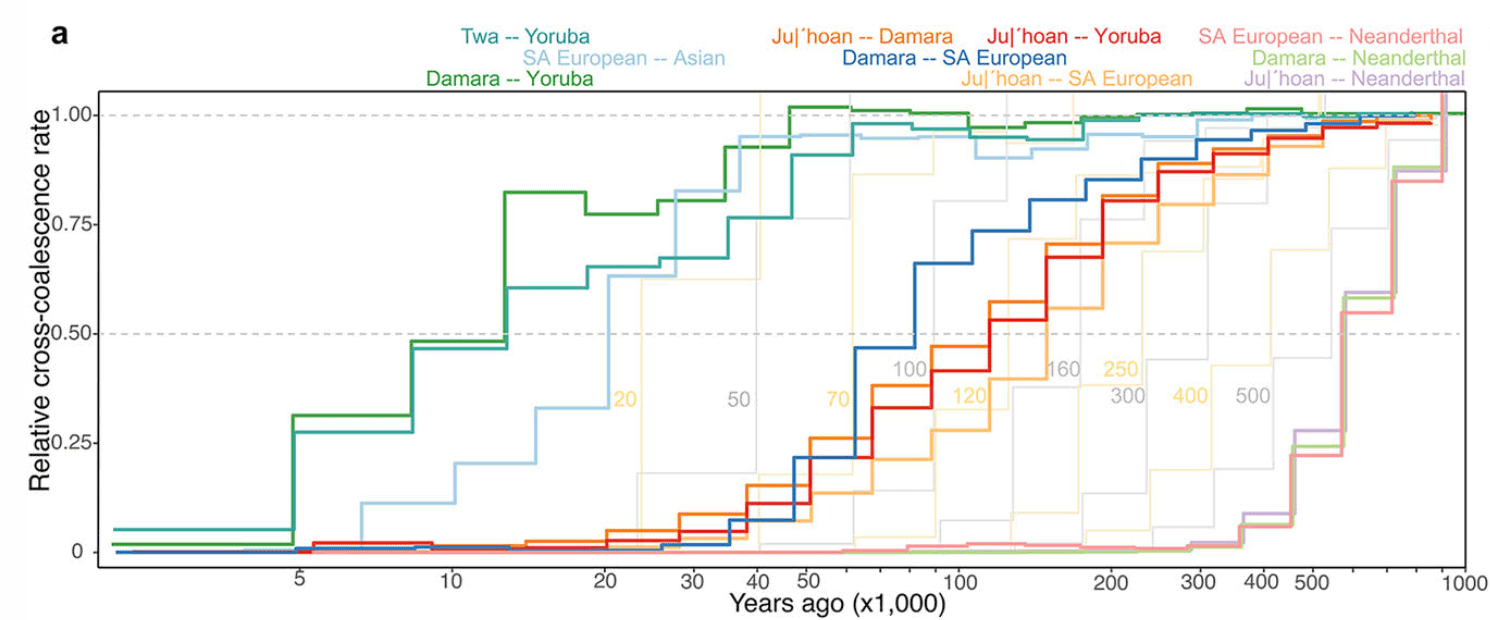
Out of all comparisons of living human populations, Khoe-San-related groups have the slowest (or longest) cross-coalescence with other African peoples. You have to look back more than 300,000 years into the past for them to share enough gene flow to approach random mating. The cross-coalesence curves connecting Ju|’hoan and Yoruba, and Ju|’hoan and Damara, reflect a deep structured ancestral network.
How did that deep structure emerge? The chart from Jaratlerdsiri and coworkers shows more than cross-coalescence data from real genomes; it also shows a series of simulated results. The simulations are represented by lightly colored stepwise curves with numbers beside them, and they assume an instantaneous split of the populations without subsequent gene flow.
The real data have more gradual curves than the simulated data. In the comparison between Ju|’hoan and Yoruba genomes, as much as 20 percent of the genome shows cross-coalescence as recently as 50,000 years ago. That could not happen without gene flow between their ancestral populations across this time.
Throughout the history of African populations, their cross-coalescence is more consistent with long-term gene flow than with instantaneous splits. This was not a simple tree of diverging populations; it was a network in which the strengths of relationships were shaped by genetic exchanges.

Long before the Late Stone Age
Genetic exchanges were stronger among groups that lived geographically closer to each other. One result of the work by Jakobsson, Schlebusch, and others has been to provide a better appreciation of how long this genetic structure has existed.
Twentieth-century ethnographic work on Khoe-San peoples tended to divide them on economic lines: traditional foragers on one side, herders on the other. But that economic division got going only around 2000 years ago as herd animals were introduced into southern Africa. That new economy was adopted by some groups in present-day South Africa and others in present-day Namibia.
Meanwhile, a few groups shifted to Khoe-San languages during their recent history. For example, the Damara started from a mostly western Bantu-related genetic ancestry and adopted a Khoe-San-related language.
Before herding came into the region, Khoe-San cultures and languages had been patterned into two branches: northern groups like the Kx’a-speaking Ju|’hoansi and !Xuun on one side, on the other southern groups like the Tuu-speaking ǂKhomani and Khoe-speaking Nama. Geneticists during the 1990s and early 2000s used single-nucleotide polymorphism (SNP) microarrays to estimate the genetic distances between northern and southern groups, suggesting a timeline in which the branches became established between 35,000 and 20,000 years ago. Some researchers thought this window might align with climate disruptions like the harsh aridity of Marine Isotope Stage 2 (MIS 2) or the shifting boundaries of Lake Makgadikgadi in present-day Botswana. Another possibility was a correspondence with the transition from Middle to Late Stone Age assemblages in southern Africa.
But the 2017 work by Schlebusch and coworkers elongated the timeline of north-south structure. The ancestors of today’s northern and southern Khoe-San populations were already differentiated long before the Late Stone Age. At an extreme, Schlebusch and collaborators suggested that the north-south population structure was in place by 156,000 years ago.
I tend to favor the suggestion by Brigitte Pakendorf and Mark Stoneking, in a 2021 review, that the pattern of genetic structure of southern African groups was isolation-by-distance. That is, the genetic structure came into being in a network of groups interconnected by gene flow across a broad geographic region. Exactly when this structure emerged is not yet clear, as illustrated in the image from Jakobsson and coworkers above, but was long before 50,000 years ago. The recent north-south linguistic and cultural patterns came into being across this network only after its initial establishment.
The legacy of this network can be seen in two research articles from this year. One of those, by Jaratlerdsiri and coauthors, was discussed above. The other, by Stacy Edington and collaborators, recovers some aspects of the deep population structure of southern Africa by sorting out the Khoe-San ancestry of descendant peoples across the Western Cape and Northern Cape provinces of South Africa. In this way, they examine the connection of geographic and ecological challenges to movement with the pattern of gene flow.
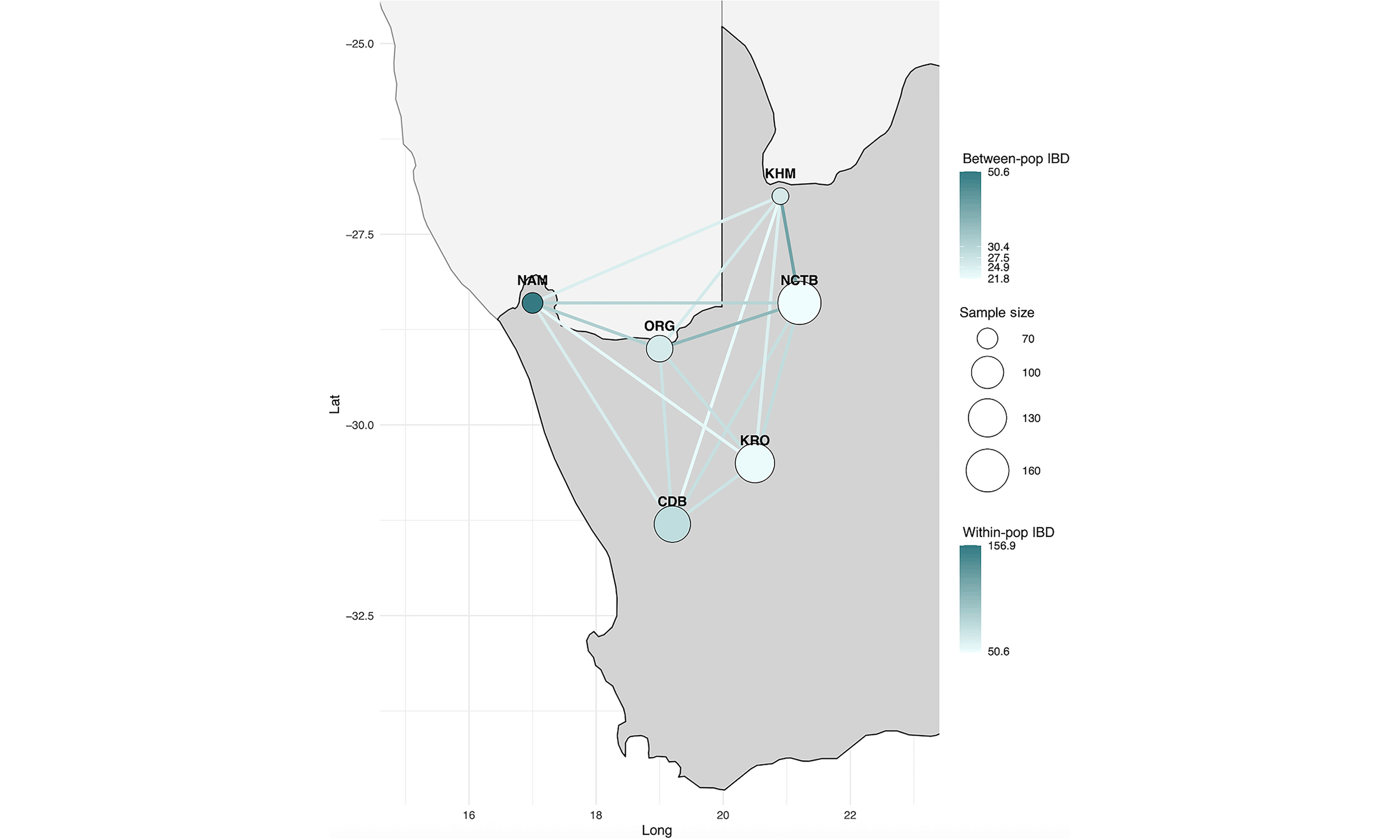
The genetic data show that the ancestors of Khoe-San peoples were relatively large, stable, and interconnected populations throughout the last 100,000 years or more. The development of both Middle Stone Age and Late Stone Age traditions in this part of Africa likely occurred within this relatively stable network. Assemblages known for site names like Mossel Bay, Still Bay, and Howiesons Poort are some of the Middle Stone Age technical patterns that became regionally common for limited times within this network.
Still, there are many unanswered questions about the relationship of genetic structure and the anatomical and archaeological record. Skeletons from Holocene archaeological sites in southern Africa share a pattern with living members of Khoe-San-speaking groups: small body size, gracile skulls with smaller facial structure and small teeth. Before 20,000 years ago, the skeletal remains are much fewer and more fragmentary, but they generally come from people with larger and more robust bodies.
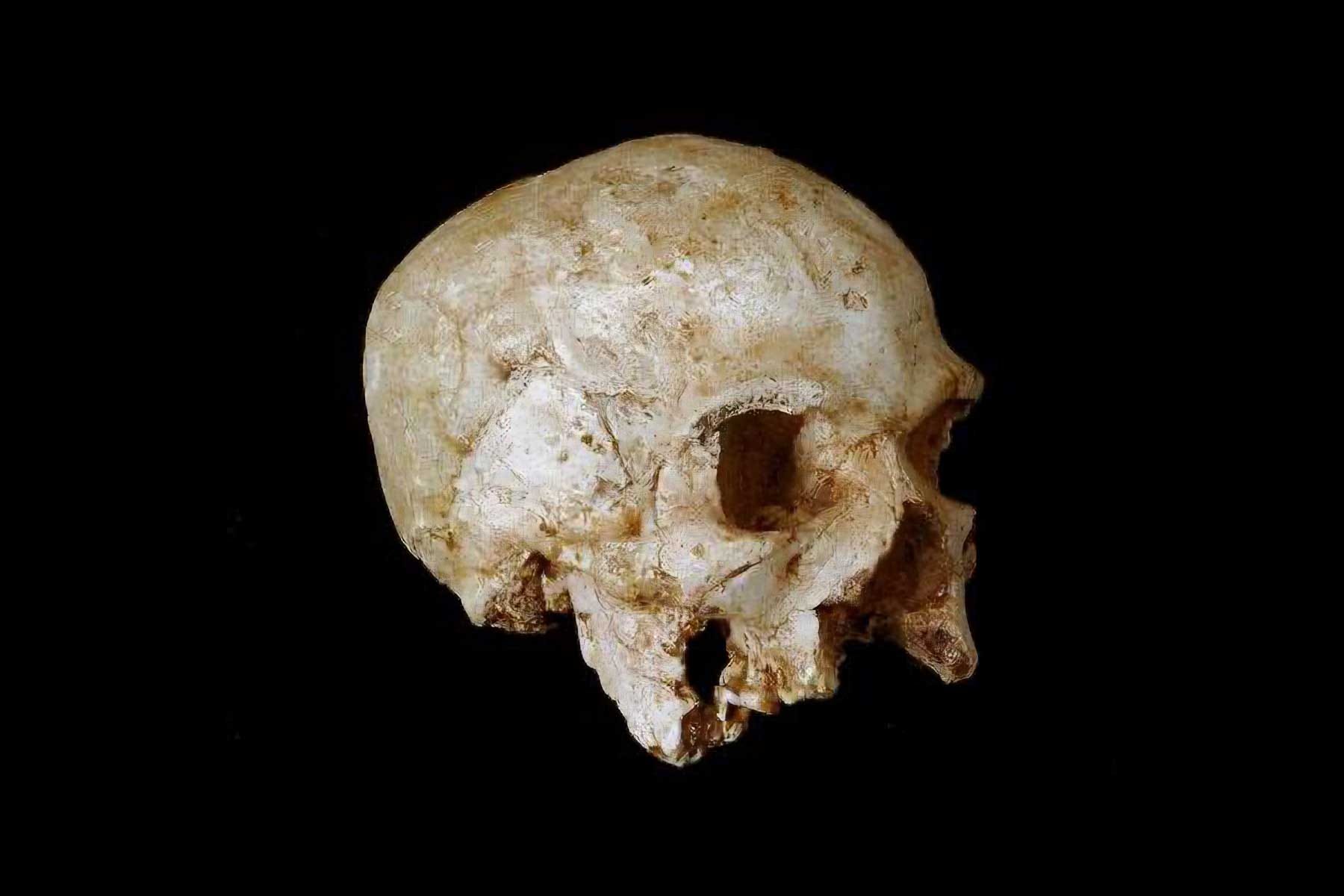
An example is the Hofmeyr skull from the Eastern Cape province, described by Fred Grine and collaborators. This skull dates to roughly 36,000 years ago and it is very different in general appearance from the sample of recent skeletal remains from the region. The size of the facial skeleton, braincase, and the form of external structures like the browridge appear to stand apart from the anatomy of Late Stone Age-associated people. Grine and coworkers have compared it to faraway skeletal remains like Europeans in Upper Paleolithic contexts or the Nazlet Khater skull from North Africa.
Yet a look at the details shows more clearly what has happened with anatomy in southern Africa. The Hofmeyr skull shares non-metric traits with recent southern African people even though it is different in size and robusticity. An analysis of 3D shape likewise shows that the Hofmeyr skull is within the variation of southern African samples when considering the correlation of landmarks on different parts of the skull. What has happened is that the population of southern Africa was once larger-bodied and more robust in its appearance, and has evolved smaller body size and more gracile features over time. That anatomical evolution may have been connected with the technical, cultural, and ecological changes of the last 30,000 years. It happened within a long-standing network of genetic exchanges.
References
Edington, S. L., Al-Hindi, D. R., Font-Porterias, N., Surowiec, A., Palmer, W. J., Myrick, J. W., Norman, P. J., Uren, C., Möller, M., Henn, B. M., & Reynolds, A. W. (2026). Recovering the precolonial population structure of Khoe-San descendant populations. Science Advances, 12(36), eadz7115. https://doi.org/10.1126/sciadv.adz7115
Grine, F. E. (Ed.). (2022). Hofmeyr: A Late Pleistocene Human Skull from South Africa. Springer International Publishing. https://doi.org/10.1007/978-3-031-07426-4
Jakobsson, M., Bernhardsson, C., McKenna, J., Hollfelder, N., Vicente, M., Edlund, H., Coutinho, A., Sjödin, P., Brink, J., Zipfel, B., Malmström, H., Lombard, M., & Schlebusch, C. M. (2025). Homo sapiens-specific evolution unveiled by ancient southern African genomes. Nature, 1–8. https://doi.org/10.1038/s41586-025-09811-4
Jaratlerdsiri, W., Soh, P. X. Y., Gong, T., Jiang, J., Simayi, Z., Petersen, D. C., Holland, E., Chan, E. K. F., Theron, K. E., Haacke, W. H. G., Förtsch, H. E. A., Bornman, M. S. R., Thomas, D. M., Mphahlele, J., & Hayes, V. M. (2026). A catalogue of early diverged contemporary human genome variation reveals distinct Khoe-San populations. Nature Communications, 17(1), 2573. https://doi.org/10.1038/s41467-026-69269-4
McKenna, J., Bernhardsson, C., Waxman, D., Jakobsson, M., Sjödin, P. (2024). Investigating population continuity and ghost admixture among ancient genomes. Human Population Genetics and Genomics, 4(3), 0–0. https://doi.org/10.47248/hpgg2404030009
Pääbo, S. (2014). The Human Condition—A Molecular Approach. Cell, 157(1), 216–226. https://doi.org/10.1016/j.cell.2013.12.036
Pakendorf, B., & Stoneking, M. (2021). The genomic prehistory of peoples speaking Khoisan languages. Human Molecular Genetics, 30(R1), R49–R55. https://doi.org/10.1093/hmg/ddaa221
Peter, B. M., Petkova, D., & Novembre, J. (2020). Genetic Landscapes Reveal How Human Genetic Diversity Aligns with Geography. Molecular Biology and Evolution, 37(4), 943–951. https://doi.org/10.1093/molbev/msz280
Sjödin, P., McKenna, J., & Jakobsson, M. (2021). Estimating divergence times from DNA sequences. Genetics, 217(4), iyab008. https://doi.org/10.1093/genetics/iyab008
Wadley, L. (2021). What Stimulated Rapid, Cumulative Innovation After 100,000 Years Ago? Journal of Archaeological Method and Theory, 28(1), 120–141. https://doi.org/10.1007/s10816-020-09499-y
Zeberg, H., Jakobsson, M., & Pääbo, S. (2024). The genetic changes that shaped Neandertals, Denisovans, and modern humans. Cell, 187(5), 1047–1058. https://doi.org/10.1016/j.cell.2023.12.029