

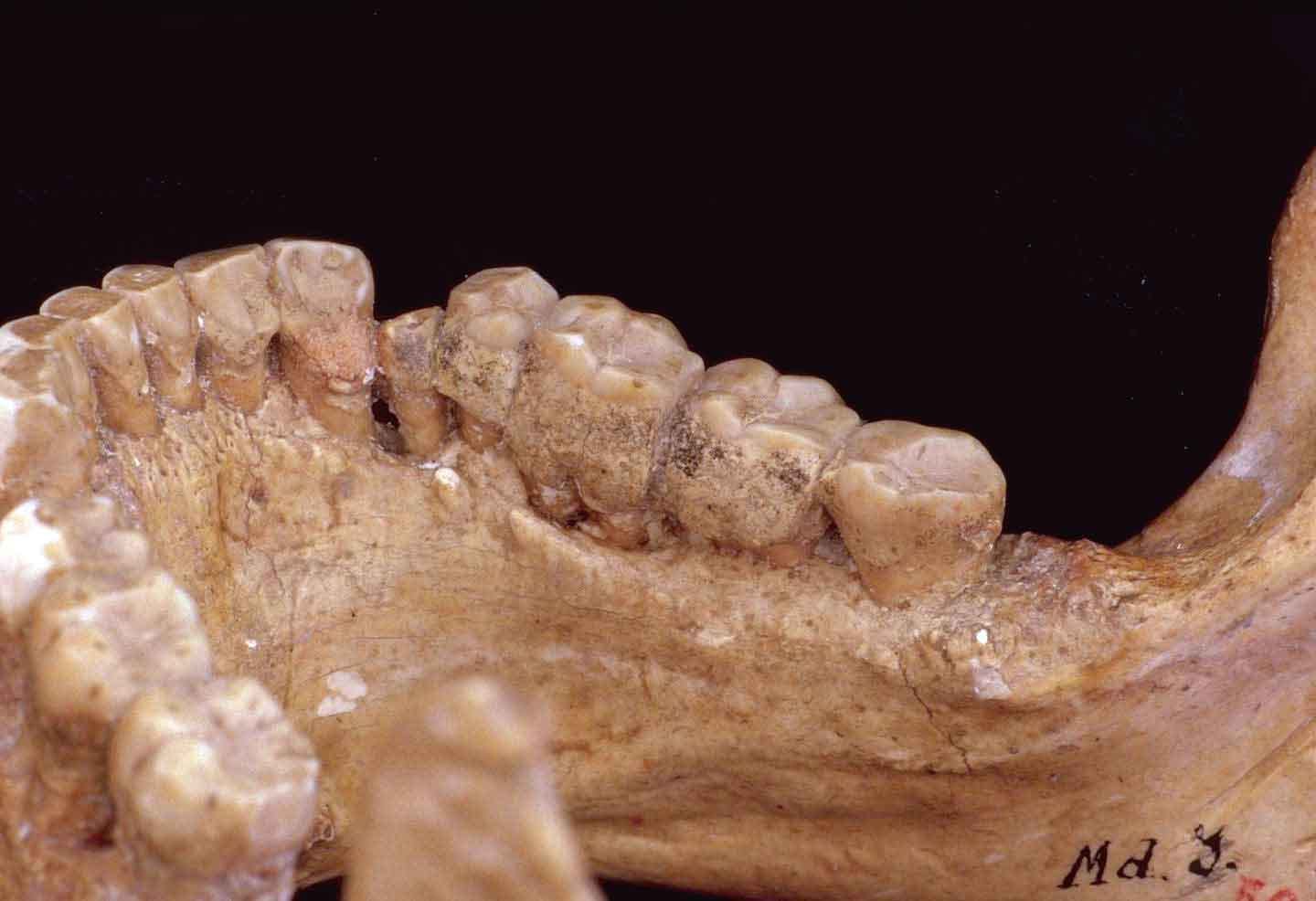
I’m fascinated today reading a recent article about insect-eating and ancient dental calculus. The study, by Manuel Piñero and Pablo Librado, looks into the dental calculus of more than 700 ancient humans, including 18 Neanderthals. They went looking for insect DNA, building a database of mitochondrial genomes of more than 10,000 species of insects to identify any signs of bugs in the ancient teeth.
They found plenty. Piñero and Librado present their findings in the context of living people around the world, and some populations of living great apes. In brief, Neanderthals have as much insect DNA in their dental calculus as western chimpanzees, while ancient European modern people have a lot less.
Calculus is what happens to the dental biofilm known as plaque as it takes up calcium and phosphate minerals from saliva, forming a hardened crust. This mineralized substance grows incrementally unless it is removed, and encapsulates oral bacteria, particles of food, and environmental microparticles from smoke or other exposures. Calculus has proven to be one of the most durable repositories of DNA, and provides valuable clues to the diets and environments of ancient species.
“With 1611 edible species cataloged worldwide, hundreds of millions of people already eat insects regularly, especially around the tropics, where their biomass and diversity warrant stable harvesting.”—Manuel Piñero and Pablo Librado
Regular readers may remember my last foray into the entomophagy literature, in which I reviewed the idea that Neanderthals got their high dietary nitrogen-15 content from eating the maggots on carrion (“Bizarre foods: Neanderthal edition”). Finding abundant insect DNA within the calculus of all Neanderthals seems like a pretty good confirmation that they did indeed rely on insects in important ways for their diet. An additional support is that the family most represented in Neanderthal calculus is Diptera, a family that includes many corpse-eating members.
Still, the story is not quite so simple.
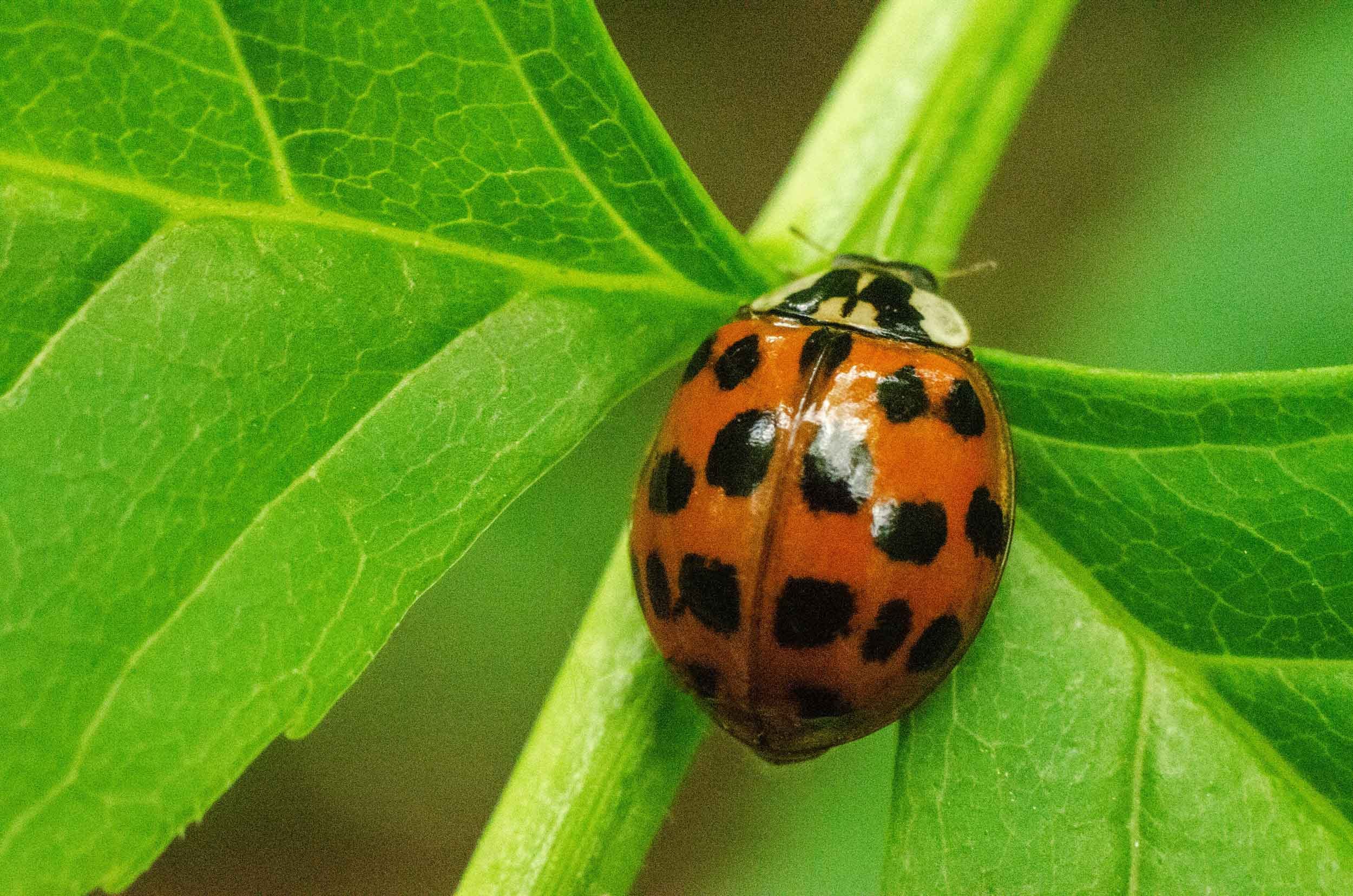
One sign of uncertainty is when traces of insect DNA seem not to belong. The most notable in this study is the trace of Asian lady beetle DNA in a Neanderthal sample. This common pest species in Europe and North America has only been recently introduced, and likely made its way into a sample from Goyet Cave due to its presence at the site today. I’ve got them in my house every fall, I don’t see why an archaeological site would be different.
Another piece of complexity is the pattern of insect traces in the living great apes. Chimpanzees vary about as expected. Western chimpanzees have a lot of insect DNA in their calculus. Their environment is highly seasonal, and termite fishing and other consumption of social insects makes up a big fraction of their diets. In contrast, the chimpanzees in more stable environments eat fewer insects. Tool-assisted insect foraging is one of their more celebrated behaviors, but makes up a small fraction of overall food.
“Eastern and Central chimpanzees occupy stable rainforests, with reliable leaf and especially fruit availability, making insectivory largely unnecessary, accounting for only <4% of their feeding budget.”—Manuel Piñero and Pablo Librado
But the most insect DNA is in calculus from gorillas, both eastern and western. Mountain gorillas have the most, but they don’t do a lot of deliberate foraging for insects. Both eastern and western lowland gorillas do eat ants and other insects, although in both cases this is a small fraction of their food consumption. Piñero and Librado suggest that their reliance on bulk plant consumption actually results in a lot of insects being crammed in along with the leaves and stems.
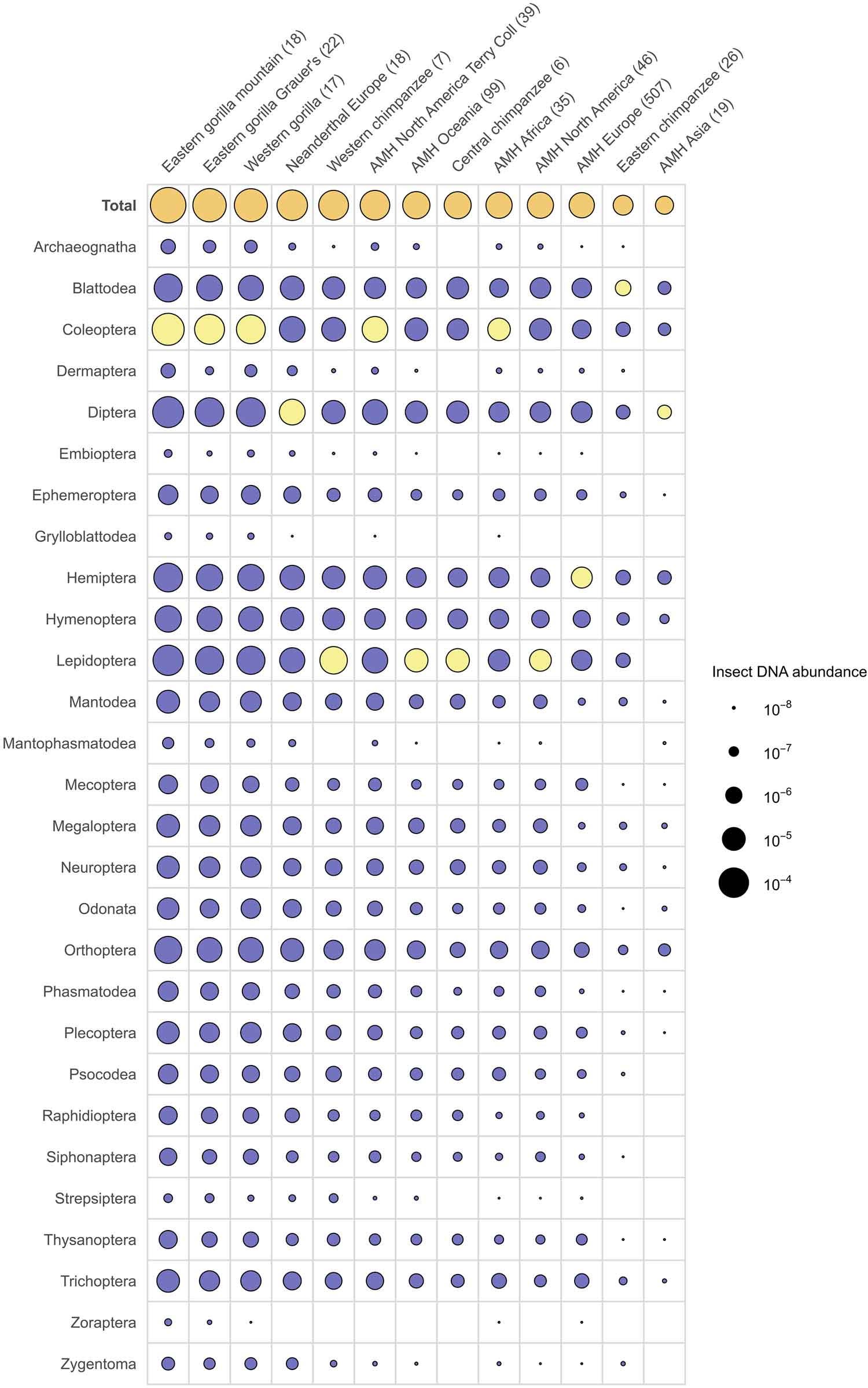
So it’s not entirely clear how to interpret the Neanderthal findings. More insect DNA probably does mean more insects in the mouth—at least, after accounting for contaminants. But whether these were intentionally foraged insects may be uncertain. Maybe a more resolved view of the insects will help with interpretation in the future.
For Piñero and Librado, the findings with the most impact are the relative rarity of insect DNA in ancient modern teeth from Europe. They take this finding as an illustration of an interesting historical pattern.
Insect consumption is fairly rare in traditional Western diets. This contrasts with the tropics where insect foods are much more commonly eaten. In many European cultures, eating insects is almost taboo.
When did this arise? One hypothesis has been that medieval shifts in religious beliefs as well as the incidence of pest species in agricultural societies drove cultural aversion toward insect foods in Europe. But the ancient calculus indicates that the lower consumption may be much more ancient.
To the calculus study, Piñero and Librado added a study of genes related to chitin digestion. Chitin is a major protein component of insect exoskeletons and other structural tissues; it is also found more broadly in arthropods as well as in fungi and some other branches of life. Humans and other primates have enzymes for breaking down chitin and some of these are preferentially expressed in the stomach. Compared to some other kinds of mammals that rely on insects, humans are not especially strong in breaking down chitin. But the full function of these genes in humans remains weakly known.
Piñero and Librado find two genes, CHIA and CTBS, that have alleles that seem to have been under selection in association with latitude. The alleles found more commonly in the higher-latitude Eurasian samples include many inferred to reduce gene expression in the stomach. It’s an interesting geographic pattern, as strong for these genes as for some of the alleles related to pigmentation. The reason for association of pigmentation alleles with latitude is pretty clear, it is the incidence of ultraviolet radiation. For chitin enzymes, it seems a pretty good hypothesis is edible insect abundance within the diet.
The end of this story in modern humans is that the latitudinal cline emerged before agriculture took hold. So this is likely a simple consequence of less foraging for insects, possibly due to a lower environmental abundance of species that may have been commonly eaten by the tropical ancestors of early modern people.
However the story for Neanderthals and Denisovans is different. Their samples are very small, but all share the high-expression versions of CHIA and CTBS found more commonly in lower latitude populations today. As noted by Piñero and Librado, this finding aligns with the higher level of insect DNA in Neanderthal dental calculus.
What I think is that this is a pretty intriguing finding. Certainly Neanderthals and early modern people in Europe lived in similar environments, with similar insect abundance. The Neanderthals may have been making more extensive use of these insects than the newly-arrived modern people. The deficit of insect consumption persisted for thousands of years after the arrival of modern people, even up to the present day.
How did this happen? This is a pretty good sign of long-term cultural persistence of foraging strategies within both Neanderthals and modern people. The Neanderthals passed information forward, relying on specific kinds of strategies—maybe including maggot-eating. The modern humans also passed information forward, but experienced a massive change in ecology as they dispersed toward higher latitudes. Foods their ancestors had relied upon for millennia were simply forgotten in their new homes.
Did they sample the Neanderthal foods and find them too strange, too weird, to take on? Or was their strategy much less broad within the geographic regions where they ranged, making the more intensive Neanderthal use of insect foods less economically viable for them? These are great questions for further study!
Notes: I’ve been very busy in the laboratory this month. There are quite a lot of new fossils and I’ve been delighted at my students’ progress toward some very interesting projects. My sincere appreciation goes out to all paid subscribers, whose contributions have helped support these students in their research.
I highly recommend the book by Julie Lesnik, cited below, as a source for a broader overview of insect consumption across the span of human evolution. I’m not sure we’ll see insect DNA within early hominins like Australopithecus, but there are tiny parts of insect scales and other body parts in some later calculus samples, which opens the possibility of much earlier discoveries.
References
Lesnik, J. J. (2018). Edible Insects and Human Evolution. University Press of Florida.
Piñero, M., & Librado, P. (2026). Genomic evidence for limited entomophagy in ancient Europeans. Science Advances, 12(23), eaec6939. https://doi.org/10.1126/sciadv.aec6939