

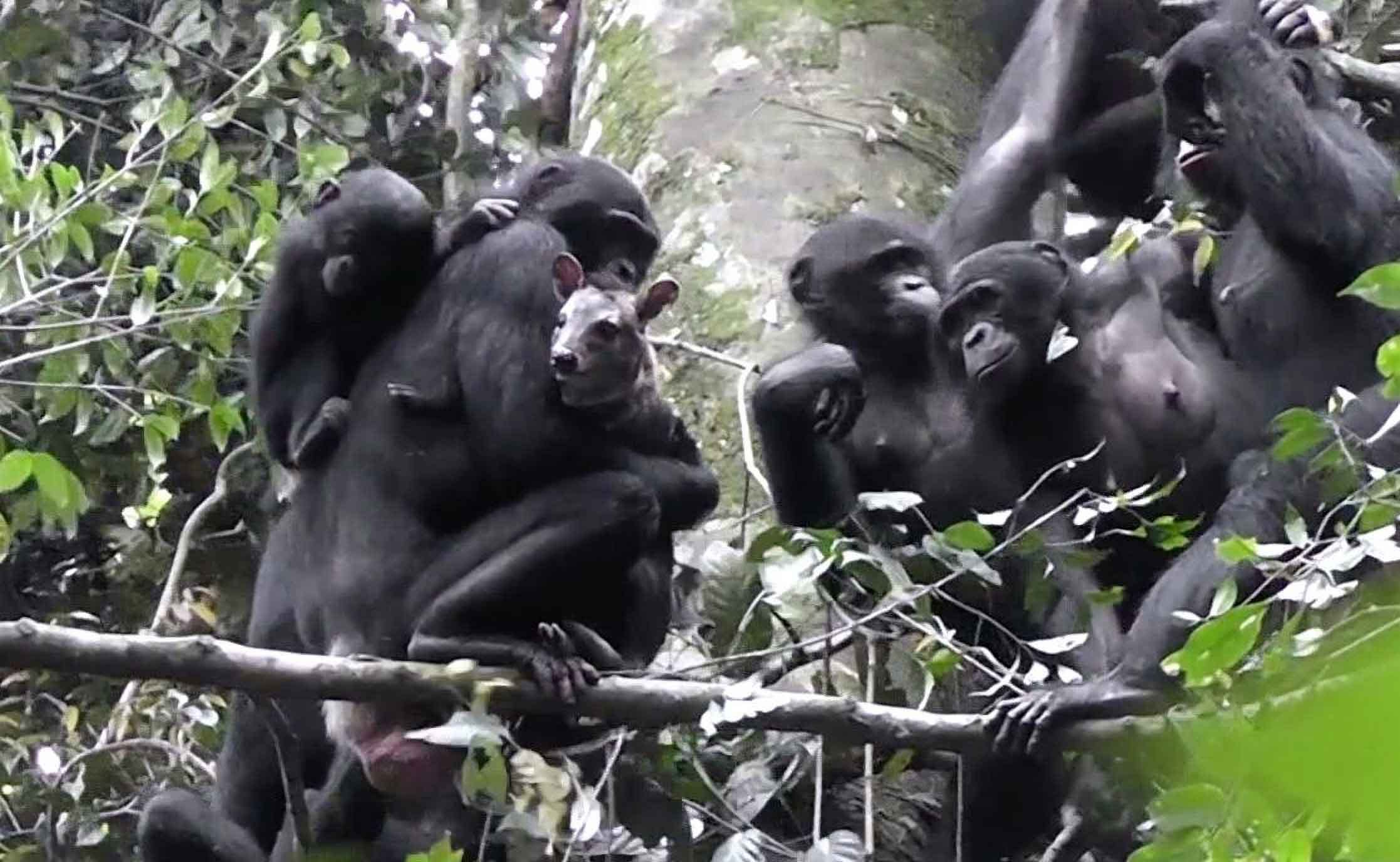
New research from Gottfried Hohmann and collaborators in Current Biology looks at the statistics of hunting by male and female bonobos. Bonobos eat meat on occasion like chimpanzees do, but while hunting seems to be male-biased in most chimpanzee groups, for the bonobos it is much more often females who are hunting and gaining direct access to meat.
What Hohmann and coworkers add is ten years of data from two groups that have been studied, both at LuiKotale in the Democratic Republic of Congo. Reading the numbers and looking at how different bonobos stack up in the hunting, there is a lot here.
These bonobos hunt quite a bit. The dataset from these two groups includes 415 successful hunts across the 10 years covered in the study. Considering that the field crews were only observing each of the groups for around 2000 days during the 10 years, the number of hunts averages to one successful capture in every 10 days or so of observation. This is a higher hunting intensity than some chimpanzee groups, such as those at Mahale, Tanzania, and more than seen at Budongo, Uganda. Chimpanzees do hunt more at some sites, but not a lot more: They average around one kill per week at sites like Taï Forest, Côte d’Ivoire, Ngogo, Uganda, and Gombe, Tanzania.
It can be misleading to talk about averages, since hunting is highly seasonal and episodic at some sites, where chimpanzees go on binges of hunting, separated by long periods of little activity. The value of hunting as a contribution to nutrition in chimpanzees has been fairly clear. Still, in some groups, hunting happens more often during times of abundant fruit availability, not scarcity. This has suggested to some primatologists that the social effects of hunting, such as social bonding by meat sharing and learning how to coordinate behavior, may be more important to the chimpanzees than the meat itself.
But for chimpanzees, that conversation has been dominated by trying to understand the benefits and costs for males. Males participate more in hunts, kill more prey animals, and eat more meat in every observed chimpanzee group. Only at Fongoli, Senegal, is there a category of hunting in which female adults invest more effort and have more success than males, hunting small galagos with sharp sticks.
The bonobo data point to a different reality. As in many other aspects of bonobo society, females run the show. They participate in hunts more often, make kills more often, and get more meat than males.
Bonobo hunting
The first sites where primatologists established long-term field observation of bonobos were Wamba and Lomako, both in the Democratic Republic of Congo. At these sites, and Wamba especially, hunting does occur but is rarely observed. According to Hiroshi Ihobe and Tetsuya Sakamaki, fecal samples showed evidence of meat-eating long before any hunts were observed. The idea took hold that bonobos don’t hunt as much as chimpanzees.
Hunting has turned out to be a culturally variable behavior across different groups of bonobos, just as it is among chimpanzees. It happened that the earliest field site for wild chimpanzees, Jane Goodall’s research area at Gombe, Tanzania, has among the highest rate of hunting. LuiKotale, the bonobo site with high hunting activity discussed in the current study by Hohmann and coworkers, only got started in 2002, almost forty years after the start of Goodall’s research.
Not only the frequency of hunting but also the prey choice varies across groups. As documented by Liran Samuni and coworkers, bonobo groups in very similar habitat, with identical abundance of prey animals, have arrived at very different prey selection strategies. One group studied by Samuni and coworkers hunted mostly duiker, a small antelope. Another hunted mostly anomalures, a large rodent. In the current study by Hohmann and coworkers, one bonobo group hunted many more monkeys, the other many more antelopes.
As in most chimpanzee groups, hunts by these bonobos are a group affair. Several individuals usually participate, and the chances of success are greater the larger the hunting party. Both female and male individuals are often included within a hunting party. The individual that makes the kill depends both upon skill and motivation and upon events in the moment. For these bonobo groups, females account for more than 70% of kills of small antelopes, and about the same proportion of monkey kills as males.
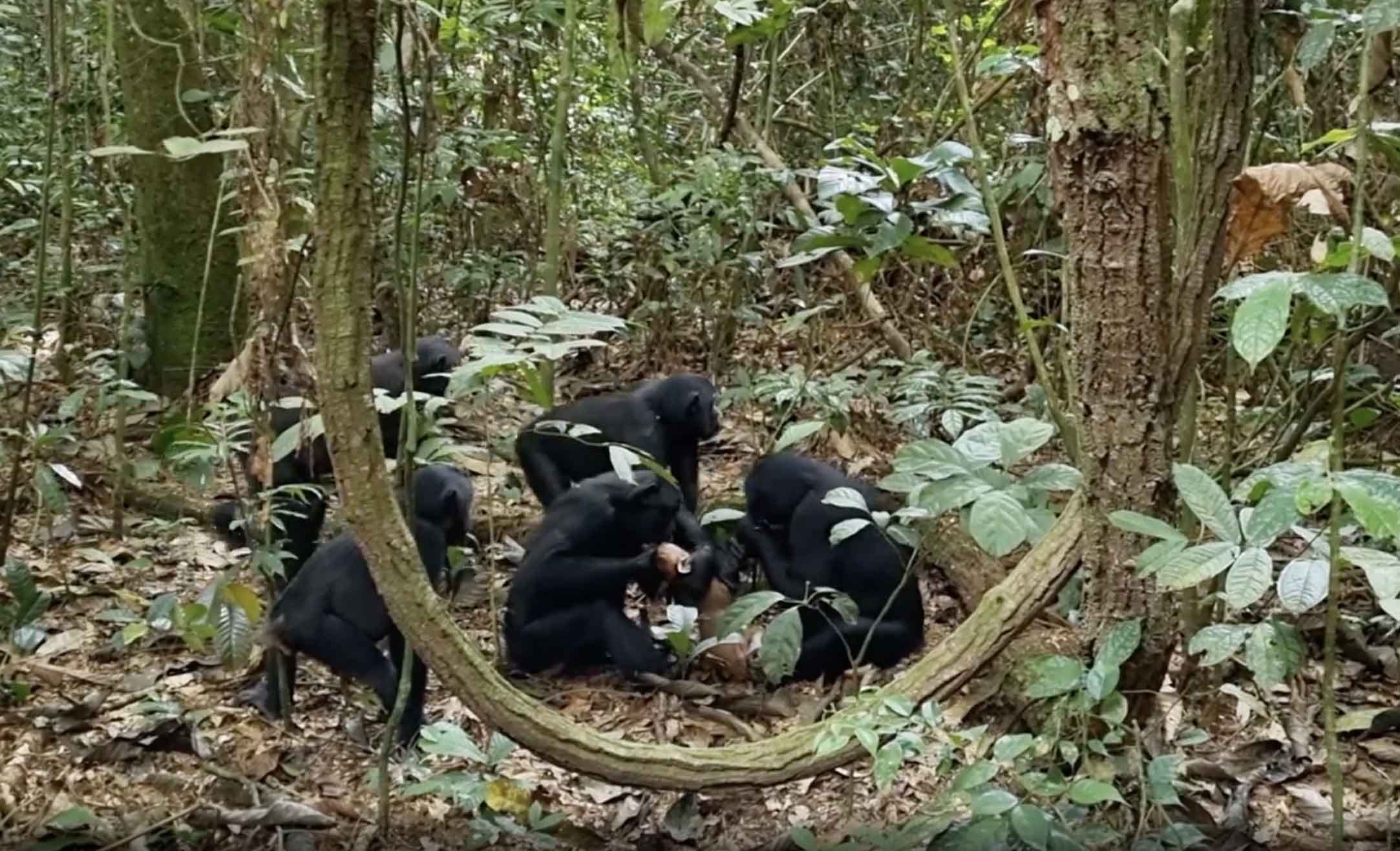
Age also mattered to the bonobos. Older individuals hunted more and killed more prey. Older females were the main hunters, and also were the highest in dominance rank in their groups. Older males hunted only about as much as females that were 15 to 20 years younger.
Hunting activity and access to meat in chimpanzee groups is somewhat different from dominance rank. Particular males tend to initiate hunts and be involved in the kill. Ian Gilby and collaborators called these “impact hunters”. They are often younger than the top-ranking males. Killing the animal confers a kind of privilege against theft of the meat, which doesn’t always hold but means that top-ranking males may be reduced to begging for a share. But this varies markedly.
Why female chimpanzees hunt less
Chimpanzee female adults hunt much less than males, and eat less meat as a result of hunting. Females do eat plenty of protein from insects including ants and termites in many groups, and at Fongoli, they specialize in spearing galagos. In other words, female adults do not neglect the acquisition of animal prey, they just focus on small animals that can be captured individually.
Meat is clearly valuable to chimpanzees. All chimpanzees in a group pay attention during a hunt. Many females participate in the hunt even if there is little chance of getting a bite of meat. The contribution of meat to overall nutrition is important. This should be doubly so for female adults with infants. That raises the question: Why don’t female chimpanzees hunt more?
There have been two common hypotheses for why male chimpanzees hunt more than female chimpanzees. One hypothesis is male dominance. Meat is a valued food, getting meat is something most chimpanzees want to do, males are dominant and fight others for access to valued resources: ergo, males mostly dominate hunts. Anyone who gets their way is likely to fail or worse, be injured in a fight.
The other hypothesis is risk aversion. Hunting takes a lot of energy and involves high kinetic climbing or running, as well as the death struggle with the cornered prey animal. The hypothesis is that females shy away from these risks. They have more to lose, including their investment as mothers of young infants. Their aversion to risk enables males to reap the rewards.
The bonobo data make pretty clear that risk aversion has little to do with it. Whatever risks chimpanzee females face from hunting antelopes and monkeys are shared by bonobo females. All but one: the risk from males. That is the deciding factor between these two social systems. It’s simply dominance of females over males in bonobos, males over females in chimpanzees.
Hominin horizons
There has been some vociferous disagreement over the last few years about the female role in hunting in ancestral humans and hominins. It has been a flare-up of much older scientific debates over the economics of hunter-gatherer societies, going back to the “Man the Hunter” conference of 1966 and beyond. Researchers have come at this question from really different ground assumptions. Many of those assumptions are rooted in ethnographic observations of human hunter-gatherer societies. But some are built upon the patterns of hunting in chimpanzees.
The bonobo work makes clear that chimpanzees are not the only model. So how do we choose?
There’s basically nothing in the archaeological record of carcasses, weapons, and kill sites to suggest that either males or females were more active in hunting parties. Maybe if we are talking about ancient humans and closely related populations like Neanderthals, it will be best to consider hunter-gatherer social ecology as a model. Cautiously, of course, with full acknowledgement that historic societies have been really variable in the behaviors socially expected from either gender.
Turning toward hominins with more distant relationships from humans, why would we assume anything?
Obviously I’m thinking about my work with Homo naledi. Every individual I’ve studied has a female proteomic signal. The female-only nature of the current samples from Rising Star suggest some pretty strong process of selection of the individuals in the settings where the team has excavated. It’s too soon to know if that is a sign of kind of gendered social bonding during life, or whether the colocation of bodies may signify connections across many generations. But I wonder if the female adults and possibly children were coordinating activity during life also. Certainly their dental morphology suggests a high-quality diet, which in hominins usually includes hunted meat.
One thing about hunting by more distant hominins seem reasonably certain: Before the routine use of projectile weapons, few hominin individuals could have hunted medium-to-large prey animals without help. Some of the best-known hominin kill sites from Middle Pleistocene times are cases where multiple hominins cooperated to drive or ambush animals, cornering them in places where landscape features impeded escape. Those hunting parties have a lot in common with how bonobos and chimpanzees hunt primates and small ungulates. As in the tool-assisted hunting at Fongoli of small primates, without projectile weapons the lone hominin hunter would have been limited to small prey.
Bonobo hunting helps to show that social dominance shapes the context of hunting. When females are dominant and provide the focus of group cooperation, females have a larger role in hunts. Although human behavioral ecologists have sometimes argued that hunting is too risky for women with infants to participate, for bonobos such risk doesn’t seem to come into the equation.
It’s an accident of history and geography that field research on wild chimpanzees had advanced for two decades before equivalent field research on bonobos got going. The vivid differences of bonobo from chimpanzee social behavior and ecology made waves. The two species are broadly similar in body size, diet, and group structure—so much so, that their differences might be scarcely noticed if they were fossil species instead of extant ones.
That makes me wonder about the variability among the fossil samples I study. I wonder how many were hunting, how often, and how they shaped their hunting parties.
References
Gilby, I. C., Machanda, Z. P., Mjungu, D. C., Rosen, J., Muller, M. N., Pusey, A. E., & Wrangham, R. W. (2015). ‘Impact hunters’ catalyse cooperative hunting in two wild chimpanzee communities. Philosophical Transactions of the Royal Society B: Biological Sciences, 370(1683), 20150005. https://doi.org/10.1098/rstb.2015.0005
Hohmann, G., Bessone, M., Balduccio, N., Decina, F., Deville, T., Pashchevskaya, S., Soliday, V., Stewart, K., & Fruth, B. (2026). Females shape hunting of vertebrates in wild bonobos. Current Biology, S0960982226013254. https://doi.org/10.1016/j.cub.2026.09.082
Ihobe, H., & Sakamaki, T. (2023). Hunting and Meat-Eating Behaviors of Bonobos at Wamba: Comparison with Other Bonobo Study Sites. In T. Furuichi, G. Idani, D. Kimura, H. Ihobe, & C. Hashimoto (Eds.), Bonobos and People at Wamba: 50 Years of Research (pp. 115–131). Springer Nature. https://doi.org/10.1007/978-981-99-4788-1_11
Samuni, L., Wegdell, F., & Surbeck, M. (2020). Behavioural diversity of bonobo prey preference as a potential cultural trait. eLife, 9, e59191. https://doi.org/10.7554/eLife.59191