

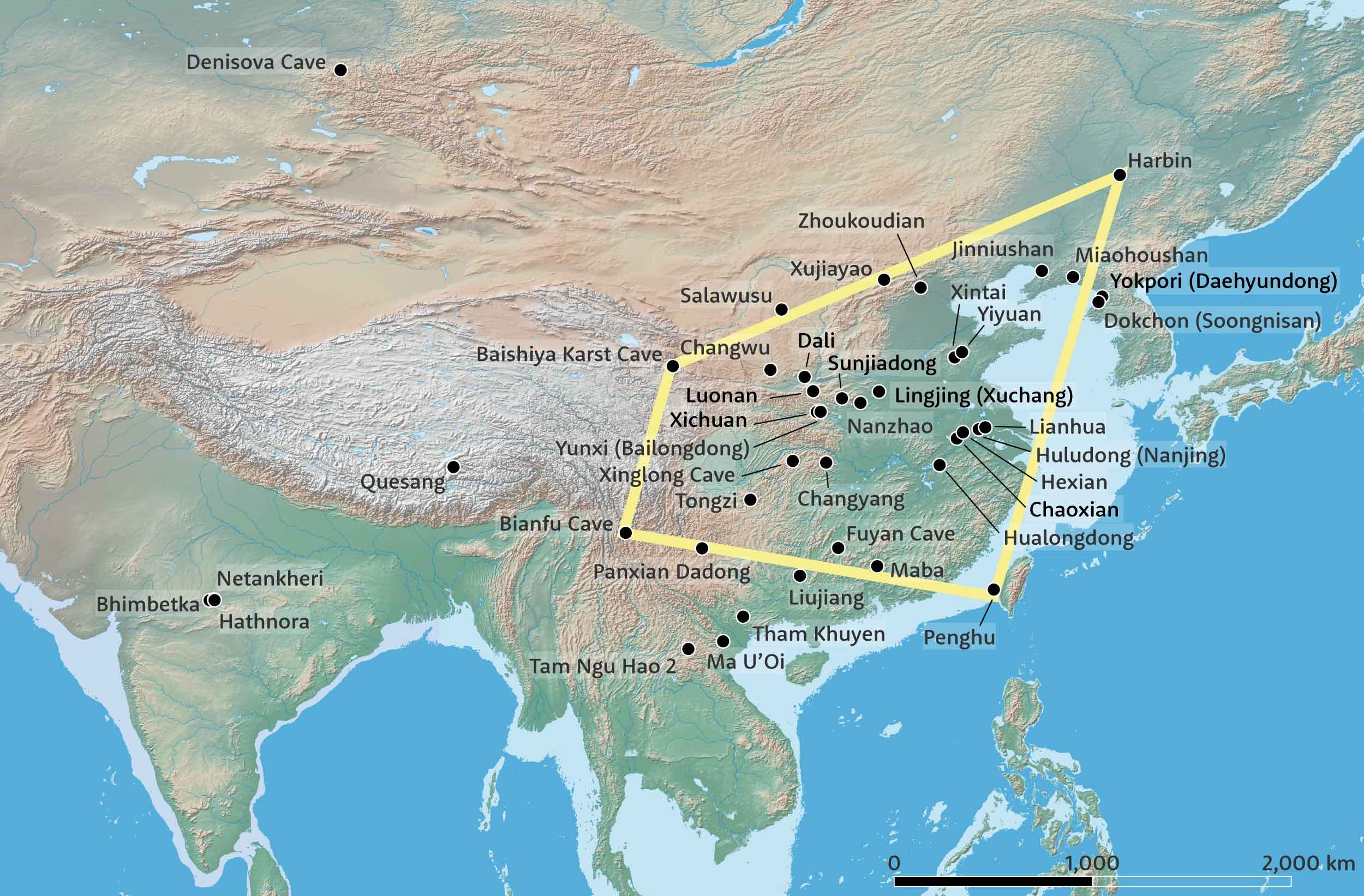
Over the last few years, genetic and proteomic data have begun to fill in the pattern of Denisovan occupation of China. Three sites with identified Denisovan fossils inscribe a great triangle with sides more than 2000 km in length: Harbin in the northeast, Penghu on the submerged continental floor of the southeast, and Baishiya Karst Cave in Gansu province, within the historic northwest.
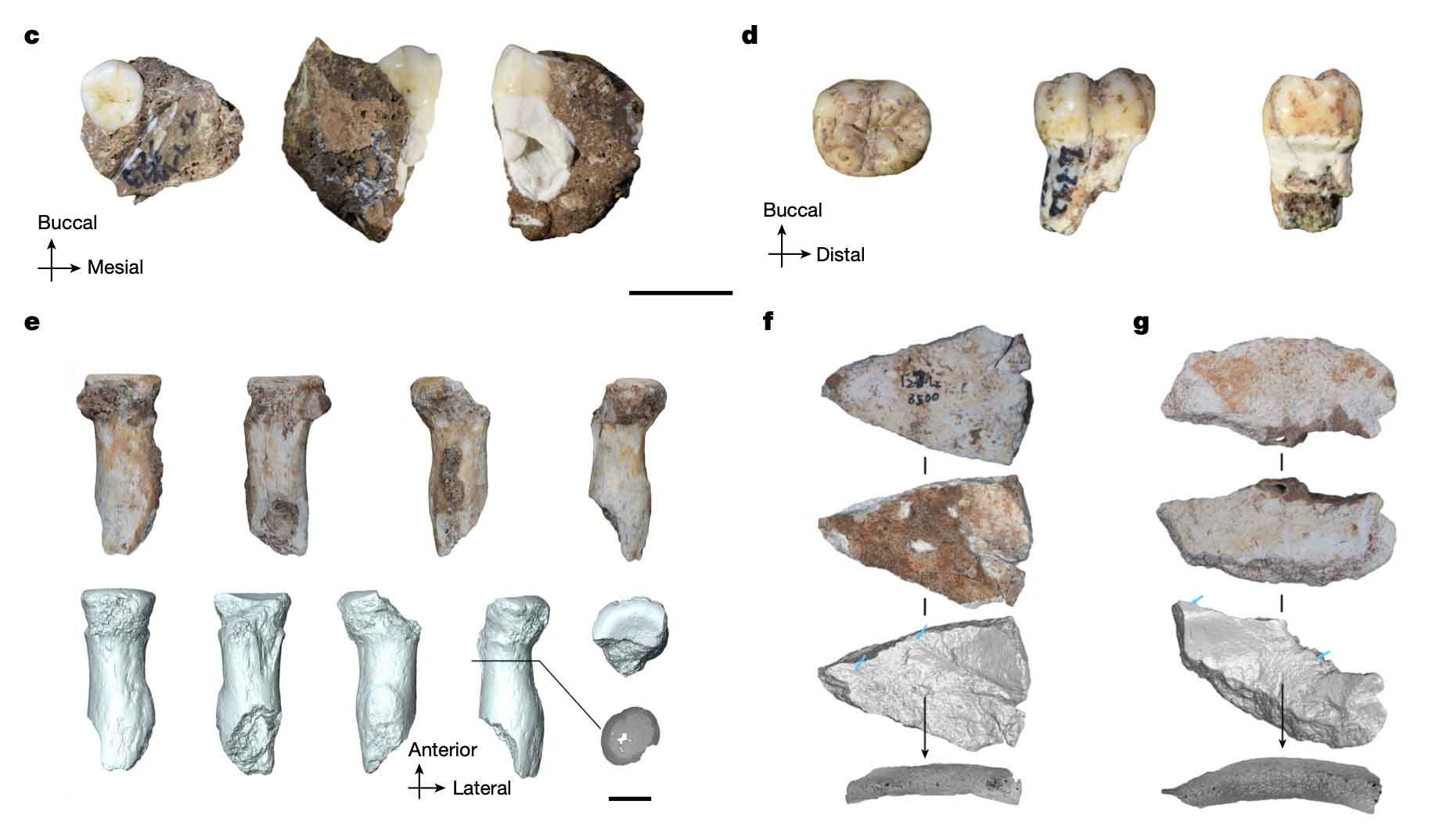
At the fourth corner of historic China, in the southwest, is Yunnan province. In this region in 2019, Qijun Ruan from the Yunnan Institute of Cultural Relics and Archaeology opened excavation trenches into cave sediments that were exposed in the sloping wall of an industrial quarry. The site is known as Bianfudong, or Bianfu Cave. The team found Denisovan bone fragments and teeth, many stone tools, and some bone tools.
Much like the case of Denisova Cave itself, the identity of most of these fragments was obscure without additional insight from biomolecules. This new work was published today in a paper led by Huiyun Rao, with Qiaomei Fu as senior author. The laboratory researchers recovered peptide data from five fossils. These included enamel proteins from two teeth and collagen from three bones, each with amino acid variants seen in Denisovan fossils. Additionally, one further tooth, a second molar, shares a similar morphological pattern with other Denisovan teeth. The hominin fossils come from different layers with ages estimated between 170,000 and 130,000 years ago.
It’s the “Bianfudong” name that gives the fossils their designation as “BFD”, but the letters do seem to fit for another reason. In my view, they pretty much cement the case that the entire Chinese record from the later Middle Pleistocene belongs to the “Denisovan” group as we now understand it.
Artifactual record
A second paper out today, led by Ruan, reviews the archaeological materials from Bianfu. These include stone tools, bone tools, and lots of faunal bone that record prey choices and carcass access by the people who used the site over time. The archaeological levels with Denisovan bones or teeth range in estimated age from around 180,000 up to around 130,000 years ago. The record as a whole extends longer, up to around 70,000 years ago. This is a follow-up on a 2023 publication that gave a brief description of the stone industry and excavation.
This record from Bianfu is like a Neanderthal site in some important ways. The faunal exploitation was similar in pattern, with heavy representation from large herbivores including sika deer, red deer, gaur, and water buffalo. The Bianfu people were skilled hunters. The bones of their prey animals show that people had primary access to carcasses, with many signs of butchery and marrow exploitation, and few signs of carnivore gnawing. The faunal bones strongly represent prime age adult animals, different in pattern from sites where the young and sick were the primary prey.
Another similarity to Neanderthals is the presence of bone tools in the site. Seven bone tools come from a layer with Denisovan skeletal material. Those tools include several bone retouchers, used to remove small flakes from the edges of stone tools.
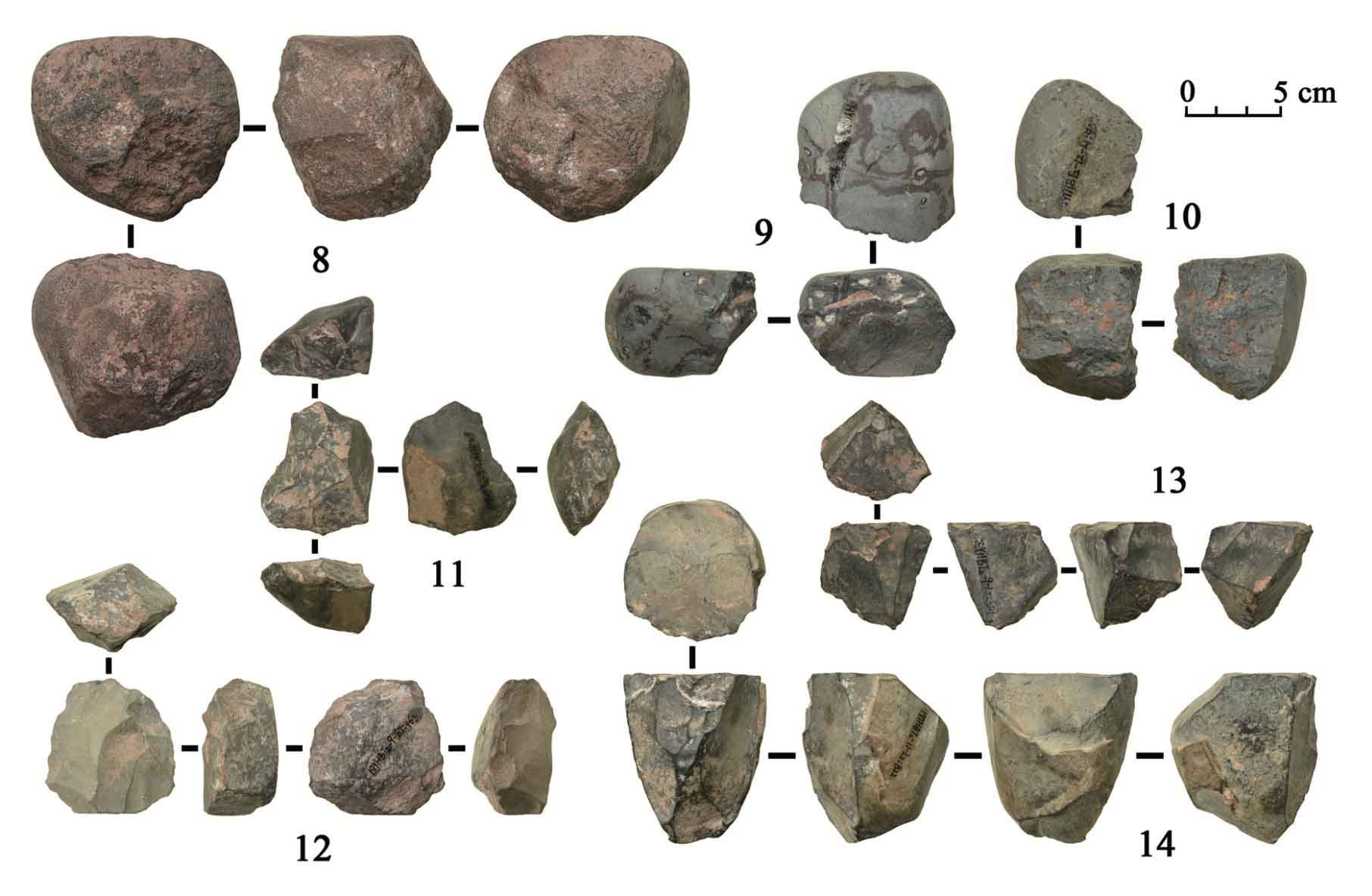
But the Bianfu stone industry is very different from most Neanderthal sites. Mousterian and other traditions made by later Neanderthals in Europe and southwest Asia are mostly based on Levallois flaking strategies. Flakes made in this way are very rare in China. Discoidal cores, which can also show a hierarchical flaking strategy, are sometimes seen in Chinese sites, and four of them were found at Bianfu Cave. But on the whole, most of the Bianfu assemblage is made from simple river cobble cores without a lot of flaking or retouch.
These Denisovans had different stone reduction strategies from most Neanderthals. These differences are not intrinsic to Denisovans. We know this because Denisovan-containing layers at Denisova Cave itself had typical Middle Paleolithic reduction strategies with Levallois flakes, parallel cores, and discoidal cores. Of course, associating these artifacts from Denisova with the Denisovan populations there requires some assumptions. But my point is simply that there’s no line of demarcation of technology or culture that matches the boundary between Neanderthal and Denisovan.
In that light, it may seem ironic that a site like Bianfu Cave with bone retouchers has little retouch. Or that a site with such strong evidence for hunting does not show more evidence of attention to points or hafting. These different aspects of behavior are simply not correlated with each other on the time scale and geographic scale of these groups. There has long been a tendency for archaeologists to assume that the “complex tools” like those made from Levallois approaches somehow signify “complex cognition”. I think that assumption ignores a lot of information from the record about decision-making and cultural transmission.
Ties to other sites
Five sites now have Denisovan biomolecular evidence, ranging in age from more than 300,000 up to only 45,000 years ago. They range in latitude from 23° to 51° north, much greater than the known latitude extent of Neanderthals. In longitude these Denisovan sites are spread from 84° to 126° east—less than Neanderthals, but even so more than Bordeaux to Moscow.
Last year I wrote that the Denisovan populations likely encompassed all of the later Middle Pleistocene fossil record of China:
“Few are really saying this, but if the Harbin skull belongs to the broader Denisovan population, it’s very likely that all or nearly all of the fossils from China during the period from 350,000 to 130,000 years ago also belong to this group.”—John Hawks
Today I would go further. As I wrote earlier this year, I think that some earlier Middle Pleistocene fossils identified with shared Denisovan protein variants, including some teeth from the Zhoukoudian and Hexian sites, are also Denisovan and not Homo erectus as traditionally thought. These examples, around 400,000 years old, are likely to have a relationship to later Denisovans similar to what the 430,000-year-old Sima de los Huesos fossils have to later Neanderthals.
I also think it is likely that much of the Late Pleistocene record spanning from 130,000 to around 45,000 years ago in China is also Denisovan. My opinion runs against the ideas of some other scientists who think that early modern humans may have been present in China during much of this interval.
Here is some of the evidence that weighs into my thinking about the Denisovan biogeography:
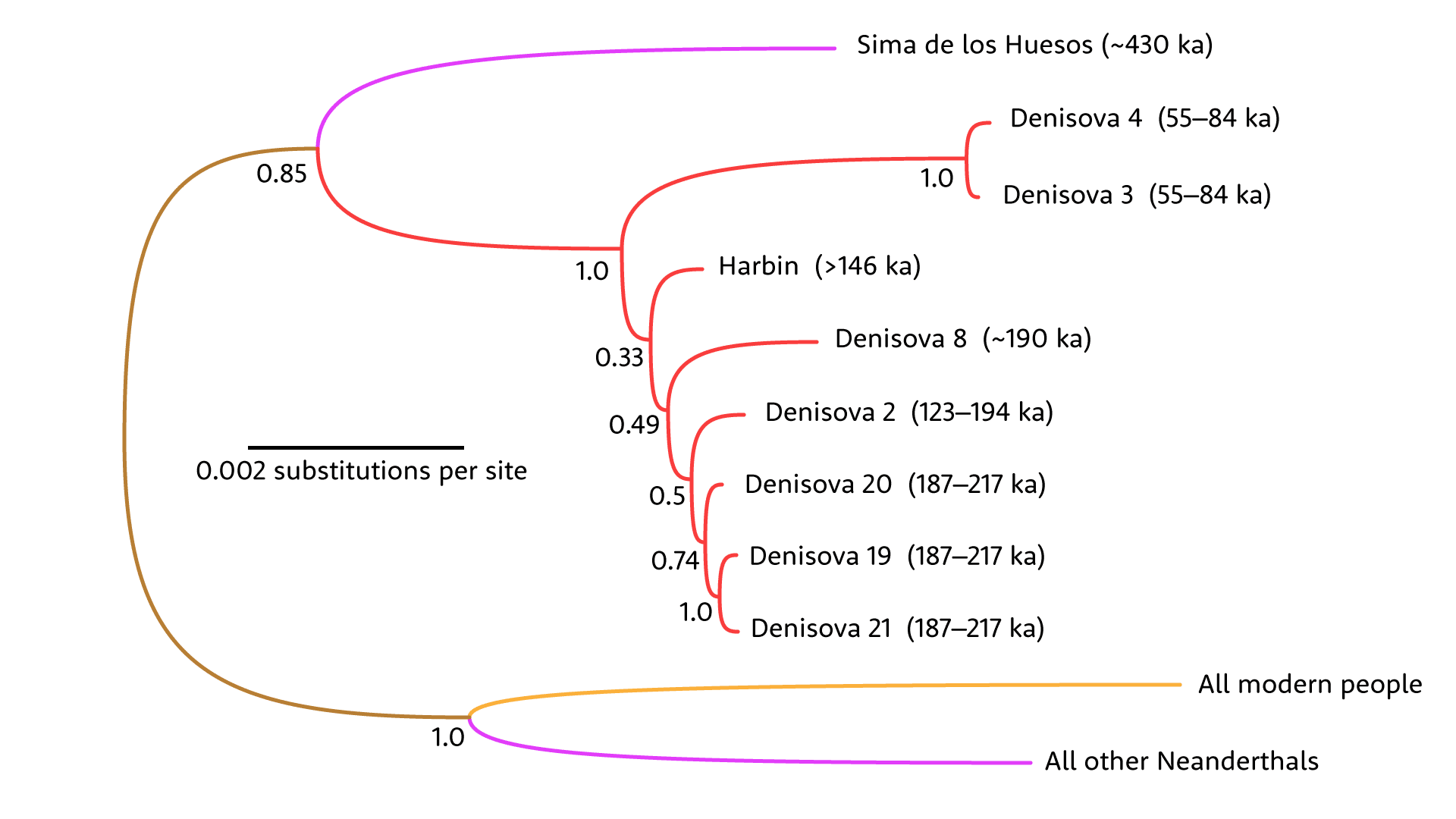
Denisova Cave. The presence of Denisovan populations at Denisova Cave itself runs from more than 300,000 years ago to around 50,000 years ago. DNA data tells us that these were not all the same group. The two Denisovan high-coverage genomes from the site, Denisova 3 at between 80,000 and 50,000 years ago and the 200,000-year-old Denisova 25, show a substantial difference in lineage history between them.
Baishiya Karst Cave. The mandible from this site, designated as Xiahe 1, has a minimum age estimate of 160,000 years and its protein signature is Denisovan. Sediments from within the cave contain Denisova-related mtDNA, dating to between 100,000 and 32,000 years old, and these mtDNA sequences are closer to the later Denisova fossils like Denisova 3.
Harbin. The enamel signature of the skull’s remaining tooth is Denisovan and the mtDNA sequence obtained from calculus is a sister to Denisova Cave individuals who lived between 220,000 and 120,000 years ago, not the later Denisova 3 and 4.
Penghu. This site has now produced three fossils attributed to the Denisovan population. With results based on collagen sequence data, these identifications are robust despite the fact that some modern humans do share a few Denisovan amino acid variants. One of the specimens, the Penghu 3 tibia, has a radiocarbon date around 45,000 years BP. The other two specimens may be earlier, but their age is uncertain.
Tam Ngu Hao 2. The molar from this site in Laos that has a Denisova-like morphological pattern is somewhere between 164,000 and 131,000 years old.
Bianfu Cave. The newly reported site has six specimens reported as Denisovan in morphology or protein sequence within two stratigraphic layers: Layer 7 at 142,000 to 134,000 years and Layer 9 at 167,000 to 161,000 years.
None of the sites in China with protein or DNA evidence between 250,000 and 45,000 years ago have any evidence attributable to anyone other than Denisovans. That’s only four sites, of course. But Baishiya has a sediment DNA record and fossil spanning up to 130,000 years, Bianfu has five individuals in two layers separated by some 25,000 years, and Penghu samples three individuals dredged from the sea floor. These are not four isolated fossils, in other words. Three of the sites have multiple samples and two have long chronologies.
To me the data are now enough to suggest that all the Middle Pleistocene record of China, at least from 50,000 years back to 400,000 years ago, is Denisovan.
Could I be wrong about this? The sites of Central Eurasia are instructive. Denisova Cave itself has clear evidence of Neanderthals in the site in at least two episodes interspersed among the much longer Denisovan presences, followed long after by the arrival of modern humans after 45,000 years ago. Chagyrskaya and Okladnikov have nothing but Neanderthals, but in each case the skeletal remains sample a much more limited time period than in Denisova. There are unfortunately few long cave sequences in northern China that seem likely targets for sediment DNA investigation, although maybe some of the Zhoukoudian sites have remaining possibilities.
Notes: Obviously there is more that I might have written about the classification of Denisovans, including whether “Homo longi” or “Homo juluensis” should be used. Maybe I’ll write something about this in the next few weeks, but I’ve covered these topics in the last couple of years. My opinion is fairly simple: All these fossils and Neanderthals, too, are part of our own extended species. The very interesting questions of how these lineages interacted, how they became genetically differentiated to some extent, and what combinations of them are present in today’s gene pool have come within reach.
References
Rao, H., Xing, S., Ruan, Q., Bai, F., Zhao, Y., Wu, Z., Tang, S., Andrew Bennett, E., Feng, X., Lin, S., Shao, Q., Yang, X., Li, Z., Zhou, K., Liu, F., & Fu, Q. (2026). Ancient proteins identify various Denisovan remains from Southwest China. Nature. https://doi.org/10.1038/s41586-026-10976-9
Ruan, Q., Li, H., Xing, S., Zhao, K., Liu, J., Zanolli, C., Doyon, L., Delpiano, D., Peresani, M., d’Errico, F., Demeter, F., Hublin, J.-J., Xiao, P., Wang, Y., Jia, Z., Yang, Q., Fu, Q., Sun, Q., Zhao, Y., … Chen, F. (2026). Denisovans from southwestern China and their subsistence strategies. Nature. https://doi.org/10.1038/s41586-026-10997-4
Ruan, Q., Liu, J., Ye, R., Shao, Q., Yang, S., Zhou, J., Hua, C., Sun, J., Zhang, X., & Luo, X. (2023). 2019 excavation report of the Bianfudong Paleolithic site in Heqing, Yunnan. Acta Anthropologica Sinica, 42(4), 503–513. https://doi.org/10.16359/j.1000-3193/AAS.2023.0024
It looks a lot like those Asian erectus may in fact have just been denisovans the whole time.
Which raises the question of what the other erectus were, if we need to take a look at the asian and african samples and start reclassifying them. Along with questions about Asian erectus, I'm curious to know how much oh9 really clusters with other african erectus samples.
Very happy fossils found decades ago are providing us new data even now.